Nowy standard. Twoje centrum tworzenia inteligentnego, szybkiego i zrównoważonego oprogramowania AI

Table of Contents
The right time to start SaMD regulatory strategy is before your team makes a decision that would be hard (and hurt) to undo: writing the first product claims, locking the architecture, picking a training dataset, or shipping to the first real users. Many founders plan it the other way around. They build, get users, raise, and only then open the regulatory file, by which point the decisions that shape the submission are already in the code. The cost shows up as rework and waiting. In FDA's latest report to Congress, about two in three 510(k) submissions that completed their first review in FY2025 got a request for more information, and each request stops the review clock while runway keeps running.
This article comes from the LinkedIn Live I co-hosted with Janet Kwiatkowski, founder and CEO of MAE Group, our regulatory and commercialization partner in the Monterail Universe. It gives founders and CTOs a test for when to bring regulatory in, the engineering habits that collect evidence while the team builds, and the fees and review times behind starting late.
Why Do Early Product Decisions Make SaMD Regulatory Work Expensive Later?
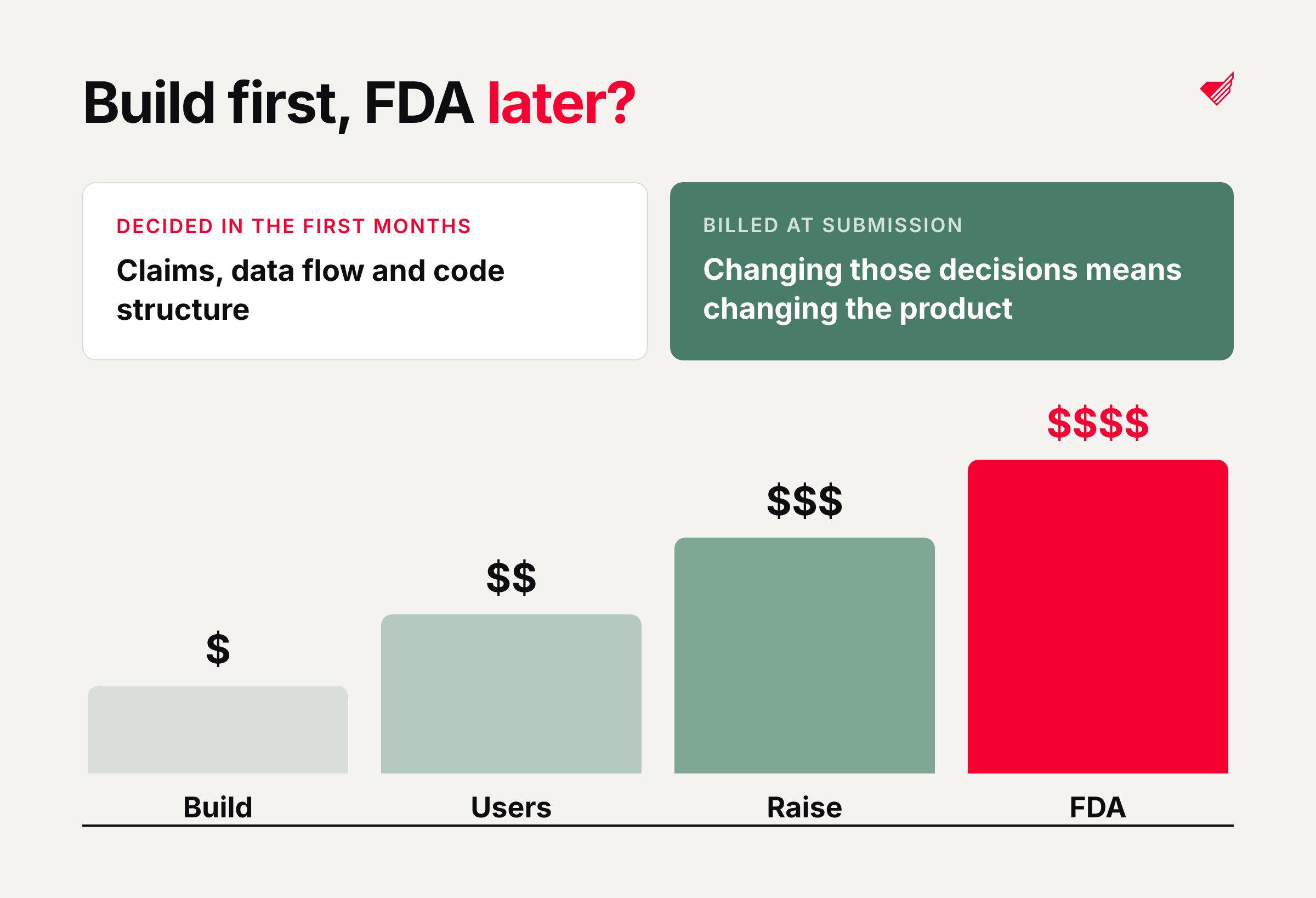
Teams make the decisions that determine a medical device's regulatory pathway in the first months of development: what the product claims to do, how its data flows, and how the code is split. By the time someone opens a regulatory file, those choices are built into the product, and changing them means changing the product.
A team skips intended use and claims while it builds a prototype. The architecture, data model, and user workflow are set around that prototype. When a reviewer, partner, or investor asks for evidence, the team has to reconstruct decisions or redo work, and the launch date moves with it. The waiting is measurable: in FY2024, companies with a De Novo request spent about 126 days answering FDA questions, slightly more than the roughly 123 days the FDA spent reviewing.
I get it, I'm a founder myself. When you have 18 months of runway, regulation feels like something for later. Like taxes: first you need a business to pay taxes on.
From the regulatory side, Janet flags risk well before the final months ahead of a submission. It begins when intended use and claims are still undefined while the architecture, data model, and workflow are already set.
How Due Diligence Exposed a Wellness Product's Missing Quality Records
A founder we worked with built an algorithm that reads a heart-related biosignal from a consumer wearable. It launched as a wellness product with no medical claims, which was a reasonable call at that stage. Then the science worked, and some of the largest medtech and pharma companies in the world got interested.
Their first questions were about quality: where is your electronic quality management system (eQMS), how does your process map to ISO 13485, and who approved each design decision? The team had to go back two or three years to figure out why decisions were made. Some reasons were never written down. Several months later, their in-house team is still rebuilding that history to meet one large partner's expectations.
They collected the evidence years after the decisions, and that's what made it expensive.
Why a Working AI Model Lacked the Independent Validation the FDA Expects
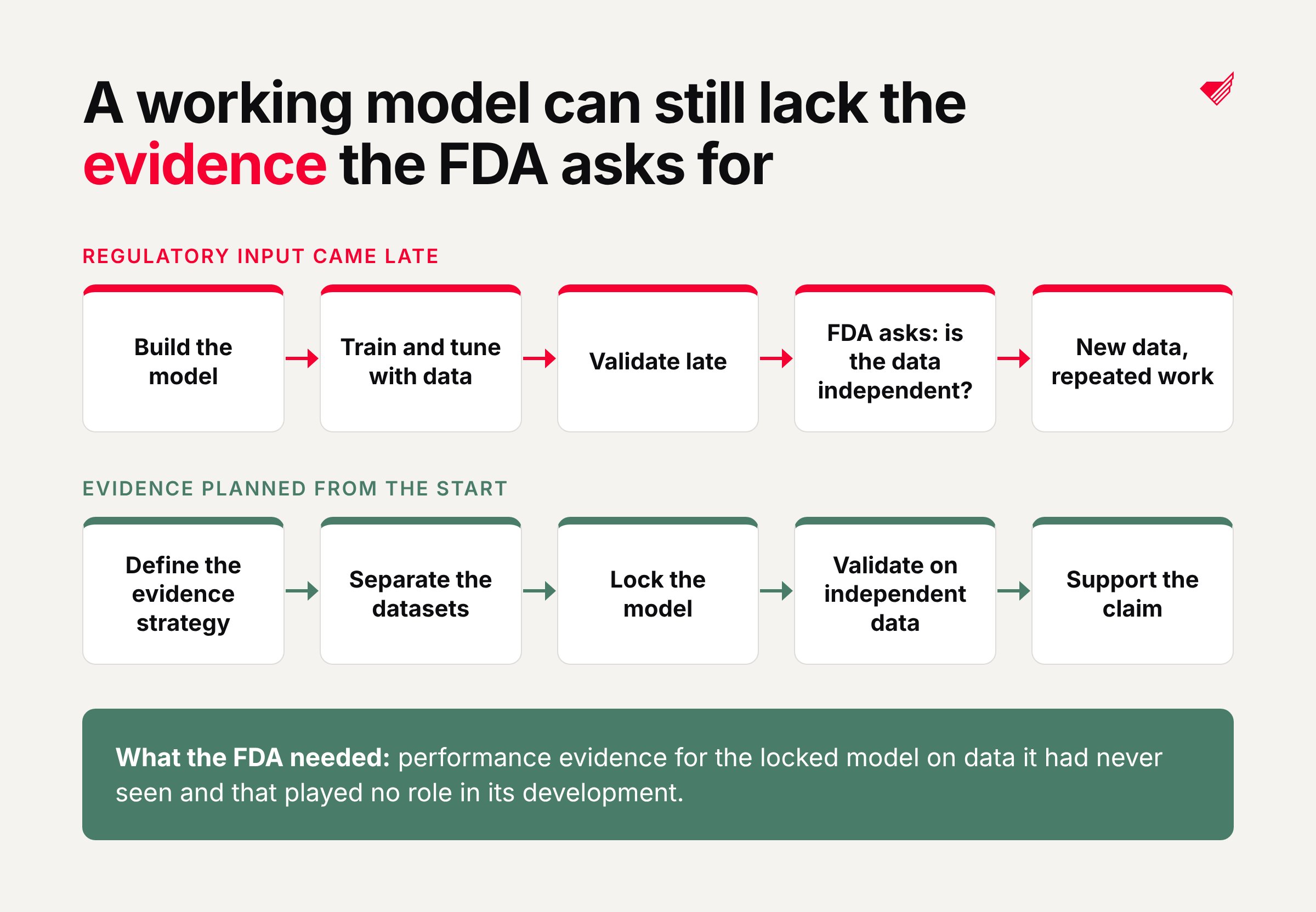
Janet described an AI-enabled software medical device that helps clinicians review medical images, with company details de-identified. The team had built the model, had substantial data, and had run what they believed was validation. During MAE Group's review, it turned out that some data used to develop and train the model also influenced the validation methodology.
The FDA asks a narrower question than whether the model works. It asks for independent evidence of how the locked model performs on data it has never seen, and that played no role in its development. The company had to rework its validation strategy, find appropriately independent data, and generate new evidence, which added cost and time.
"The failure was not necessarily that the algorithm didn't work. The problem was that the evidence had not been designed from the beginning." - Janet Kwiatkowski, Founder and CEO, MAE Group
A model that works can still lack the evidence the FDA will ask for. Had regulatory and development worked together before data collection, the team could have defined training, tuning, and validation populations correctly at the outset.
When Regulatory Enters SaMD Development: Cost and Rework Compared
When regulatory enters | What is still cheap to change | Typical rework if something is wrong | Effect on investors and partners |
|---|---|---|---|
Concept, before claims are written | Claims, intended use, target users, pathway assumptions | Rewording a value proposition | Clear pathway and evidence budget in the plan |
Before architecture and data collection | Module boundaries, data sources, dataset separation | Adjusting a design or a data plan | Credible roadmap with known regulatory steps |
Mid-build, before first real users | Release process, test evidence, documentation habits | Retrofitting traceability and risk files | Open questions on timeline and cost |
At submission or due diligence | Very little without changing the product | Repeating V&V, replacing datasets, narrowing claims, rebuilding records | Schedule, funding and valuation risk |

How Do Five Engineering Habits Collect SaMD Regulatory Evidence While You Build?
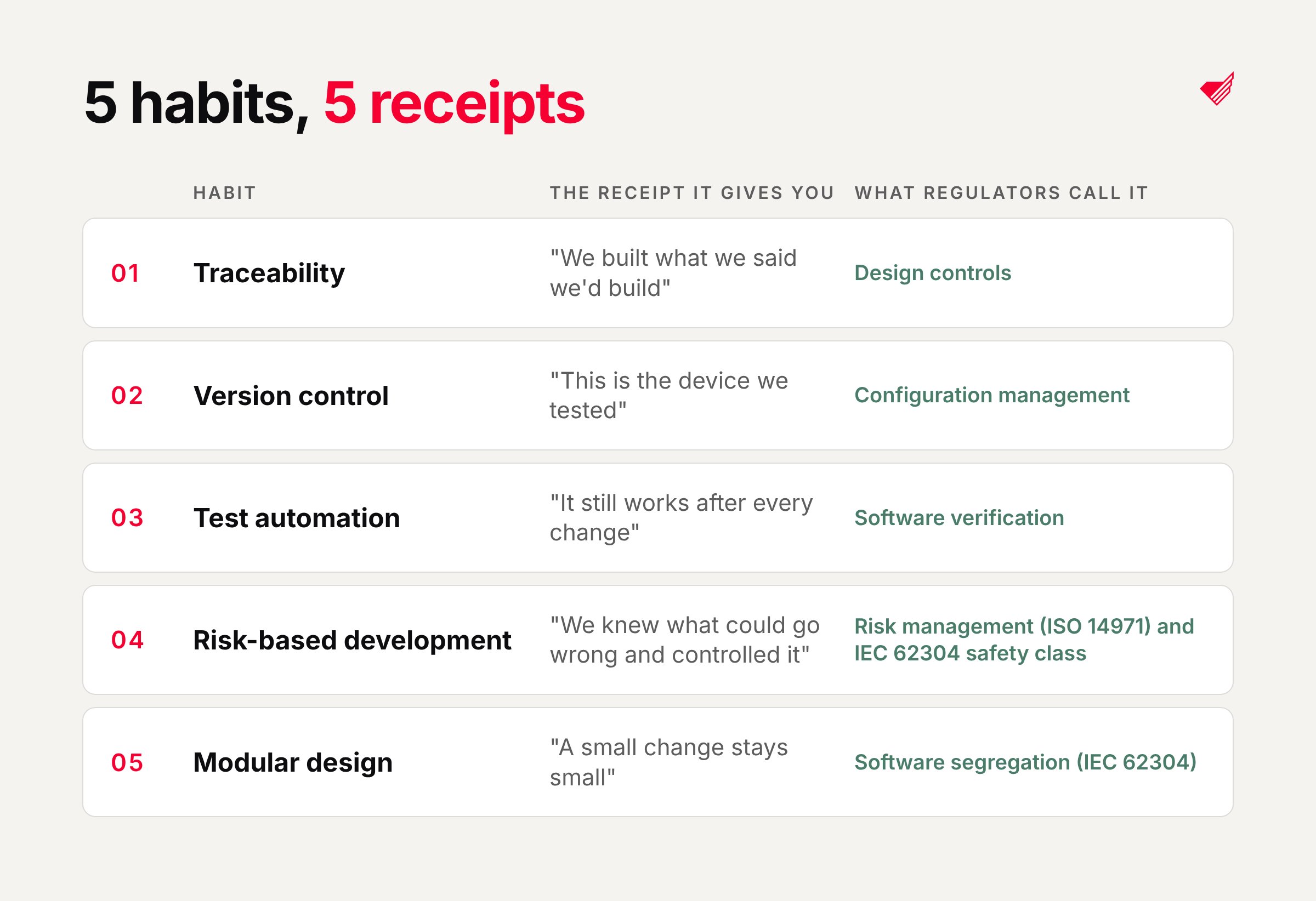
Five engineering habits produce much of the software evidence the FDA or a notified body will ask for, at little extra cost, if the team starts them in the first sprint. I like to compare it to taxes: some people keep every receipt in one folder all year and file in an afternoon; others rebuild a year of spending from bank statements in the last week before the deadline. The money spent is the same, but the last week before the deadline looks very different.
Regulatory evidence works the same way. A reviewer will ask you to prove that the software does what you claim, and each habit below leaves a record, a receipt for the reviewer, that does part of that proving. The mechanism is a short chain: a habit runs inside the normal sprint, it leaves a dated record tied to a requirement or risk, the submission is written from existing records, and the company needs less time to answer requests for more information. That response time is the part of the review clock a company controls, and in FY2024 it averaged about 38 days for a 510(k) and about 126 days for a De Novo.
"Each of those engineering practices has a direct regulatory consequence." - Janet Kwiatkowski, Founder and CEO, MAE Group
How Traceability Proves a SaMD Team Built What It Claimed
Every requirement and every risk control links to the code that implements it and to the test that proves it. In practice, that means a ticket ID in every commit and every test, so the tooling draws the map instead of a person. A reviewer reads that map as the line from the clinical claim to product requirements, risks, controls, and verification. A team that adds traceability late ends up reading old commits to reconstruct why code exists, which can force architecture changes and repeated verification.
How Modular Design Keeps a Small Change to Medical Software Small
The parts that support a medical decision sit apart from settings, onboarding, payments, and login, so a change to an onboarding screen does not trigger revalidation of the clinical algorithm. The split separates functions with different regulatory significance, while the intended use and the actual interaction between functions still determine the analysis, as Janet pointed out. The FDA judges the split by function and intended use, so it has to hold up in the documentation as well as in the code. Retrofitting it means separating tightly coupled code, which is a refactor of the product itself.
How Version Control Identifies the Exact Device a Team Tested
The team can name exactly which version was tested and rebuild it on demand. That record establishes what was actually tested, and without it nobody can prove that the build in users' hands matches the build behind the test results.
How Test Automation Shows Medical Software Still Works After Each Change
Every test links to a requirement or a risk, and its result is saved with the version it ran on. Automated suites then provide consistent evidence across releases, provided the test environment and acceptance criteria are controlled. Without that control, a passing run is harder to defend as evidence.
How Risk-Based Development Focuses Effort Where Patients Could Be Harmed
IEC 62304 gives each software part a safety class based on how badly a failure could hurt someone, and higher classes carry more documentation. Most of the effort therefore goes where a patient could be harmed, which is also where a reviewer expects the strongest controls and evidence. When risk classes are assigned late, the team learns which parts are high risk after the architecture has already mixed them with everything else.
The good news for your CTO: good engineering teams already have most of it. Pull requests and automated tests are already there. What changes is that you connect them to requirements and risks from the first sprint.
For how each habit maps to FDA design controls, configuration management, verification and validation, and ISO 14971, see our earlier article with Janet on how software architecture becomes regulatory evidence.
Definition of Done for Regulated Software Projects
The habits stick when they become part of the team's Definition of Done, the checklist a feature passes before anyone calls it finished. On a regulated healthcare software project, our teams at Monterail add a few lines to the standard list.
Standard Definition of Done | Added on a regulated project |
|---|---|
Code reviewed | Pull request approval recorded |
Tests green | Test evidence saved with the version it ran on |
Deployed to staging | Feature linked to a requirement |
Ticket closed | Risk analysis updated if the feature touches anything risky; dependency list updated if it adds a library |
The records get collected in the same sprint as the work, by the people who still remember why a decision was made. The team still writes submission documents, but from records that already exist, which is much faster. In my experience, the first few sprints feel slower, and then the team stops noticing. For CTOs who worry that agile and the FDA do not mix, AAMI's technical report TIR45 covers agile development for medical device software.
When Should a SaMD Startup Bring Regulatory Into Development?
A SaMD startup should bring regulatory thinking in whenever the team is about to make a decision that would be expensive to reverse. "As early as possible" is good advice that nobody can put in a sprint plan. The hard-to-undo test can go into one, because it ties regulatory input to specific moments the team already recognizes.
If you're about to make a decision that would hurt to undo, regulatory thinking should be in the room.
My four everyday triggers are writing the first claims, locking the architecture, picking a dataset and shipping to the first real users. A team does not need a complete specification to start. In Janet's words, the early work is about identifying the decisions that would be costly or difficult to reverse, and the full submission strategy comes later.
Seven Checkpoints for Regulatory Input in SaMD Development
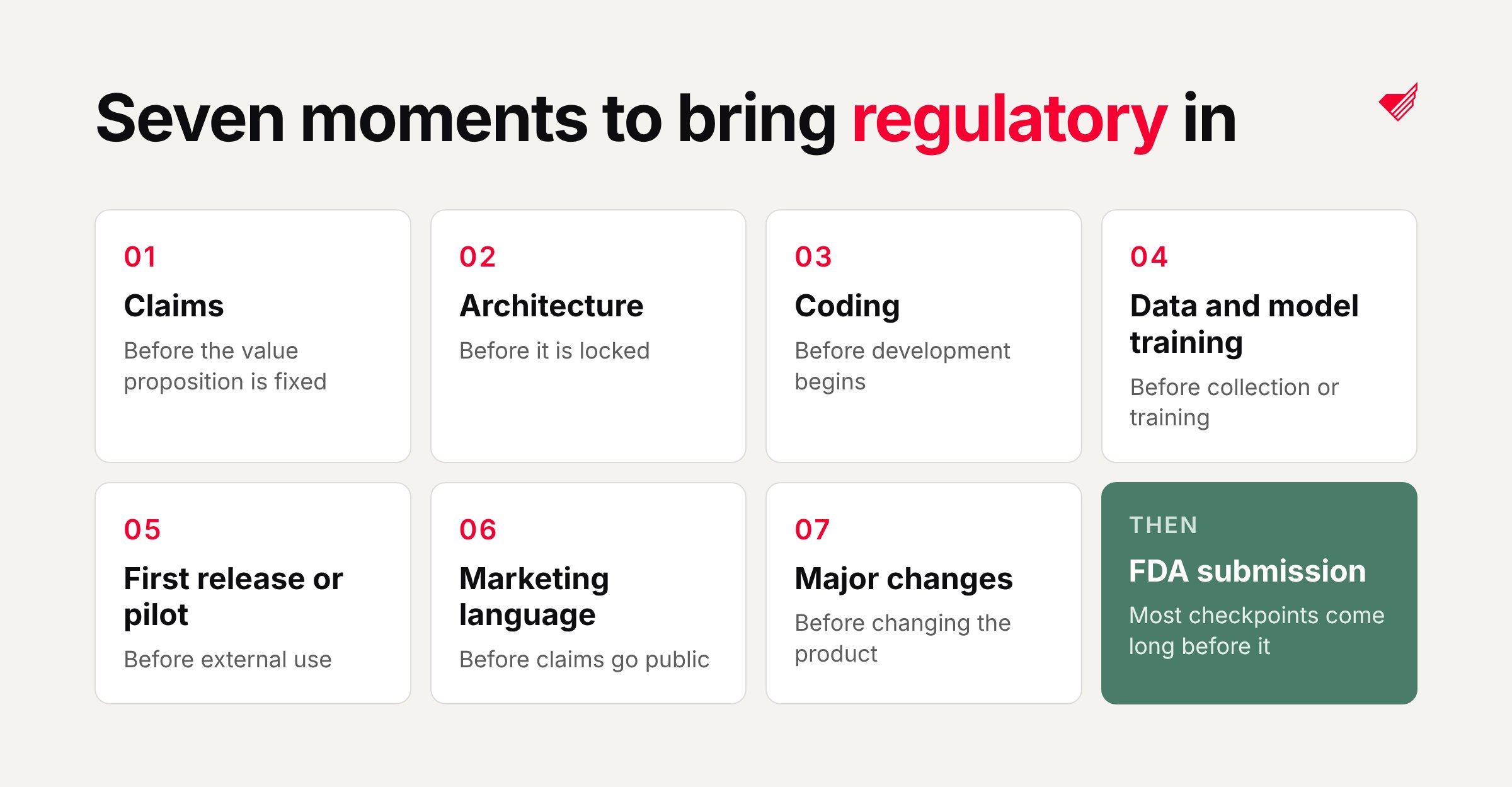
The full list from Janet has seven checkpoints, most of them long before any FDA submission.
Claims, before the value proposition is fixed. Intended use, patient population, clinical environment, and the decisions the product supports drive classification, pathway and evidence. Similar technologies can land on very different pathways because of their claims.
Architecture, before it is locked. Identify which functions are regulated and whether they can be separated from the rest.
Coding, before development begins. Build requirements, risk management, traceability, verification, and cybersecurity into the workflow.
Data and model training, before collection or training. Define the intended population, data sources, ground truth, and the separation between training and independent validation data. Janet sees teams run into problems here most often, because a convenient dataset is not necessarily one the FDA will accept.
First release or pilot, before external use. Confirm the right version, the right users, and the right evidence.
Marketing language, before claims go public. Marketing and evidence have to tell the same story, and a demo that makes clinical suggestions has already made a claim.
Major changes, before changing the product. Reassess risk, performance, and regulatory impact.
"The objective isn't to have every answer on day one. It's to identify critical unknowns while there's still flexibility to address them." - Janet Kwiatkowski, Founder and CEO, MAE Group
How an FDA Pre-Submission Settles Open Regulatory Questions
When a checkpoint raises a question the team cannot settle alone, such as which pathway applies, what clinical evidence a novel technology needs, or whether a planned validation approach is acceptable, Janet points to the FDA Pre-Submission. A Pre-Sub is a written request for FDA feedback on specific questions before the formal submission, with an optional meeting, and it carries no FDA user fee. Janet's advice is to use it for focused questions about regulatory strategy, clinical evidence, or novel technology.
Where Early Regulatory Strategy Pays Off in SaMD Delivery
Three situations from the webinar show the habits and checkpoints at work: turning a prototype into a regulated build, preparing for two markets at once, and keeping regulatory input on a regular cadence.
Turning a Vibe-Coded Prototype Into a Regulated Build
Tools like Lovable let a founder build a working prototype over a weekend, and I use them myself. It is the fastest way to show investors and users what you mean. A vibe-coded prototype has no records behind it, though. Nobody can say why the code looks the way it does, including the tool that wrote it.
The practical rule is to treat the prototype as a sketch. User research and the clinical logic tested with clinicians usually carry over to the regulated product. The team rebuilds the code behind the medical function, with the five habits in place from the first sprint. My team at Monterail has been auditing vibe-coded apps for a while, and more software houses now sell refactoring of vibe-coded code as a separate service, which shows how common the gap has become.
The constraint is budget: put the rebuild into the plan before the round, so it does not surprise investors later. And if the prototype already makes clinical suggestions in a demo, it has already made a claim.
Building One Evidence Core for FDA and EU MDR
During the webinar, I asked the audience which is stricter, the FDA or the EU MDR. My own answer was Europe. Under MDR Rule 11 for software, software that informs diagnosis or treatment usually lands in Class IIa or higher, which means a notified body reviews the technical documentation and clinical evaluation before CE marking. In my experience, working under the MDR made our US projects easier.
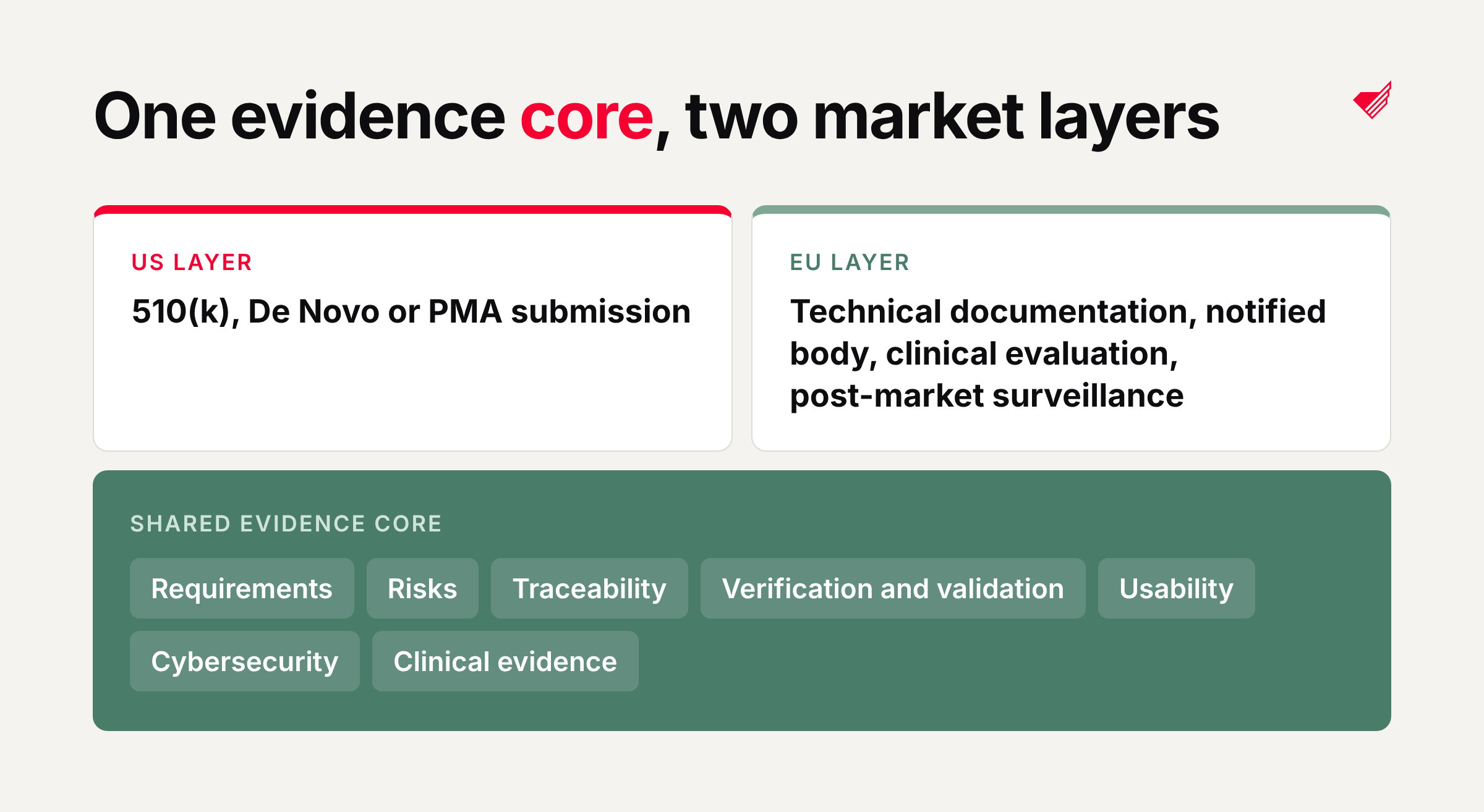
Janet disagreed with the framing. She would not call either system inherently stricter: the underlying principles align, while the pathways, evidence expectations, and review processes differ. In the US, intended use, risk, classification regulations, product codes, and available predicate devices shape the pathway. In the EU, the company establishes intended purpose, applies MDR classification rules, prepares technical documentation, demonstrates conformity with the general safety and performance requirements, supports the device with clinical evaluation and runs post-market processes.
We agreed on the engineering underneath. The FDA and EU MDR share the same evidence core: requirements, risks, traceability, verification and validation, usability, cybersecurity, and clinical evidence. Each market then adds its own layer on top. The expensive version is building for one market and discovering the second one later, which means rebuilding the same records a second time for the other market.
"Regulatory sequencing is both a regulatory and a business decision." - Janet Kwiatkowski, Founder and CEO, MAE Group
Janet's list for choosing the first market covers target customers, classification and pathway, predicate availability, notified body considerations, evidence requirements, reimbursement, commercial priorities and timing.
Two Monterail projects show what building for regulated markets looks like in practice. For Remedee Labs, our team built the app and the personalization algorithms while clinical trials were running, so every software change had to protect trial integrity. Remedee's wristband became the first CE-marked medical device for treating fibromyalgia in Europe, and the FDA accepted it into its Breakthrough Devices Program, which speeds up review but is not an authorization. On the US side, our team worked with Eargo for five years on the apps for its self-fitting hearing aid, a 510(k)-exempt Class II device, across the sixth and seventh device generations.
Running Regulatory Checkpoints Inside the Sprint Cadence
A founder building a regulated product ends up with four jobs: the vision, the build, the architecture, and the regulatory path. There is also an investor in the room who will ask about all four. When the work goes well, it splits four ways:
The founder and leadership own the vision, the clinical problem, and the decisions.
Monterail turns those priorities into architecture and disciplined software development.
MAE Group connects intended use and claims to classification, clinical evidence, quality-system expectations, and commercialization planning.
The internal product team carries the decisions into daily execution.
The partners meet at three recurring checkpoints instead of one review at the end:
Before architecture is locked: align on intended use, claims, risk and pathway assumptions.
Before a release or a study: confirm the version, the objective evidence and the validation plan.
Before a major change: assess the effect on risk, performance and market authorization.
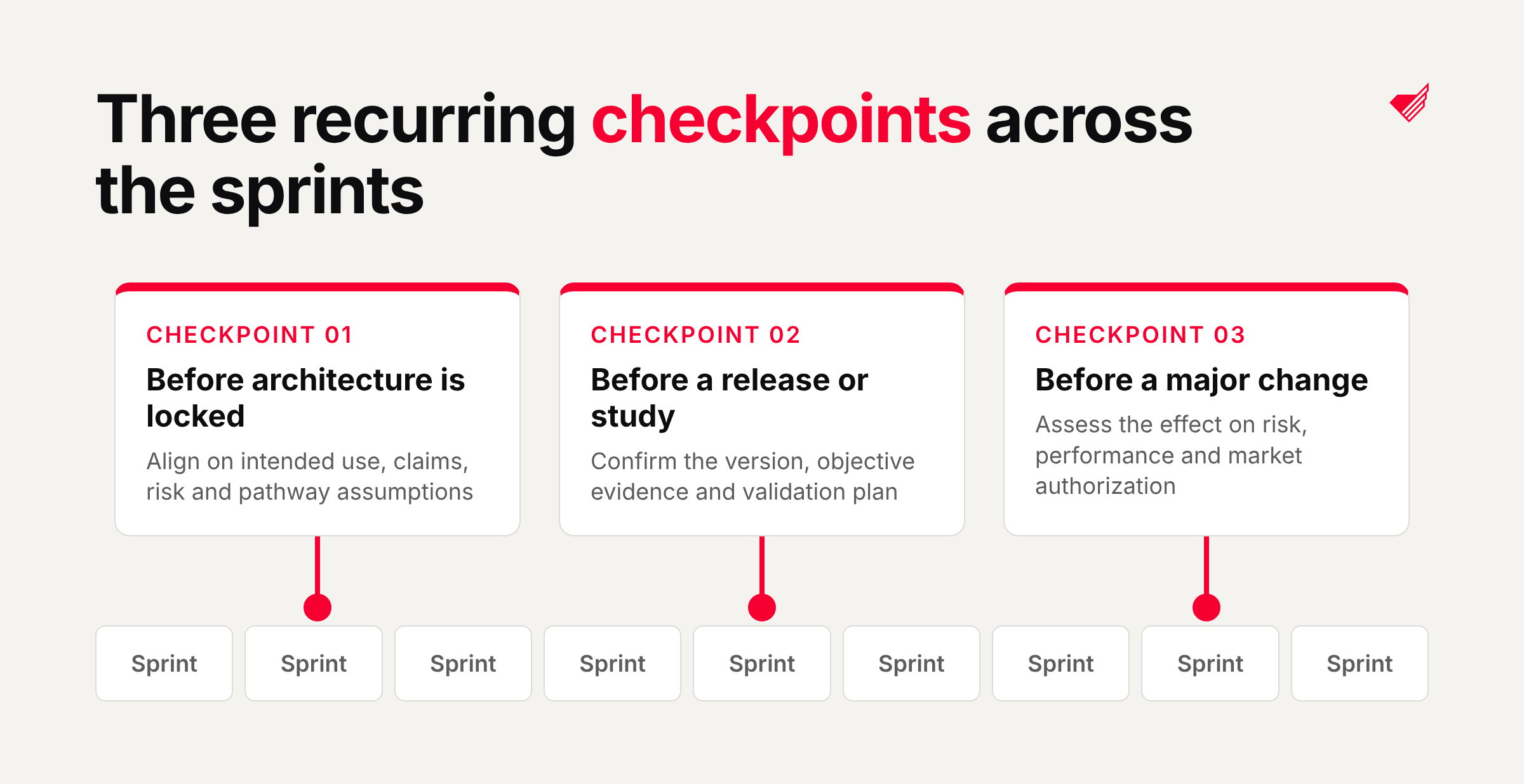
This cadence gives founders earlier visibility into cost and schedule. The checkpoints also answer investors: when they ask where you are, you show the last checkpoint and what comes next, and if the records are in place, due diligence is a short meeting.
What Does Starting SaMD Regulatory Work Late Cost in Fees, Time and Funding?
The FDA fee is only a small part of the cost of starting late, and waiting costs more. Which fee a company pays depends on its pathway, and the pathway depends on the claims it writes early. The time cost comes from review cycles that stop the clock while the company gathers missing evidence, and that time comes straight out of runway.
Item | US (FDA) | EU (MDR) |
|---|---|---|
Submission fee, FY2027 | 510(k): $28,653 ($7,163 with small-business status). De Novo: $191,020 ($47,755 with small-business status) | Set by each notified body |
Small-business status | Must be requested and granted before you submit | Not applicable |
Elapsed time, review plus company response | 510(k), FY2024 average: about 68 FDA days plus 38 company days, roughly 106 days. De Novo, FY2024 average: about 123 FDA days plus 126 company days, roughly 249 days. De Novo, FY2025 preliminary: about 129 plus 135 days, roughly 264 days | 13 to 18 months for quality system plus product certification at most notified bodies |
Where the delay sits | About 2 in 3 510(k)s that completed their first review in FY2025 got an additional-information request; each request stops the FDA clock | On average 58% of certification time is spent waiting for the manufacturer |
Sources: FDA FY2027 medical device user fee rates (Federal Register); MDUFA Performance Report to Congress, FY 2025; FDA MDUFA performance reports for review days; European Commission notified body survey (August 2025).
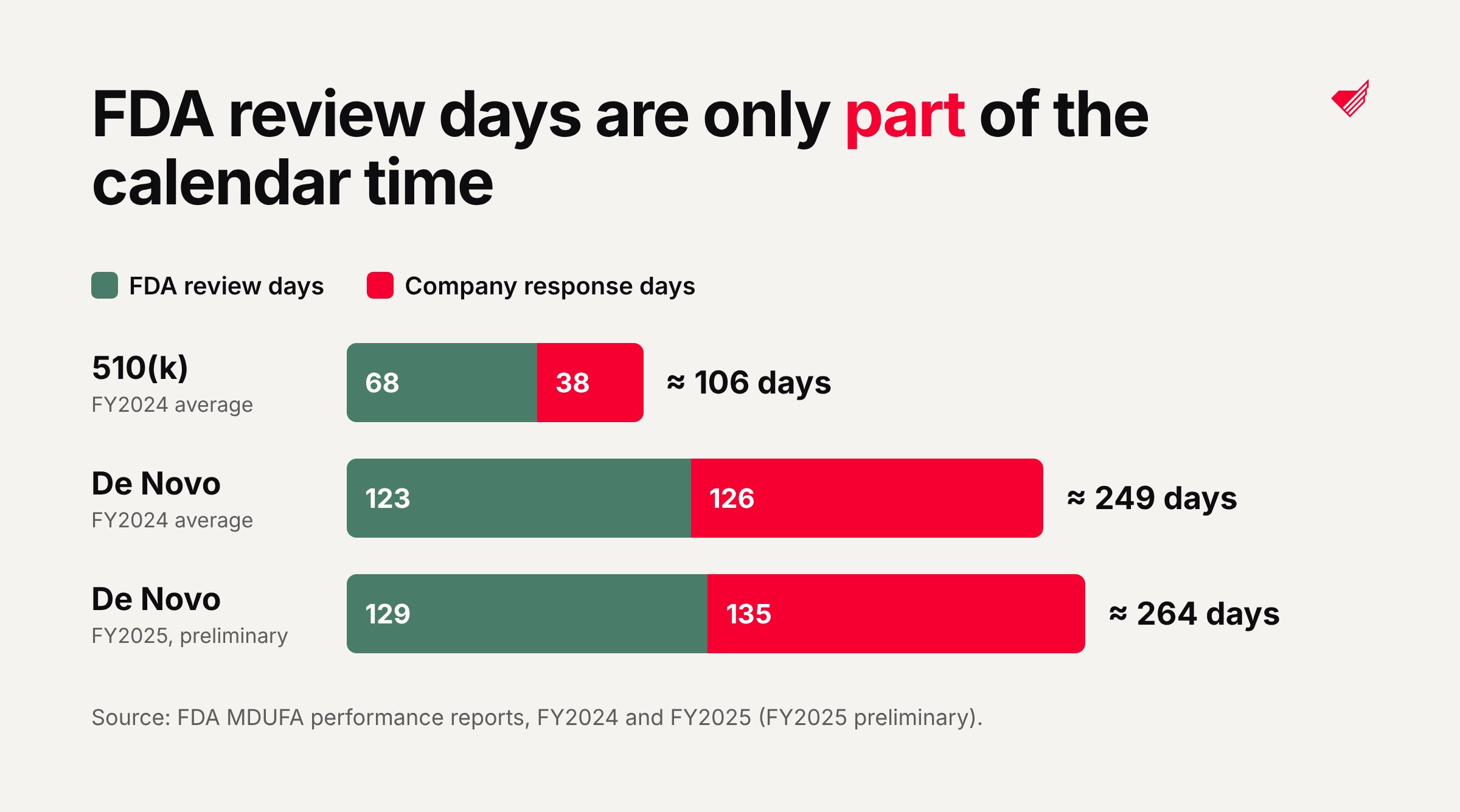
The company response time is what a team controls, and the records collected during the build are what shorten it. My advice for founders raising money is to decide which regulatory step each round pays for and put it on the use-of-funds slide.
"Regulatory strategy is also a financial strategy. Unresolved regulatory questions translate directly into schedule, funding and valuation risk." - Janet Kwiatkowski, Founder and CEO, MAE Group
Technical and Organizational Prerequisites for SaMD Regulatory Readiness
Early regulatory work pays off only when a few conditions are in place, and some of them require upfront effort. Not every health product needs this setup. A wellness app that will never make medical claims may not need a regulated build, as long as the team revisits that decision when its claims, partners or target markets change.
A quality management system the development workflow can plug into. FDA's Quality Management System Regulation took effect on February 2, 2026, and incorporates ISO 13485:2016, so design controls, risk management, traceability, verification, validation, and change management belong inside the development workflow from the first sprint.
Tooling that links tickets, commits, tests, and releases, so tools draw traceability instead of doing it by hand.
A data plan written before data collection, with training and independent validation sets defined and kept apart.
A team ready for a slower start. The first few sprints with the regulated Definition of Done take longer, and the team needs a reason to accept that.
Regulatory expertise in the room at the checkpoints. At Monterail, we build software to standards such as IEC 62304 and ISO 13485 and work with MAE Group for regulatory strategy, clinical evidence, and commercialization.
What Investors Ask About Regulatory Before They Fund a Health Product
In the rounds I see across our clients, investors ask four things: what exactly the product will claim; which pathway it will take and why; what the evidence will cost and how long it will take; and whether the product being demoed is the one that will be submitted. Janet added a fifth question that sits under all four.
"Investors want to know whether the regulatory plan supports the business plan. If those two are disconnected, the risk shows up in time, cost, and valuation."
Janet Kwiatkowski, Founder and CEO, MAE Group
Key Takeaways
Regulatory work fits into a sprint plan when it is tied to decisions that would hurt to undo, such as first claims, architecture, dataset selection, and first real users, rather than to a calendar date.
A claim in marketing copy or a demo can set the FDA pathway, so marketing language needs the same review as product requirements.
Plan dataset separation before training, because a model cannot become independent of data it has already seen.
The part of FDA review time a company controls is its own response time, about 126 days of the average FY2024 De Novo, and records kept during the build are what shorten it.
Building one evidence core for both FDA and EU MDR costs less than adapting a single-market product later, whichever market comes first.
Strategic Takeaway
A SaMD submission is the output of many small decisions made during development, and it can only be as strong as the records those decisions left behind. When you wire regulatory work into claims, architecture, data plans and the sprint checklist, you arrive at review with the evidence already in place.
The regulatory plan and the business plan have to describe the same product on the same timeline, because investors and partners check both. That alignment is what my team and MAE Group set up together: architecture and disciplined engineering from us, and regulatory strategy, clinical evidence and commercialization planning from MAE Group.
Collect your receipts while you build. It's the cheapest evidence you'll ever get.
To see where your product stands, run the free SaMD Building It Right the First Time self-assessment. It takes about 10 minutes and works before any code is written. If you want a second pair of eyes, book a 30-minute call with Janet and me and leave with a short list of what to fix first.
SaMD Regulatory Strategy FAQ

Piotr Zając
HealthTech Director

Piotr, Monterail’s Director of HealthTech brings over 15 years of entrepreneurial leadership and strategic innovation to the MedTech and HealthTech sectors. Piotr has demonstrated exceptional ability to build and scale healthcare solutions. Former President of EO Poland, part of the world's largest entrepreneur network. Combining his entrepreneurial background with Management 3.0 principles, Piotr specializes in helping organizations drive sustainable innovation in the rapidly evolving HealthTech landscape.