The New Default. Your hub for building smart, fast, and sustainable AI software

Table of Contents
Monterail has partnered with MAE Group, a global medtech advisory and commercialization firm. Our HealthTech clients now get direct access to regulatory, clinical, and commercialization specialists from the first product decisions onward. MAE Group joins the Monterail Universe, our network of independent partner companies covering regulatory, clinical, hardware, legal, and market-access work. For teams building a medical device, Software as a Medical Device (SaMD), or another regulated digital health product, regulatory planning now runs alongside software development, coordinated through Monterail.
Executive Summary
Most delays in regulated HealthTech come down to timing. A regulatory finding, a clinical evidence gap, or a market-access requirement that surfaces after the architecture is set can push a working product back into redesign right before submission. The Monterail and MAE Group partnership moves those questions to the start of the project, while acting on them still means adjusting a plan. Monterail builds to the relevant standards and prepares audit-ready documentation, while MAE Group leads regulatory strategy, submissions, and commercialization support. Our clients get one coordinated team from concept to market.
Why should regulatory planning alongside development?
In regulated HealthTech, software is only one of several things that must be ready before a product can reach patients. Intended use, device classification, clinical validation, quality management, and reimbursement strategy all shape what the product needs to do and how it needs to be documented. Once the core architecture is set, teams often discover that data flows, audit trails, or feature scope don't match what the regulatory pathway requires.
Piotr Zając, HealthTech Director at Monterail, sees this pattern repeatedly. He argues that regulatory, clinical, and commercial requirements are too often treated as a later phase, resulting in redesign work and delays on the way to FDA clearance and market entry. As he puts it:
"In 15 years, I've seen more rebuilds than I'd like to count. It always costs more than the original build, both in time and money. And almost every time, it was avoidable."
MAE Group's role is to bring that expertise in before the architecture is set, so early decisions reflect what approval and launch will actually demand.
Who is the MAE Group?
MAE Group was founded in 2013 and works where regulated technology, clinical validation, and capital formation meet. Its founder and CEO, Janet Kwiatkowski, brings more than 25 years of experience in medical devices and commercialization. The firm reports a 100% success rate across the regulatory submissions it has managed, and supports organizations from early-stage startups to established global medtech companies with FDA clearances and approvals, CE marking, and ISO-aligned quality systems.
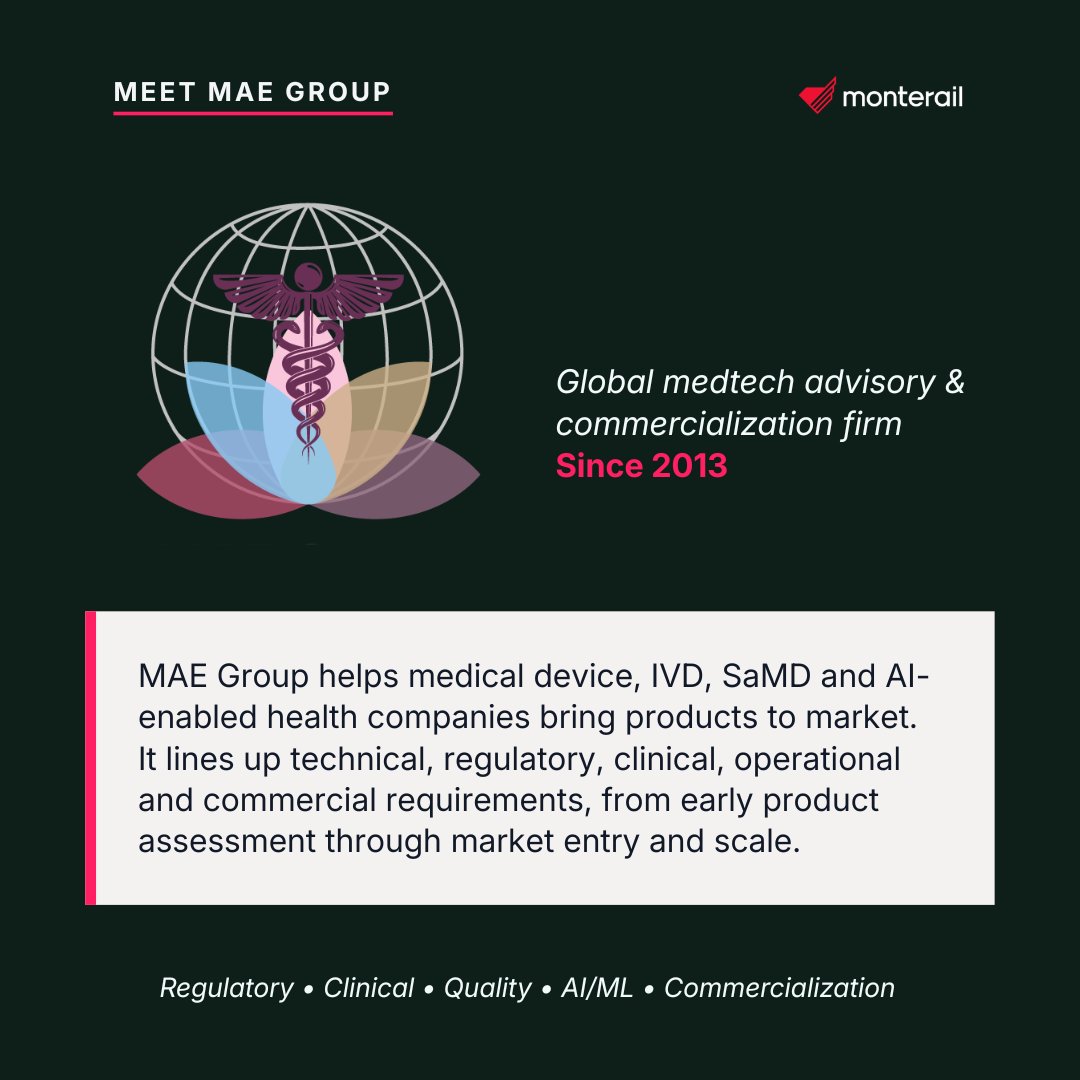
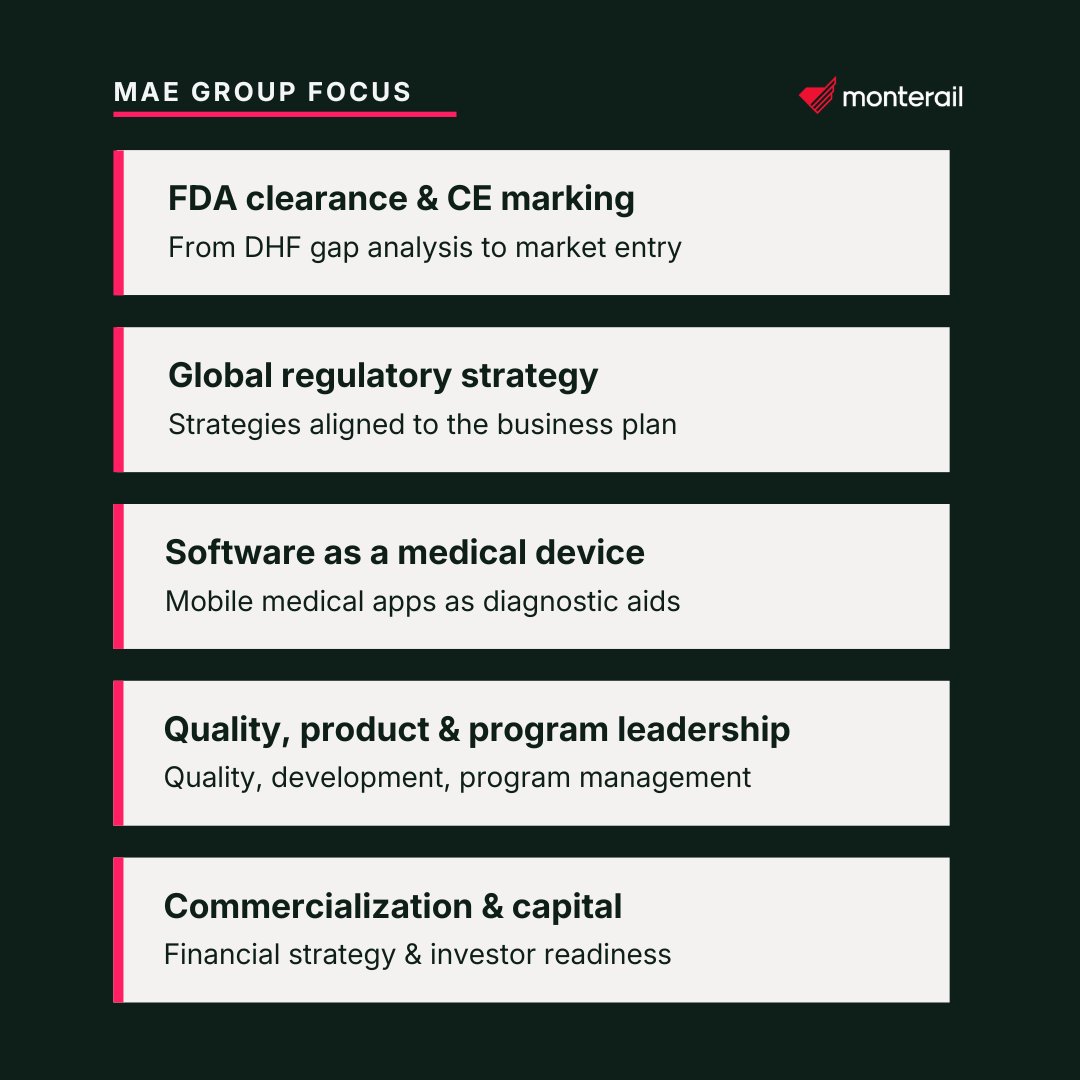
MAE Group's cross-functional model keeps technical, regulatory, clinical, operational, and commercial requirements aligned, from the first product assessment through market entry and scale.
For Janet, timing is the core risk. "A regulatory issue discovered late can force even a technically sound product back into redesign," she says.
"Our partnership with Monterail brings regulatory, clinical and commercial requirements into product development early, while teams still have time to respond."
How the partnership works: who does what
Monterail and MAE Group remain independent companies with distinct responsibilities. Monterail builds software to named standards such as IEC 62304 and ISO 13485 and prepares audit-ready documentation. MAE Group leads regulatory strategy and interactions with regulators. The client, as the legal manufacturer, keeps ownership of the regulatory file and the final submission.
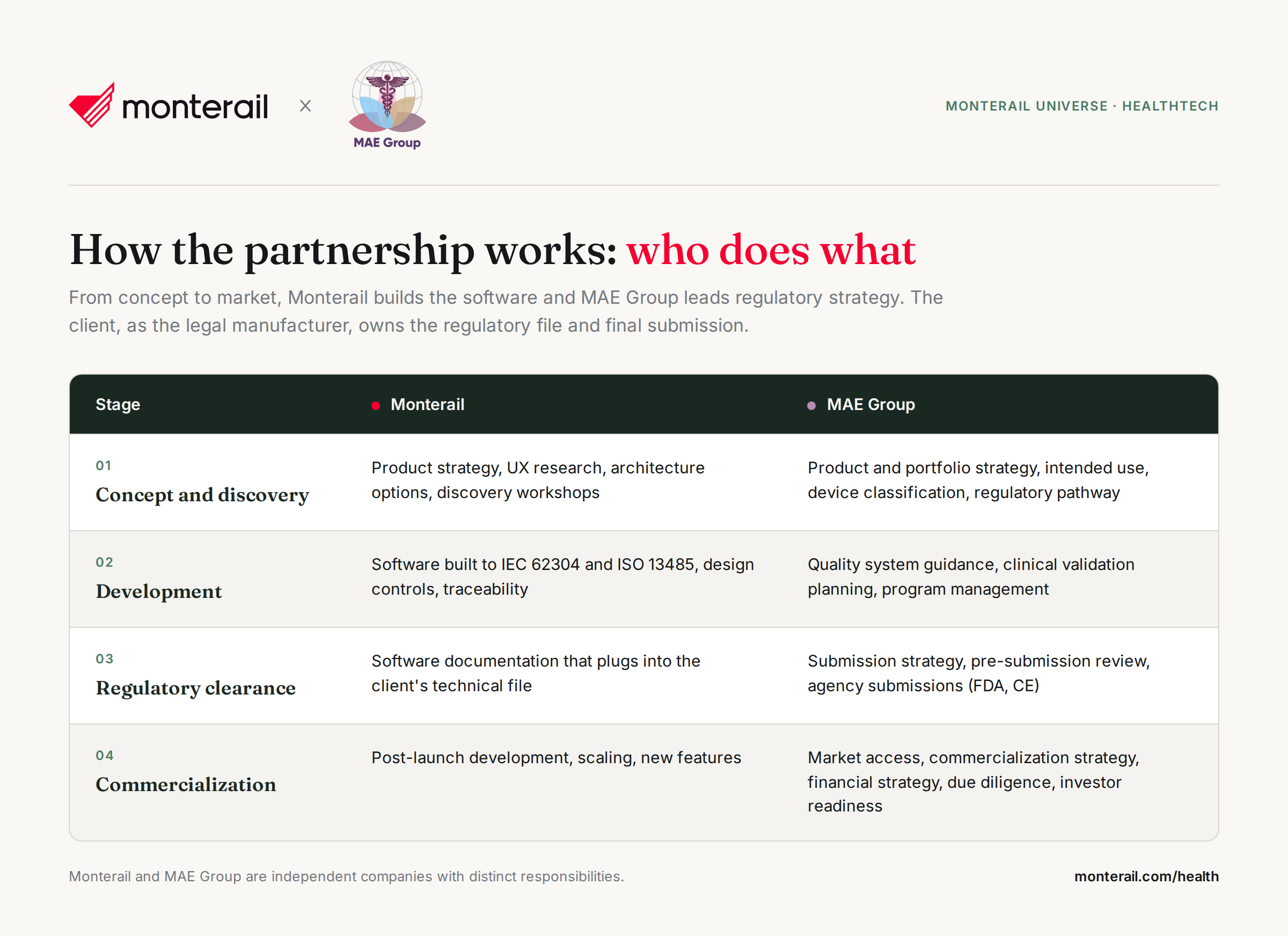
In practice, this means architecture choices can be checked against the regulatory pathway before they are locked in, and documentation is produced in the format the submission will need.
Who benefits most from this partnership
Three groups of companies tend to get the most value from having development and regulatory expertise work together:
Early-stage founders who are still deciding whether their product qualifies as SaMD or a wellness app, and need that answer before committing to an architecture.
Teams with a working proof of concept that now needs to become a regulated product, where early decisions can either become a head start or a costly rewrite.
Established healthcare and medtech companies entering the US market, where FDA expectations for software documentation and quality systems shape the development plan from the start.
Companies that already work with a regulatory consultant can still benefit. Monterail coordinates directly with existing advisors, and MAE Group is available when a team does not have that expertise in place yet.
About the Monterail Universe
We built the Monterail Universe so that clients don't have to find, vet and coordinate separate specialists for every stage of a regulated product. The network brings together independent partner companies under signed agreements, each covering an area Monterail deliberately does not provide itself: regulatory affairs, clinical work, hardware, legal, and market access.
Monterail's own track record in the space includes 75+ healthcare products and 15+ regulated devices delivered for clients such as Docplanner, Merck, Elvie, and Eargo, out of more than 900 products shipped globally since 2010. Adding MAE Group adds a regulatory and commercialization counterpart to that experience, so people who have done it before cover the full path from concept to market.
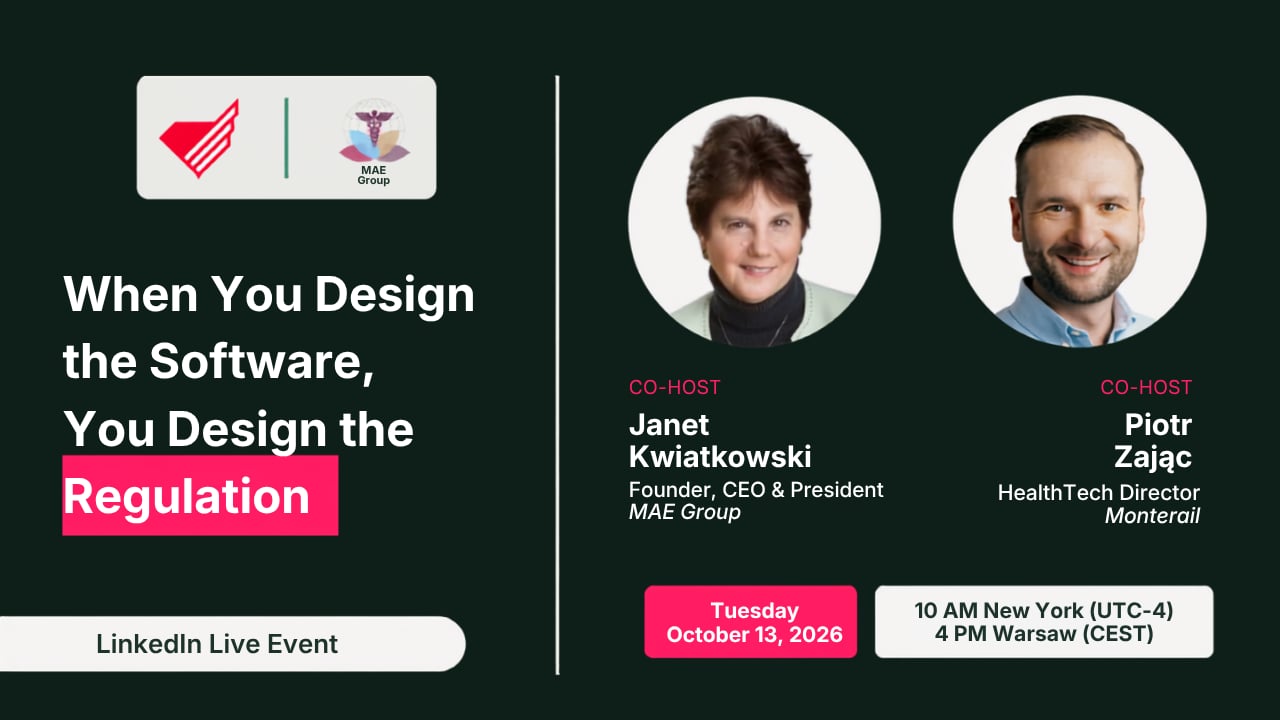
As part of the collaboration, Monterail and MAE Group are also publishing a joint content series, starting with SaMD FDA Submissions: How Software Architecture Becomes Your Regulatory Evidence and the upcoming LinkedIn Live, "When You Design the Software, You Design the Regulation," on October 13.
Key Takeaways
MAE Group, a global medtech advisory and commercialization firm, has joined the Monterail Universe partner network.
The partnership brings regulatory input into product decisions early, when changes are still inexpensive.
Monterail builds software to standards like IEC 62304 and ISO 13485 and prepares audit-ready documentation; MAE Group leads regulatory strategy and submissions.
MAE Group, founded in 2013, reports a 100% success rate across the regulatory submissions it has managed.
Clients get one point of coordination from concept through clearance and commercialization.
Strategic Takeaway
Getting a regulated health product to market depends on how well its software, evidence, quality system, and commercial plan fit together. Each of those is a separate discipline, and the gaps between them are where most delays start. Putting development and regulatory strategy in the same planning conversation lets the path to approval run as one connected system.
If you're building a HealthTech product that needs regulatory support alongside development, contact our HealthTech Team.
Monterail x MAE Group cooperation
)
Joanna Staromiejska-Drwięga
Marketing Strategy Specialist

Joanna Staromiejska-Drwięga is a T-shaped marketer with over 10 years of experience in B2B tech marketing. As a Marketing Strategy Specialist at Monterail, she drives growth through multi-platform campaigns and cross-functional collaboration. Joanna holds a degree in International Business and Management. Her work spans landing pages, ebooks, and in-depth guides, including the well-known State of Vue reports.