The New Default. Your hub for building smart, fast, and sustainable AI software

Table of Contents
and 6 more
An AI diagnostic pipeline is the full path data takes from a clinical source, an imaging study, a signal, or a structured EHR record. It runs through preprocessing and model inference to a decision-support output a clinician acts on. Integrating machine learning into healthcare systems means making each step of that path deliberate. Building one means making a specific architecture choice at each stage. What you choose depends on how urgent the output needs to be and where the data is allowed to live.
Most of that architecture is well understood by now. The part that decides whether the system holds up in production is the part most teams underbuild: monitoring, versioning, and retraining.
Executive Summary
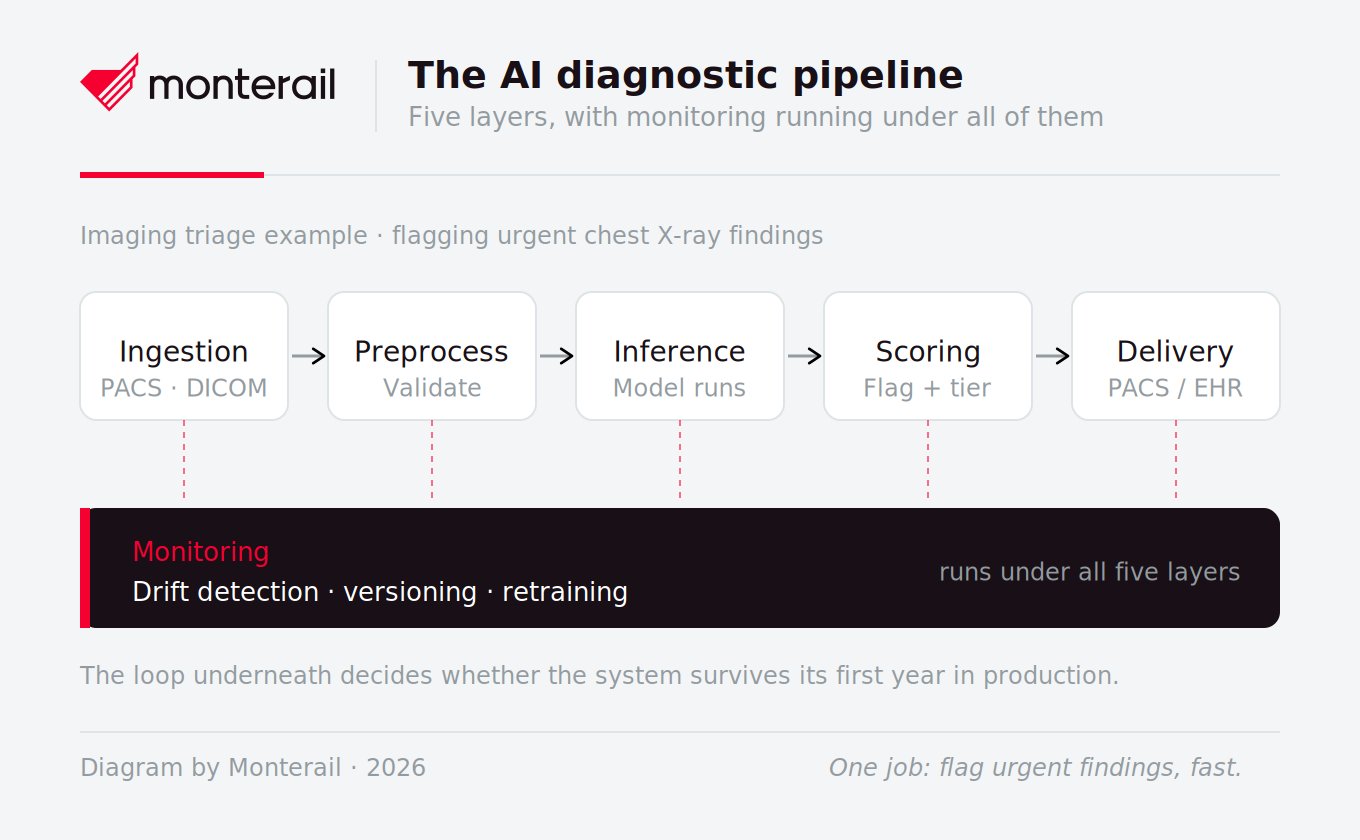
An AI diagnostic pipeline consists of five layers, from ingestion to clinical use, with monitoring active throughout. Key architectural choices extend beyond accuracy: where data enters, how quickly a result reaches a clinician, and how much control you retain after deployment. What shapes most of the rest are batch versus streaming ingestion, and on-prem versus cloud inference. Many teams overlook post-launch AI model monitoring, which involves tracking drift and managing models securely. This guide covers the entire process, exemplified by a pipeline that flags urgent chest X-ray findings for faster radiologist review.
AI Pipeline Architecture for Medical Diagnostics: What It Means
For an imaging triage tool, the pipeline's job is narrow and specific. Take a chest X-ray as it's captured and run it through a model trained to flag likely urgent findings. Surface that flag to a radiologist before the study reaches the bottom of a routine reading queue. Everything downstream in this guide traces back to that single job.
The same five-layer shape applies whether the input is an image, a physiological signal, or structured lab data pulled from an EHR. What changes from case to case is the tolerance for latency and the format in which the data arrives. A triage tool flagging a possible stroke on a CT scan needs a much tighter latency budget than a model scoring long-term readmission risk once a day from structured records.
You already know your product is SaMD, so what's left is the architecture itself, starting with where the data comes from.
The Data Ingestion Layer
Ingestion is where the pipeline's architecture begins to diverge based on urgency. For the imaging triage example, source data comes from the hospital's PACS (picture archiving and communication system) as a DICOM file the moment a study is captured. Other pipelines pull from bedside monitors that emit continuous signal data, typically as HL7 messages or vendor-specific formats, or from EHR-sourced structured fields such as lab values and vitals, delivered as HL7 or FHIR resources. Getting the format wrong at this layer shows up later as a parsing edge case.
The core decision at this layer is batch versus streaming, and it shapes nearly everything built on top of it.
Dimension | Batch Ingestion | Streaming Ingestion |
|---|---|---|
Typical source | Nightly PACS or EHR exports | Live imaging feed as studies are captured |
Latency to the model | Minutes to hours | Seconds |
Best fit | Retrospective scoring, population-level analysis, non-urgent flags | Time-sensitive triage, like urgent imaging findings |
Infrastructure complexity | Lower; scheduled jobs, straightforward reprocessing | Higher; needs message queues and backpressure handling |
Failure recovery | Re-run the batch, or a clearly bounded subset of it | Must tolerate partial or out-of-order data without stalling |
An urgent-finding triage tool has to stream. A study that sits in a nightly batch queue defeats the entire point of triage, since the radiologist needed the flag hours earlier. And a model scoring long-term risk from structured EHR data, by contrast, usually has no real reason to run more than once a day. Batch ingestion is simpler to build, test, and recover from failure.
Data Preprocessing Pipelines for Clinical AI
Raw clinical data isn't ready for modeling.
For imaging, that means normalizing pixel spacing and orientation across scanners and protocols, since hospitals rarely configure equipment identically.
For signal or structured data, this means handling missing values, inconsistent units, and the noise that real clinical settings constantly produce.
This is also where a pipeline earns or loses trust, before a single prediction gets made. A preprocessing step can drop malformed records or normalize a value incorrectly, and the model keeps running anyway, just on bad inputs. Explicit validation is the fix: reject records that fail basic checks, and log every rejection somewhere visible.
For imaging triage, this stage resizes images to the model's expected size, adjusts contrast for tissue type, and removes identifying metadata before the model receives it, ensuring privacy and that decisions are based solely on clinical content.
This work stays invisible in a demo and shows up months into production, in how few false alerts a clinical team has to sift through.
Deploying AI Models in Regulated Healthcare Environments
Inference is when the trained model runs on a new, preprocessed input. In production, what materrs most is where the model physically runs and how quickly it needs to return a result.
Dimension | On-Prem Inference | Cloud Inference |
|---|---|---|
Data residency | Data never leaves the hospital network | Data transits to external infrastructure, requiring a signed BAA |
Latency | No network round trip | Added round-trip time, dependent on connectivity |
Scalability | Bounded by local hardware | Elastic, scales with demand |
Maintenance | Falls on hospital IT or a vendor-deployed appliance | Falls on the vendor's cloud operations team |
Best fit | Single-site, latency-critical triage | Multi-site deployments, or models needing frequent updates |
For urgent imaging triage, on-prem inference is often the safer default, since every network hop adds latency and risk a triage flag can't afford. A flag arriving after the radiologist has already read the study has failed at its one job. Cloud inference earns its complexity back at multi-site scale, since maintaining a fleet of on-prem appliances across dozens of facilities gets expensive fast, while a single cloud deployment makes shipping model updates far simpler.
Either way, deploying AI models in regulated healthcare environments means the inference layer needs its own audit trail: which model version processed which input, and when.
Post-Processing and Confidence Handling in a Clinical AI Pipeline
Post-processing performs a specific task. It turns a raw probability score into something a clinician can act on: a binary flag, a confidence tier, or a structured note attached to the study.
Setting Thresholds That Clinicians Will Trust
For imaging triage, that means setting a threshold above which a study gets flagged as urgent. A distinct, higher threshold applies to anything routed to an automated critical-alert pathway. Getting that threshold wrong in either direction has a real, measurable cost:
Threshold set... | What happens |
|---|---|
Too low | Radiologists start ignoring flags, since too many turn out to be false positives |
Too high | Genuinely urgent findings slip through with no flag at all |
Confidence Scoring as a First-Class Signal
Confidence scoring deserves to be a primary output alongside the flag itself, treated with the same weight from the start. A model returning "urgent, 51% confidence" and one with "98% confidence" shouldn't be treated the same downstream, even if they cross the same threshold. Some teams route low-confidence flags for secondary review rather than as urgent, maintaining human oversight where the model is least certain. How that oversight is presented to the clinician is a design problem in its own right, and it shapes whether the tool gets adopted at all.
Getting the threshold right matters as much as getting the model right. A slightly weaker model with a well-tuned threshold can outperform a stronger model nobody trusts.
Integrating Machine Learning into Healthcare Systems: The Clinical Workflow Layer
A model prediction that never reaches a clinician's screen might as well not exist. For imaging triage, getting it there typically means one of two things:
Writing the flag back into the PACS worklist, moving the study toward the top of the radiologist's queue
Pushing a structured note into the EHR through a FHIR-based interface, covering the deeper tradeoffs between SMART on FHIR, vendor APIs, and middleware
The interoperability layer underneath gets most of the engineering attention. Whether the flag lands somewhere a radiologist sees it within minutes, this step rarely gets the same care, even though it's the only part of the pipeline a clinician ever directly experiences.
AI Model Monitoring in Medical Software: Drift and Retraining
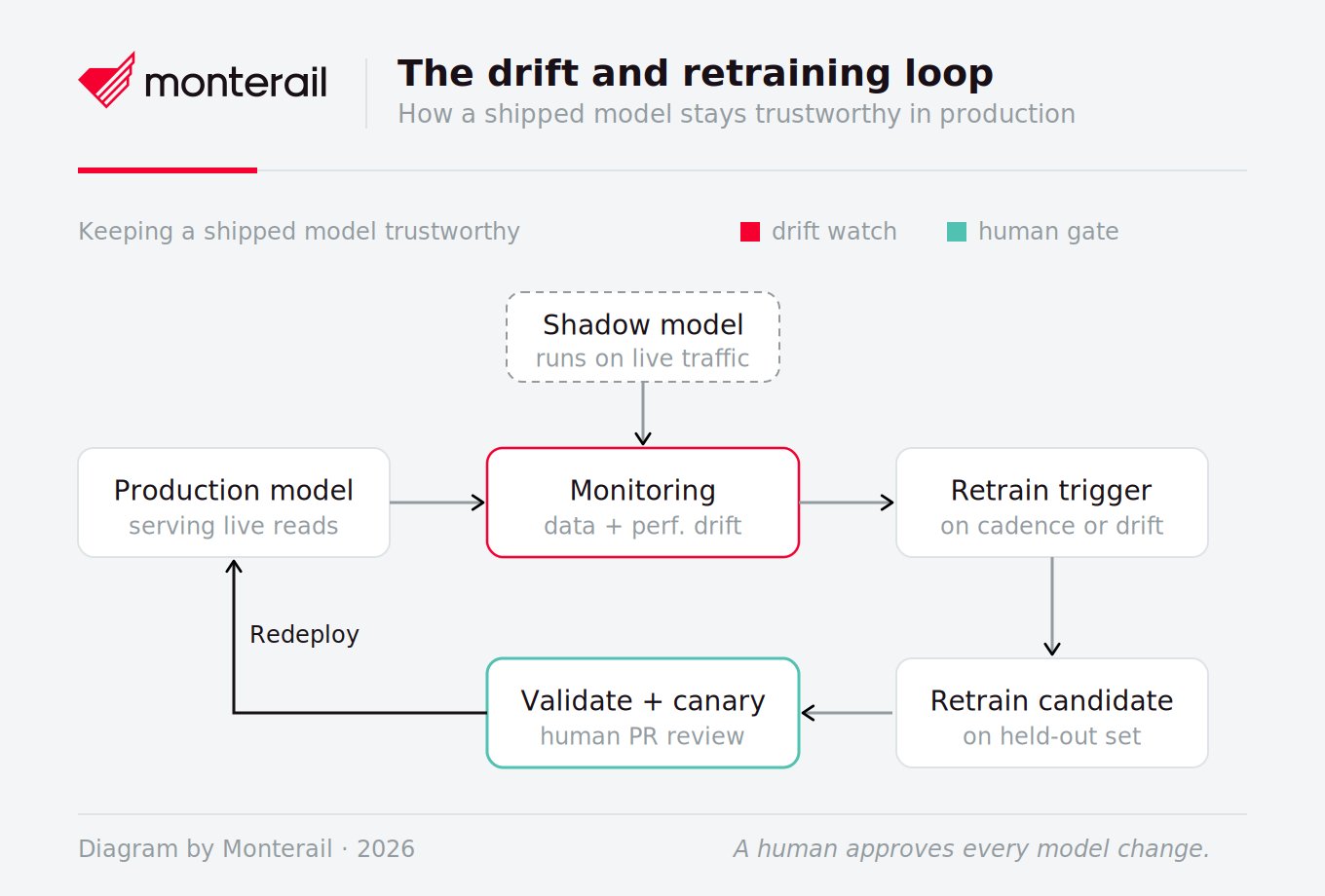
This is where most AI diagnostic pipelines are weakest and where the real, ongoing engineering work lives after a model ships. A model that performed well during validation will not perform identically a year later. For the imaging triage example, the reasons are usually simple: a hospital switches imaging equipment, a new patient population enters the data, or an upstream workflow change alters what 'normal' input looks like.
Keeping a model trustworthy in production comes down to three ongoing disciplines.
1. Detecting drift before it reaches a patient
Two failure modes matter most. Data drift is when the distribution of incoming inputs shifts, for example, a new scanner producing systematically different image characteristics. Performance drift is when the model's measured accuracy degrades even without an obvious input shift.
The two are related but not identical, and a pipeline needs to watch for both: input-distribution monitors on the ingestion side, and outcome tracking that compares model flags against confirmed radiologist reads on the output side. Shadow-mode deployment catches both early, running a candidate model alongside the production model without acting on its output, comparing the two silently.
2. Choosing what triggers retraining.
Three retraining strategies exist, and most products combine them. Scheduled retraining runs on a fixed cadence. Performance-triggered retraining fires when monitored metrics cross a defined threshold. Data-triggered retraining fires when input drift itself crosses a threshold, independent of measured accuracy.
Most production clinical AI in 2026 runs on the first category, since a model that updates itself unpredictably is hard to validate and audit. What is called "continuous learning" in a clinical AI product is usually quarterly or monthly batch retraining, evaluated on a held-out validation set and reviewed by humans before deployment.
3. Versioning every model change
Every inference should be traceable to a specific model version, and every version change needs a rollback path that doesn't require redeploying the entire pipeline. A canary rollout, sending a small percentage of traffic to a new model version before a full switch, catches problems validation data alone often misses, since production data always finds edge cases a test set didn't anticipate.
Versioning is also what makes a Predetermined Change Control Plan enforceable: the plan describes which updates are pre-authorized, and the versioning system is the evidence that the pipeline stayed inside those bounds.
Regulators ask why the evidence doesn't exist, regardless of which discipline got skipped
Where Compliance Touches the Pipeline
Compliance shows up at five specific points within the pipeline, well short of being a single layer bolted on top.
Model versioning and retraining, governed by the FDA's Predetermined Change Control Plan framework.
Traceability, linking every inference back to a specific model version and input.
Data handling, its own distinct privacy and governance surface once patient data enters the pipeline.
Human oversight, how a clinician reviews and can override the model's output.
Any LLM component, selected against its own separate criteria if the pipeline summarizes findings into a clinical note.
That assumes the classification question itself is already closed. Nothing below this point matters until it is, since how deeply each of these five points gets scrutinized scales directly with how the product was classified in the first place.
An FDA reviewer, or a hospital's own procurement team, asks for evidence at each point separately, rather than accepting a general assurance that 'compliance was considered' somewhere along the way. Building that evidence in from the start, as a natural byproduct of how the pipeline gets architected, costs far less than reconstructing it under a deadline once an auditor asks for it.
Key Takeaways
An AI diagnostic pipeline has five structural layers: ingestion, preprocessing, inference, post-processing, and clinical integration, with monitoring running continuously under all five once it is live.
Batch versus streaming ingestion comes down to urgency: a triage tool flagging urgent findings must stream, while population-level scoring rarely needs to.
On-prem inference tends to win for single-site, latency-critical triage; cloud inference earns its complexity back at multi-site scale or when models need frequent updates.
Monitoring and drift management is the layer most pipelines underbuild. Most 2026 production clinical AI runs on scheduled or trigger-based batch retraining, not true continuous learning.
Compliance attaches at specific, identifiable points, above all model versioning and retraining, rather than sitting as one generic requirement across the whole system
Architecture Decisions Now Are Compliance Decisions Later
Painful rework almost always traces to one root cause: monitoring, versioning, and retraining were built as an afterthought instead of as an architectural decision. A PCCP or a post-market audit eventually asks for evidence the pipeline was never designed to produce, and that gap gets expensive to close under deadline pressure.
Teams that avoid it treat the monitoring layer as a first-class part of the architecture from day one, not a maintenance concern to schedule later. The five visible layers get the design attention, but the loop running underneath them is what decides whether the system is still trustworthy a year after launch.
Scoping the architecture for a diagnostic AI build, or auditing one that's already in production? Talk to Monterail's healthtech experts about the build.
AI Pipeline Architecture - FAQ
)
Piotr Zając
HealthTech Director

Piotr, Monterail’s Director of HealthTech brings over 15 years of entrepreneurial leadership and strategic innovation to the MedTech and HealthTech sectors. Piotr has demonstrated exceptional ability to build and scale healthcare solutions. Former President of EO Poland, part of the world's largest entrepreneur network. Combining his entrepreneurial background with Management 3.0 principles, Piotr specializes in helping organizations drive sustainable innovation in the rapidly evolving HealthTech landscape.