Nowy standard. Twoje centrum tworzenia inteligentnego, szybkiego i zrównoważonego oprogramowania AI

Spis treści
A target price model is a budgeting arrangement in which the client and the software vendor agree on a target budget before work starts, then split any overspend or underspend according to a ratio set in the contract.
It sits between fixed price and time and materials (T&M): the budget is close to fixed, but the vendor doesn't have to pad the estimate with a large risk margin, and the client doesn't carry all the cost risk alone.
If you're choosing how to contract your next build, this article explains how the model works, when it fits, and when one of the other two models is the safer choice.
Executive Summary
A target price contract makes both sides share the financial result of a project: finish under the target and the savings are split, go over it and the overrun is split too.
That shared stake pushes the team to deliver the core value first and to simplify features rather than let scope creep eat the budget. The model works best when the project goals are clear and can be frozen, but the details of how each feature is built can still flex.
It's a poor fit for exploratory work where the goals themselves are still moving, and it demands more active project management than T&M.
What Is a Target Price Model in Software Development?
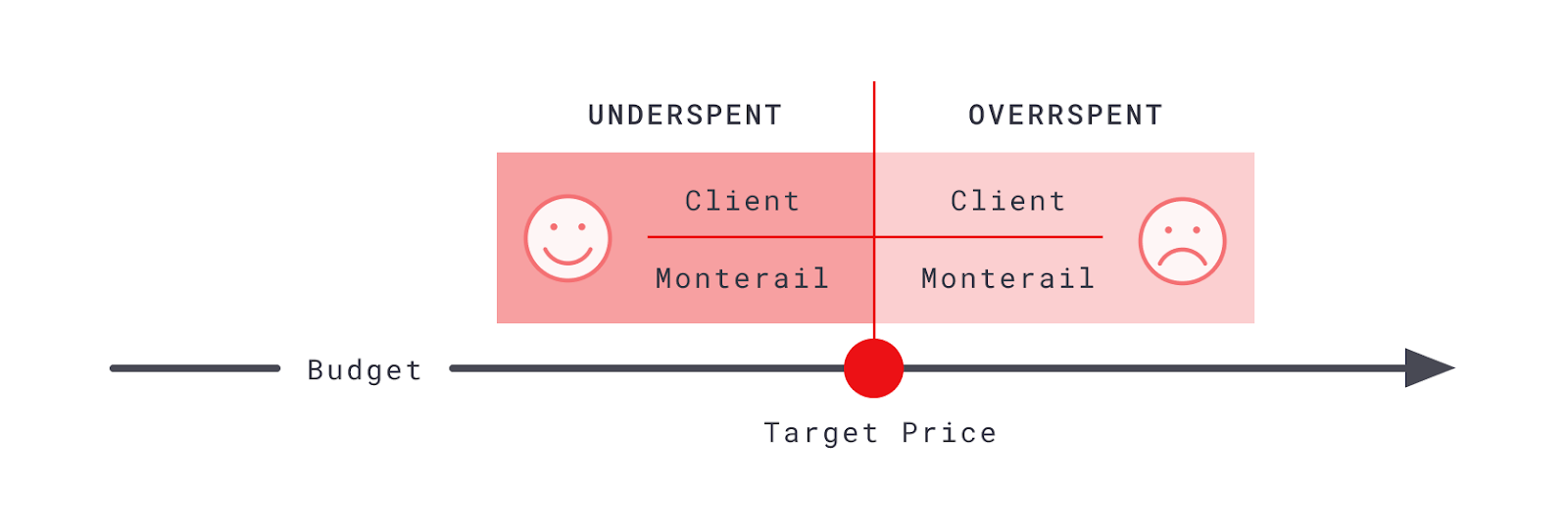
Put simply, the target price scheme means sharing the savings with the client when the project is delivered below the agreed price, and sharing the costs when the budget is exceeded. The mechanism is borrowed from construction, where target cost contracts with a "pain/gain share" are standardized, for example in the NEC4 Option C target contract. Agile software teams have used the same idea for years; Eckfeldt, Madden and Horowitz described it at the Agile 2005 conference as a way to sell agile projects to clients who need budget certainty.
The target is set before the project starts, based on an estimate of the project's cost that takes its goals, timeline and available budget into account. Once the work is done, the difference between the actual cost and the target is shared between the client and the vendor. Because both sides have money on the line, both have a reason to deliver on or under budget.
How Is a Target Price Overrun or Underrun Calculated?
Take a hypothetical project with a target price of $100,000 and a 50/50 share ratio:
If the actual cost is $90,000, the $10,000 saving is split. The client pays $95,000, and the vendor keeps $5,000 more than its costs.
If the actual cost is $110,000, the $10,000 overrun is split. The client pays $105,000, and the vendor absorbs the other $5,000.
A 50/50 split is the simplest version, but the ratio is a negotiable term. Before signing, it's worth agreeing on four things in writing:
The share ratio, and whether it's the same for overruns and underruns.
A ceiling, if you need one: a maximum price above which the vendor carries the full overrun.
What counts as a cost, so neither side argues about it at the end.
How scope changes adjust the target, because a new goal added mid-project is a new target, not an overrun.
When Does a Target Price Contract Make Sense?
Target price works when you can fix the project's goals and timeline but want room to adjust how each feature is built. It suits companies that plan their spending around a fixed pot of money, such as a funding round, a grant or an annual budget, because the realistic range of outcomes is known up front. With T&M, that kind of budget is harder to plan around, since the final bill depends on how the scope evolves.
It's also a good fit for a first project with a new vendor. A client can test the collaboration on a small, well-defined project, track progress and costs throughout, and get notice early when the budget is at risk, how much and why. It removes the main risk of fixed price, where the client commits to a number without knowing whether it's accurate, and the vendor's risk margin is already baked in.
It's not the right model for everything. If you're still exploring what the product should be, the goals will keep changing, and T&M will cost you less friction. If the job is small and fully specified, a fixed price is simpler to administer.
We first tested the target price approach with GiveDirectly, a nonprofit that sends cash transfers directly to people living in extreme poverty. We started with a relatively small project, which made it easier to set the scope and budget precisely. The client was proactive and suggested changes and iterations almost daily. Gathering the requirements and setting priorities took time, but once that was settled, development went smoothly. GiveDirectly's team later said Monterail's detailed scoping and estimation process led to the project being completed under budget, which meant the savings were shared with them.

What Are the Pros of the Target Price Model?
The biggest advantage is that both parties have the same incentive to control the budget. That makes intentions clear on both sides, which helps build trust.
Target Price helps to set a clear objective of delivering core value first. After that, it's easy to manage scope and priorities to meet previously established business goals within the budget. Both the team and the client are motivated to keep the product as simple and functional as possible - it embraces Lean values and simplifies delivery.
For the development team, the main gains are predictability and clear goals. When the budget is at risk, the team has a reason to challenge the complexity of the scope early instead of quietly absorbing it. That helps deliver a functional MVP on time and on budget.
What Are the Cons of the Target Price Model?
Target price is less flexible than T&M. You have to estimate and freeze the goals, then control deviations by adjusting the complexity of features. That calls for closer project management throughout. Without it, the team will soon struggle to tell work in the statement of work (SoW) apart from "nice-to-haves" that should be billed separately.
The model also needs more preparation. The goals have to be thought through and the plan has to be solid but adjustable, which usually means a product discovery workshop before kick-off. That adds cost and pushes back the start date. In return, both sides understand the scope much better, which is what makes the target realistic in the first place. A target set too low means pain from day one; one set too high means easy gain for the vendor and a worse deal for you.
Target Price vs Fixed Price vs Time and Materials: Which Should You Choose?
Fixed Price | Time and Materials | Target Price | |
|---|---|---|---|
Budget | The client knows the exact cost. The price is the estimate plus the vendor's risk margin. | The client pays for the actual time spent. New requirements are billable, which makes it easy to pivot. | Close to fixed. Finishing over or under the target triggers a pain or gain share. |
Timeline | Usually set in the contract. | Hard to predict. | Should be fixed. |
Scope | Every scope change means renegotiating the contract. | Flexible. Both sides can add features as the market demands, so the team can't commit to a final deadline. | Goals are fixed, but the complexity of individual features can be adjusted to fit the budget and timeline. |
Best for | Clear, well-understood scope, a vendor with experience in similar projects, and a buyer willing to pay extra for set-in-stone predictability. | Long-term projects with changing requirements, where the client wants the freedom to modify scope. | Projects with fixed goals and budgets, companies working from a set funding pot, and first-time partnerships. |
Key Takeaways
A target price contract splits both savings and overruns between client and vendor.
The share ratio, any price ceiling and the definition of cost are all negotiable; put them in writing.
It fits projects with fixed goals and a fixed budget, but flexible feature details.
It's a poor fit for exploratory products whose goals are still changing; use T&M there.
A realistic target needs solid upfront discovery, so budget time for it.
Should You Choose Target Price for Your Next Project?
Fixed price, T&M and target price each fit a different kind of project, and none of them is right every time. Target price is worth considering when your goals and budget are fixed but you want a vendor that shares the risk of getting the details right. Whatever model you pick, check it against your scope, timeline and funding before you sign.
If you're not sure which budgeting model fits your project, get in touch. We'll walk you through the options and tell you which one we'd choose in your place.
Target Price Model FAQ

Grzegorz Hajdukiewicz
Chief Delivery Officer

With over a decade of experience in the IT industry, Grzegorz has a proven track record of delivering complex projects on time and on budget. At Monterail, he leads a team of dozens of developers, designers, project managers, and business analysts, ensuring the successful delivery of software solutions for clients worldwide. Passionate about agile methodologies and continuous improvement, he constantly seeks new ways to optimize the delivery process.