The New Default. Your hub for building smart, fast, and sustainable AI software
Table of Contents
A knowledge architecture for enterprise RAG sits between raw company content and retrieval: it decides which sources are trusted, how documents are split into chunks, what metadata and permissions each chunk carries, and how accuracy is measured before launch. In Monterail's RAG engagements, retrieval errors found in pilot evals typically traced to content or permission issues, not to the model.
Gartner sees the same pattern across AI projects, predicting that through 2026, organizations will abandon 60% of AI projects unsupported by AI-ready data (Gartner, February 2025). This guide is for CTOs and data leads in regulated industries, and it covers the seven components, a pre-launch checklist, and when a RAG platform beats a custom build. To help CTOs and data leads in regulated industries get their content AI-ready, we've gathered the seven components of a knowledge architecture, a pre-launch checklist, and the trade-offs between RAG platforms and custom builds.
Executive Summary
An enterprise RAG system’s accuracy depends more on how its knowledge is organized than on which model writes the answer. The model answers faithfully from whatever chunks it receives, so a superseded policy, a duplicate document, or a file the user shouldn't see becomes a confident wrong answer, and a larger model won't catch it. Seven components prevent that: source ownership, structure-aware chunking, metadata, permission-aware retrieval, freshness rules, hybrid retrieval, and evaluation. A pilot is ready for production when those components are in place, and it clears an accuracy threshold that business and security owners agreed on before the build. For budget owners, that means paying for content owners, permission sync, and a golden question set before paying for a bigger model.
Why do enterprise RAG pilots fail before production?
Enterprise RAG pilots usually fail at retrieval. The model faithfully answers from whatever chunks it receives, so a stale policy, a conflicting duplicate, or a document the user should never see can produce a confident wrong answer. Demo questions hide these failures because pilots run on a small, clean slice of content and a handful of friendly users.
The pattern repeats across corpora. Each retrieval defect has a predictable effect on answers and a predictable business consequence.
Cause in the knowledge layer | Effect on retrieval and answers | Business impact |
|---|---|---|
Versioned duplicates of the same policy | Conflicting chunks reach the model | Confident wrong answers and compliance exposure |
Fixed-size chunking | Tables and clauses split mid-row or mid-sentence | Answers miss the exception or condition that changes the outcome |
Access-control lists (ACLs) not synced into the index | Users retrieve chunks they cannot open in the source system | Security blocks the rollout |
Internal acronyms and product codes | Low recall from embeddings that never saw the terms | Users stop trusting the tool and stop using it |
Teams fixing these failures choose between three architectures. The right one depends on how uniform the content is and how complex the permissions are.
Naive vector RAG | Off-the-shelf enterprise RAG platform or copilot | Custom RAG on a knowledge architecture | |
|---|---|---|---|
Cost | Lowest upfront: a vector database and an LLM API | Per-seat or usage license | Highest upfront: build and maintain the knowledge layer |
Time to start | Days | Weeks, mostly connector setup | Longest, including time to build the knowledge layer and run the first evals |
Control over sources and permissions | Low; whatever was loaded | Limited to the platform's connectors and permission model | Full: owners, schema, ACL sync and evals are yours |
Accuracy risk on domain content | High on versioned, tabular or jargon-heavy content | Medium; tuning options are limited | Lowest, provided evals run before launch |
Best fit | Prototypes and internal demos | Uniform workspace content with simple permissions | Regulated, permissioned or jargon-heavy corpora |
Choose when | You need to test whether users want the tool at all | Content is uniform, and the platform already indexes your systems | Answers carry compliance weight, or permissions differ by region, role, or client |
Monterail's view: a platform is the right call when content is uniform, and custom work only pays off when the knowledge itself is the hard part.
How does a knowledge architecture keep enterprise RAG retrieval accurate?
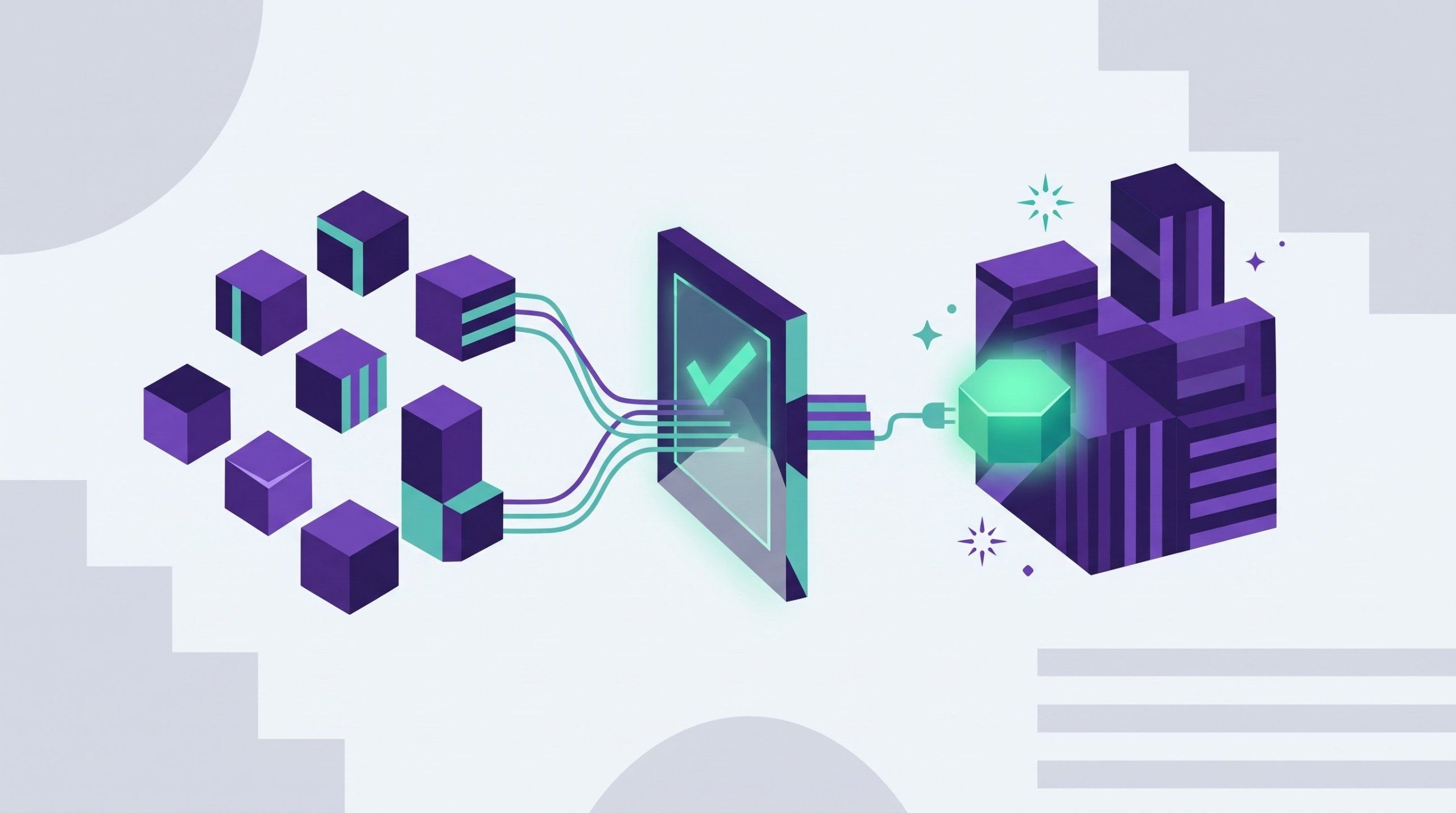
It filters what the model sees before it writes a word. Every chunk that reaches generation has passed checks on its source, structure, metadata, and access rights, so stale, duplicated, or forbidden content never makes it into an answer. Seven components do that work: source ownership, structure-aware chunking, metadata, permission-aware retrieval, freshness rules, hybrid retrieval, and evaluation.
How should enterprise RAG sources and ownership be defined?
Every corpus needs one system of record and one named owner. The system of record settles which copy of a document is authoritative, so drafts, email attachments, and archived exports stay out of the index. An HR corpus shows why: the same travel policy often exists as a SharePoint page, a PDF attached to an onboarding email, and an export in a team drive, each from a different year. Without a declared system of record, all three get indexed and compete at query time.
The owner approves what gets indexed and decides which source wins when two disagree. Ownership also comes with a recurring workload. After each eval cycle, the owner reviews the corpus's failed questions and decides whether each fix belongs in the content (rewrite or retire the document) or in retrieval (chunking, metadata, or filters). Without that routine, failed answers pile up in a backlog nobody owns.
How should enterprise documents be chunked for RAG?
Chunk enterprise documents along their own structure (headings, sections, tables, and clauses) instead of at a fixed token count. Fixed-size splitting can cut a benefits table between its header row and its values, or separate a contract clause from the "except where" sentence that follows it. The retriever then returns a chunk that looks relevant, and the model answers without the condition that changes the outcome.
Structure-aware splitting keeps a table row with its header and a clause with its exceptions. Each chunk also carries its heading path, so "Section 4.2, Parental leave, Germany" travels with the text and helps both matching and citation.
Parent/child retrieval adds context without diluting the match. The retriever matches a small, precise child chunk, then passes the whole parent section to the model, so the answer sees the surrounding context. Parsing quality sets the ceiling for all of this: if the PDF extractor flattens a table into a run of numbers, no chunking strategy can recover it.
Which metadata does enterprise RAG need?
Every chunk needs at least five metadata fields: document type, owner, effective date, region, and sensitivity. With them, retrieval stops returning the most similar text and starts returning the most similar text that is current, applies to the user's region, and comes from the right document type. A question about German parental leave should never be answered from the US handbook because its wording happens to be closer.
The same fields drive citations and audit trails, so an answer can show which document, version, and effective date it relied on.
Keep the taxonomy short and controlled. Free-text tags drift quickly ("DE", "Germany", "germany-hq"), and a filter on a drifting field silently drops valid chunks. Useful additions are a superseded-by link, the source URL, and the language. Populate fields from the source system where possible, such as SharePoint content types or Confluence labels, because manual tagging by authors is usually the first routine to lapse.
How does permission-aware retrieval work?
Permission-aware retrieval syncs access-control lists from each source system into the index and filters chunks by the user's identity at query time, before generation. The model never sees a chunk the user couldn't open in SharePoint, Confluence, or Google Drive. Filtering after generation is too late, because the forbidden content has already shaped the answer, even if its citation is hidden.
Put the filter inside the vector query. If you filter a top-10 result list afterward, a user with narrow access can end up with two usable chunks out of ten, and recall drops for exactly the users with the most restricted views.
Group membership is where ACL sync tends to break. Source systems grant access through nested groups and inherited site permissions, and the index needs the resolved set of users or groups for every chunk. Test parity with real accounts from different roles and regions. An admin test account can open everything, so it will hide every gap.
How do you keep a RAG index fresh?
Four rules keep the index fresh: supersession, re-index triggers, deduplication, and deletion propagation. When a new version of a document is published, supersession marks the old one as replaced, so only one version is retrievable. Re-index triggers fire on change events from the source system, such as webhooks or change feeds, and a scheduled reconciliation job catches what slips through, including bulk moves and permission changes that never emit a content event.
Deduplication removes near-identical copies before they compete in results. Exact duplicates are easy to catch by hash; near-duplicates, such as a policy with a changed footer, need a similarity check at ingestion.
Deletions have to reach the index, the chunk store, and any answer caches, because a cached answer built from a withdrawn policy keeps getting served after the source is gone. Agree on a freshness window per corpus with its owner: a price list may need same-day updates, while a code of conduct can tolerate a weekly sync.
When does enterprise RAG need hybrid search and reranking?
Add hybrid search and reranking as soon as the corpus contains exact identifiers: part numbers, error codes, clause references, internal acronyms. Embedding models learned from public text and have never seen your error code format or your internal name for a pricing tier, so a dense-only search returns chunks that are semantically close and factually wrong.
Keyword search (BM25) finds exact terms that dense vectors miss, and dense vectors find the paraphrases keyword search misses. Running both and merging the candidate lists, for example with reciprocal rank fusion, covers both cases. A reranker then reorders the merged candidates by relevance to the question.
An acronym glossary expands queries with the full terms employees actually use. A knowledge graph justifies its maintenance cost only when entity relationships determine the answer, such as which policy applies to which subsidiary. For most corpora, a subsidiary or region metadata field handles that relationship with far less upkeep.
How do you evaluate enterprise RAG retrieval?
Retrieval is evaluated against a golden question set written with subject-matter experts, where each question lists the source passages a correct answer has to use. Recall@k measures whether those passages appear in the top k results. Because it scores retrieval separately from generation, a failure points at the knowledge layer instead of the prompt. Answers are then scored on faithfulness to the retrieved context and on citation accuracy.
Write questions the way employees actually ask them, including the vague and misspelled ones from pilot logs. Add questions that a given test user should not be able to answer, so the set checks permissions as well as relevance.
Run the evals on every change to chunking, metadata, models, or prompts. Failed questions go back to the content owner, so a bad answer ends in a content fix instead of a support ticket. Keep the set growing after launch: every production failure a user reports becomes a new golden question.
How do the 7 components move an enterprise RAG pilot into production?
The components reach the business through a four-step chain:
Metadata and ACL filters remove irrelevant and forbidden chunks before generation.
Answer accuracy and citation rate rise on the golden question set.
Security and business owners sign off on measured results.
The pilot reaches production, and compliance risk goes down.
At Monterail, this work sits in the Diagnose and Prove stages of our Diagnose, Prove, Ship method for AI products.
Which standards should an enterprise RAG pilot meet before launch?
A named owner for every corpus.
ACL parity with the source systems, tested with real user accounts.
A golden question set written with subject-matter experts.
A retrieval accuracy threshold agreed with business and security owners before launch.
A citation shown with every answer.
Where does a knowledge architecture make the biggest difference in enterprise RAG?
Wherever a wrong answer is expensive, and the content is versioned, permissioned or technical. Three enterprise RAG use cases fit that profile: internal policy and HR assistants, technical support knowledge bases, and compliance Q&A in regulated industries. Each one depends on a different subset of the seven components.
How does a knowledge architecture improve internal policy and HR assistants?
A policy assistant answers employee questions about versioned, regional policies such as leave, expenses, and travel. It sits in employee self-service, and HR and legal own the content. When an answer comes from a superseded policy, the company has a compliance problem.
Constraints: metadata and freshness rules are required, and HR has to own versioning.
How does a knowledge architecture improve technical support and field-engineering knowledge bases?
A support knowledge base answers questions from manuals, specification tables, part numbers, and error codes. It sits in support triage and field service, where an engineer needs the exact procedure for one model and one firmware version. When retrieval works, escalations drop and tickets close faster.
Constraints: PDF and table parsing quality, structure-aware chunking and hybrid retrieval.
How does a knowledge architecture support compliance Q&A in regulated industries?
Compliance Q&A in HealthTech and FinTech returns answers with clause-level citations and an audit trail. Compliance, risk, and clinical operations teams use it to check obligations against internal procedures and external rules, and an auditor can trace every answer back to the clause that supports it.
Constraints: permission-aware retrieval, evaluation, and data residency are required.
What do you need before putting enterprise RAG into production?
Enterprise RAG holds up in production when three things are in place before launch: named content owners, permissions synced from the source systems, and an eval set everyone agreed on. A pilot missing any of the three tends to stall at security review or lose its users after the first wrong answers. Integration, compliance, scale, and change management make up the rest of the work.
Integration
Connectors for SharePoint, Confluence, Google Drive, and ticketing systems decide how much content reaches the index and how quickly changes arrive. ACL sync latency matters as much as content sync: a revoked permission should leave the index within an agreed window. Knowledge that lives only in people's heads needs a capture plan, or the assistant will answer around the gap.
Compliance
GDPR erasure applies to the vector index, chunk store, caches, and eval logs, not only to the source document. Data residency rules cover the embedding API and the LLM API as well as storage. Expect security reviews to ask how SOC 2 and ISO 27001 controls apply across the whole pipeline, including the embedding and LLM APIs. EU AI Act obligations depend on the use case's risk category.
Scale
Changing the embedding model means re-embedding the whole corpus, so the choice deserves an eval run before scale. Index storage and inference cost grow with corpus size and query volume. The golden question set has to grow with the corpus, or new content ships untested.
Change management
Subject-matter experts need scheduled time to write and review golden questions. Content owners need a routine for handling failed answers. Business, security and engineering need one shared definition of "accurate" before anyone debates whether the pilot passed.
Monterail fits teams that need retrieval over permissioned, regulated or jargon-heavy content; it is not the right choice for generic workspace content an off-the-shelf copilot already indexes.
How does Monterail build knowledge architecture for enterprise RAG?
Monterail builds enterprise RAG knowledge architecture with the Diagnose → Prove → Ship method. The Diagnose phase audits the pilot against a golden question set and classifies every failure by component. Prove fixes the failing components until the agreed accuracy threshold holds, and Ship moves the system to production with eval monitoring and a content-owner routine.
Monterail is a Wrocław-based product design and AI software development company building web, mobile and AI products for HealthTech, FinTech and PropTech.
The same accuracy discipline applies outside retrieval. For Simfoni, a global spend automation platform for large enterprises, a three-person Monterail team built Insights AI. It loads customers' spend data, analyzes it with Claude on AWS Bedrock, validates the model's numeric output, and generates a ready-to-present PowerPoint report in one click. Getting reliable numbers took extra data preprocessing and cross-checking, and the work that used to take analysts hours now runs automatically.
Key Takeaways
Most enterprise RAG accuracy problems are retrieval and content problems, so changing the LLM rarely fixes them.
Metadata filters for date, region, and document type often improve precision more than switching embedding models.
Enforce permissions at retrieval time, or security teams will block the production rollout.
A golden question set built with subject-matter experts before launch is the only reliable proof that accuracy improved.
Monterail engagements move an enterprise RAG pilot into production once the knowledge layer is in place.
What should decide whether an enterprise RAG pilot reaches production?
Enterprise RAG is a knowledge management system with an LLM interface. Its knowledge layer needs owners, evals, and refresh routines that run as long as the system does, making the initial data load the smallest part of the job. Monterail's position is that a pilot earns production by clearing accuracy thresholds that business and security owners agreed on before the build started. Plan the budget the same way: ongoing ownership and eval time belong in the operating cost, alongside tokens and hosting. If your pilot works but hasn't passed security or business sign-off, book a RAG readiness review of the existing pilot with Monterail's AI team.
Enterprise RAG Knowledge Architecture FAQ

Michał Nowakowski
Solution Architect and AI Expert at Monterail

Michał Nowakowski is a Solution Architect and AI Expert at Monterail. His strong data and automation foundation and background in operational business units give him a real-world understanding of company challenges. Michał leads feature discovery and business process design to surface hidden value and identify new verticals. He also advocates for AI-assisted development, skillfully integrating strict conditional logic with open-weight machine learning capabilities to build systems that reduce manual effort and unlock overlooked opportunities.