The New Default. Your hub for building smart, fast, and sustainable AI software
AI Agent Development Services
Outside engineering help design and run AI agents that carry out business tasks on their own, within set limits.
What Are AI Agent Development Services?
Building an AI agent is like hiring for one well-defined job: the agent gets a job description and system access, and someone still reviews its riskier calls.
AI agent development services involve designing and deploying AI agents. An AI agent is software that pursues a goal by planning its own steps and calling tools such as databases and business APIs. The work spans use-case selection, agent design, evaluation, and production monitoring. It gives organizations automation for tasks that vary from case to case.
Monterail has delivered 900+ projects since 2010 and builds AI in stages, with a working prototype on your own data before you commit to production.
What Does an AI Agent Development Engagement Cover?
An AI agent development engagement covers the path from picking the use case to running the agent in production. It stops at the systems and licenses the client already owns.
What it includes
Workflow mapping and interviews with the people who do the work today, to find the steps where an agent removes manual effort
A fit check that includes a recommendation against AI when a simpler tool does the job
A working prototype on your own data, with a go or no-go decision before production spend
Agent design: the procedure it follows, the model, its tools and permissions, and when it escalates to a person
Integrations with the systems the agent reads from and acts in
Validation steps and evaluations that check agent output before it reaches users
Production release with security, monitoring, documentation, and training for your team
Full ownership of the code and prompts the team builds
What it doesn't include
Model and cloud usage fees, which grow with how often the agent runs
Licenses for the business systems the agent connects to
Training a foundation model from scratch
Fixing data quality inside the client's own systems, although discovery flags the gaps
Ongoing optimization after launch, which runs as a separate support phase
When Do AI Agent Development Services Fit?
AI agent development fits when a task has a clear goal, but its steps vary from case to case.
It fits when
Staff spend hours on a task whose steps change with each case, such as triaging supplier responses or reconciling records across systems
The work spans several tools that people currently copy data between
Mistakes can be caught by a validation step or a human reviewer before they cost money
You have examples of the task done correctly, which become the agent's first evaluations
It doesn't fit when
The steps are identical every time, so a scripted workflow or intelligent automation can run the task with predictable results
A platform you already pay for, such as Microsoft Copilot Studio or Salesforce Agentforce, already offers an agent for the job, which gets you to value sooner
The agent would rely on incomplete or inconsistent data. A data clean-up project comes first and gives the agent something trustworthy to work from
One wrong action cannot be undone and nobody can review it in time, which makes a tool that recommends actions to a person the safer fit
What Are the Benefits of AI Agent Development Services?
The main benefit of AI agent development services is automation for variable, multi-step work, built by a team that has shipped AI into production before.
Hours come back from cross-system busywork. Agents take on the lookups and comparisons that sit between systems, so the same team can handle more volume and spend its time on decisions.
A prototype answers the go/no-go question early. A working version on your own data shows whether the agent performs before the budget for a production build is committed.
Security and monitoring ship with the build. The production release includes both, so monitoring can surface problems early.
You own what gets built. The code stays with your team, so you can change the model or partner later.
Experience shortens the learning curve. A team that has shipped AI to production already knows common failure points, such as unclear success criteria and model costs that need active routing.
How Does an AI Agent Development Engagement Work?
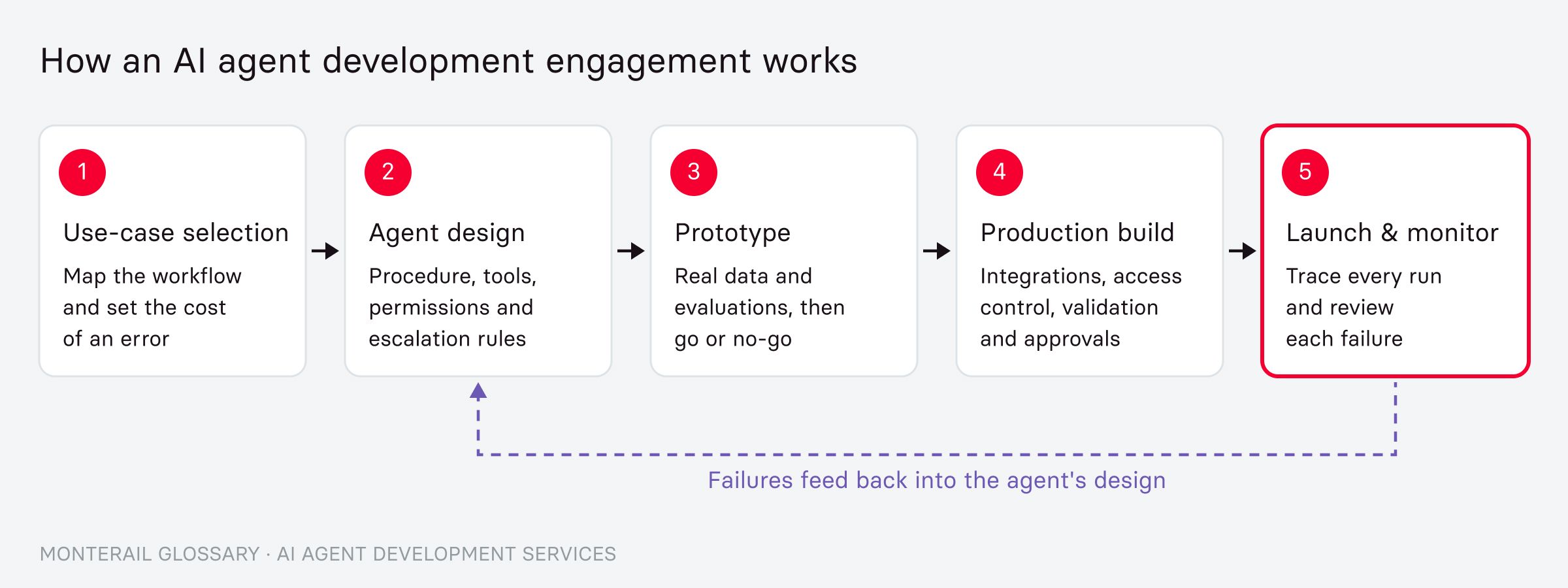
An AI agent development engagement moves through five stages, from choosing the use case to monitoring the agent in production.
Use-case selection. The team maps the workflow with the people who run it and picks the steps where an agent removes the most manual effort. It also defines what success looks like and what an error costs, since that decides how much autonomy the agent gets.
Agent design. The team writes the procedure the agent follows, modeled on how an expert does the task, then picks the model and sets the agent’s permissions and escalation rules. Almog Baku, a guest on Monterail’s The New Default podcast, has shipped more than 30 agents into production. He argues for procedure first and model second in the episode “Your First Agent Will Fail. Build for It.”
Prototype and evaluation. A working version runs against a set of past cases with known correct answers. The results support a go/no-go decision before production work starts.
Production build. The team builds the integrations and sets access control. It adds validation steps, plus human approval for actions that are costly to undo.
Launch and monitoring. Every agent run is traced so the team can see which step went wrong when an output fails review. Keeping an agent running for hours is easy; checking that its work is right is hard, as LangGraph creator Nuno Campos explains in Why AI Agents Fall Apart After Hours of Work.
Should You Build a Custom AI Agent or Use an Off-the-Shelf Agent Platform?
Build a custom agent when the task runs across your own systems and procedures, and use an off-the-shelf platform when the task lives inside software you already license.
Factor | Custom agent built with a partner | Off-the-shelf agent platform |
Fit to your process | Designed around your procedure and edge cases | Configured inside the platform’s builder and connectors |
Systems it can act in | Any system the team can reach through an API or database | The vendor’s own suite plus the connectors and MCP servers it supports |
Ownership | You own the code and the data pipelines | The vendor hosts the agent and you configure it |
Time to first working version | Weeks, starting with a 4–6 week prototype on your own data | Often shorter, when the use case matches what the platform supports |
Governance and audit | Controls designed to your requirements, including private deployment | Controls the platform provides, such as access policies and audit logs |
Cost structure | Upfront build cost, then model and hosting usage | Licensing or usage fees set by the vendor |
Challenges to plan for: A custom agent needs evaluation and monitoring for as long as it runs, so budget for ongoing tuning instead of treating launch as the finish line. Model upgrades can change how an agent behaves, so you need to re-run the evaluation set every time the underlying model changes.
How Does Monterail Approach AI Agent Development?
Monterail starts its AI builds with the workflow and the people who run it, then proves the idea on client data before committing to production. Its Diagnose stage takes 2–4 weeks, Prove takes 4–6 weeks, and Ship takes 8–16 weeks.
Simfoni, a global spend automation platform, had Fortune 500 clients spending 3 to 5 weeks per RFP cycle. Monterail interviewed 8 procurement leads and mapped the full procurement lifecycle to find where AI could remove manual effort without adding compliance risk. The team then shipped four AI tools bi-weekly: upstream quality, supplier response processing, categorization, and RFP creation.
The result was about 80% less RFP drafting time and 66% less manual categorization, 12 weeks from discovery to production, with each tool working inside existing workflows from day one. See Simfoni on Monterail’s AI development page and a related build, the Simfoni Insights AI case study.
When Should You Bring In an AI Agent Development Partner?
An AI agent development partner helps most when the team knows the task it wants automated but has not shipped an agent to production. It also helps when the agent must work inside regulated or core business systems, where mistakes are expensive. Internal engineers who are committed to the product roadmap do not have to spend a quarter learning AI evaluation and monitoring. A partner can also join as additional AI engineers on your team or run the build as a separate delivery team.
Monterail’s AI agent development services cover the path from use-case selection to production. Talk to our AI team about the task you want an agent to take on.
FAQ About AI Agent Development Services
Need expert help with AI Agent Development Services?
Monterail builds custom software solutions that leverage the latest technologies. Let's discuss how we can help with your project.
EXPLORE AI SERVICESEXPLORE AI SERVICES