The New Default. Your hub for building smart, fast, and sustainable AI software
AI Solutions in Healthcare
AI solutions in healthcare are software systems that use machine learning or generative AI to support clinical or operational work, such as flagging findings on medical images or drafting clinical notes.
What Are AI Solutions in Healthcare?
Clinicians spend a large part of their day on pattern recognition and paperwork, and software can now take on part of both. The harder question for any AI product in healthcare is who checks its output, and what happens when it is wrong.
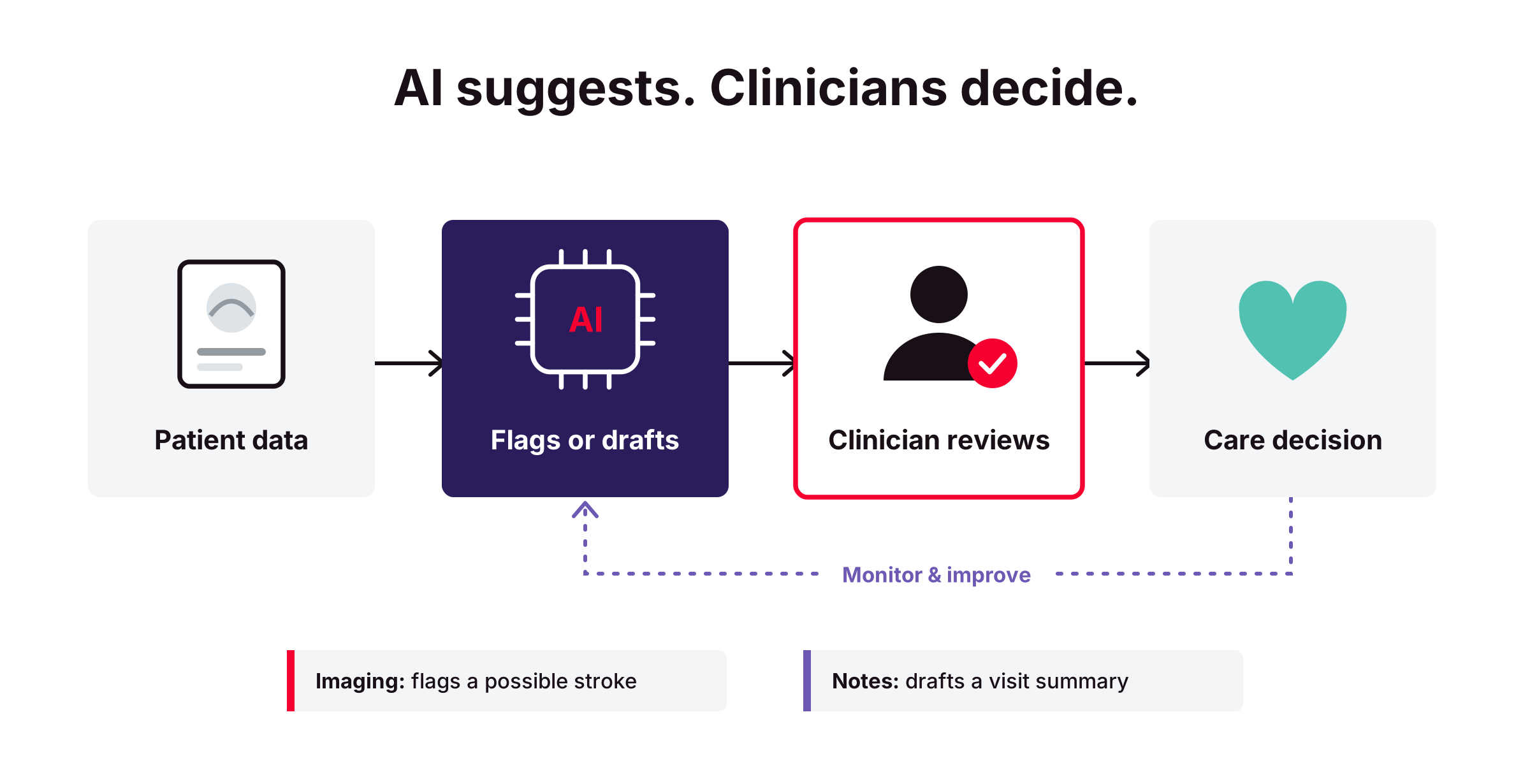
Uses fall into two broad groups. Clinical AI supports diagnosis or treatment, for example software that flags a possible finding on a scan for a radiologist to review. Operational AI handles the work around care, such as drafting a visit note from a recorded conversation.
That split decides how a product is regulated. The FDA keeps a public list of AI-enabled medical devices authorized for marketing in the US, and radiology dominates it: a 2026 analysis in the Journal of Medical Internet Research found that radiology accounted for 77.5% of AI-enabled device authorizations from 2023 to 2025. Software for administrative support, such as billing or appointment scheduling, is excluded from the medical device definition under the 21st Century Cures Act.
Why Do AI Solutions in Healthcare Matter?
They stretch scarce specialist attention. Triage tools can move the most urgent scans to the top of a specialist's worklist, which matters most where specialists are in short supply.
They take on the documentation load. Ambient documentation tools listen to a consultation and draft the note, so the clinician reviews and edits a draft instead of writing it from scratch.
How Are AI Solutions in Healthcare Built?
Intended use first. The team defines exactly what the system does and for which patients and settings. That definition sets the regulatory class and the evidence the product will need.
Lawful, representative data. Training and test data have to be collected on a valid legal basis and reflect the patients the product will serve. In the EU, GDPR treats health data as a special category with stricter processing conditions.
Model development or adaptation. Teams either train a model on their own data or adapt a general-purpose model. Generative tools are often grounded in approved sources through retrieval, so answers cite material the organization trusts.
Validation on unseen data. The model is tested on data it never saw during training, ideally from different sites, and results are broken down by patient subgroup to catch gaps in performance.
Human review in the workflow. Output appears inside tools clinicians already use, such as the EHR, and a person reviews it before it affects care.
Monitoring after launch. Performance is tracked in use, because patient mix and equipment change over time.
What Tools Do Teams Use for AI in Healthcare?
Medical imaging AI. Aidoc and Viz.ai build FDA-cleared triage software that flags suspected urgent findings, such as stroke, on imaging and alerts the care team.
Ambient documentation. Microsoft Dragon Copilot combines Dragon Medical One speech recognition with the ambient listening of DAX Copilot to draft notes, and Abridge offers a comparable ambient note-drafting tool.
Cloud AI platforms. AWS, Microsoft Azure, and Google Cloud sign HIPAA business associate agreements that cover a defined list of in-scope services. Google's list includes its generative AI platform, and teams have to confirm on each provider's current list that the specific AI service they plan to use is covered.
What Are the Key Characteristics of AI Solutions in Healthcare?
Probabilistic output. Models give likelihoods, not certainties. Choosing the alert threshold is a clinical decision about how many false alarms are acceptable to avoid missed cases.
Performance depends on the training data. A model built on one hospital's patients and scanners can perform worse at another hospital with different ones.
Two layers of rules in the EU. AI-enabled medical devices fall under the Medical Device Regulation and the EU AI Act. The AI Act's high-risk obligations for these devices are being phased in under an evolving timeline, most recently amended by the EU's 2026 Digital Omnibus package.
Accountability stays with people. The clinician remains responsible for decisions made with AI support, and for regulated products the legal manufacturer remains responsible for the device.
What Are the Benefits of AI Solutions in Healthcare?
Consistency at volume. A model applies the same criteria to the thousandth image of the day as to the first, which helps in high-volume screening.
Screening where specialists are scarce. Some systems let general clinics run checks that would otherwise need a specialist visit, widening access to screening.
Earlier risk signals. Predictive models on health record data can flag patients at rising risk so the care team can look sooner.
New value from existing data. Images and records already collected for care can be used to build and test models, within the limits of consent and data protection law.
What Are the Challenges of AI Solutions in Healthcare?
Bias and uneven performance. A model can work well on average and poorly for a subgroup. Validating across sites and populations exposes those gaps, but multi-site data is slow and expensive to obtain.
Generated errors. Generative tools can produce statements that were never said or written. Clinician review catches them, but review time eats into the time the tool was meant to save.
Drift after deployment. Accuracy can fall as patients and equipment change. Monitoring catches the decline, but needs a steady flow of labeled outcomes and someone accountable for acting on them.
Updating a cleared model. Changing a cleared model can require a new submission. Final FDA guidance on predetermined change control plans lets manufacturers get specified changes authorized in advance, but those changes and their validation methods have to be planned before launch.
What Is the Difference Between Clinical AI and Operational AI in Healthcare?
Aspect | Clinical AI | Operational AI |
Purpose | Informs diagnosis or treatment | Supports administrative work around care |
Examples | Flagging suspected strokes on scans; screening for eye disease | Drafting visit notes; scheduling appointments |
Regulation | Often regulated as a medical device by the FDA or under the EU MDR | Generally outside device rules when it does not inform diagnosis or treatment |
Evidence needed | Clinical validation for the stated intended use | Accuracy and usability testing |
Impact of an error | Can directly affect a patient's diagnosis or treatment | Mostly affects workload, though errors in records can reach care later |
FAQ about AI Solutions in Healthcare
Need expert help with AI Solutions in Healthcare?
Monterail builds custom software solutions that leverage the latest technologies. Let's discuss how we can help with your project.
GET IN TOUCHGET IN TOUCH