The New Default. Your hub for building smart, fast, and sustainable AI software
Conversational AI
A system that holds a conversation in everyday language while remembering what was said earlier and can act on a request.
What Is Conversational AI?
A conversational AI system takes a request written or spoken in everyday language and answers in the same form. It combines language understanding, conversation state management, integration with business systems, and response generation. That combination powers customer support assistants and voice agents, as well as internal help tools.
The distinction from a scripted chatbot is worth clarifying. A scripted bot matches input against predefined patterns and follows a decision tree; anything outside the script produces a fallback message. Conversational AI interprets intent from phrasing it has not seen, holds context across turns, and can complete tasks by calling other systems.
What makes these systems useful commercially is not conversation but action. An assistant that discusses a delayed order is mildly helpful. One that looks up the order, determines the delay, arranges a replacement, and confirms the new date has resolved the issue. That requires integration with order management, inventory, and shipping, which is where most of the engineering effort goes.
How Does Conversational AI Cut Support Costs?
Support volume grows with customer numbers, but support quality does not improve with headcount alone. Conversational AI changes how many contacts require a person.
Strategic Advantage: A well-implemented assistant resolves routine inquiries continuously, in multiple languages, without queuing. This changes support economics: cost per contact falls for handled cases, and human agents concentrate on complex and sensitive issues where judgment matters. It also lets a company offer round-the-clock service without staffing overnight shifts.
The Problem It Solves: Most support contacts are repetitive questions with answers that already exist in documentation. Customers ask them because finding the answer is harder than asking. Conversational AI absorbs that volume, and it removes the wait time that damages satisfaction more than the eventual answer improves it.
How Does Conversational AI Work?
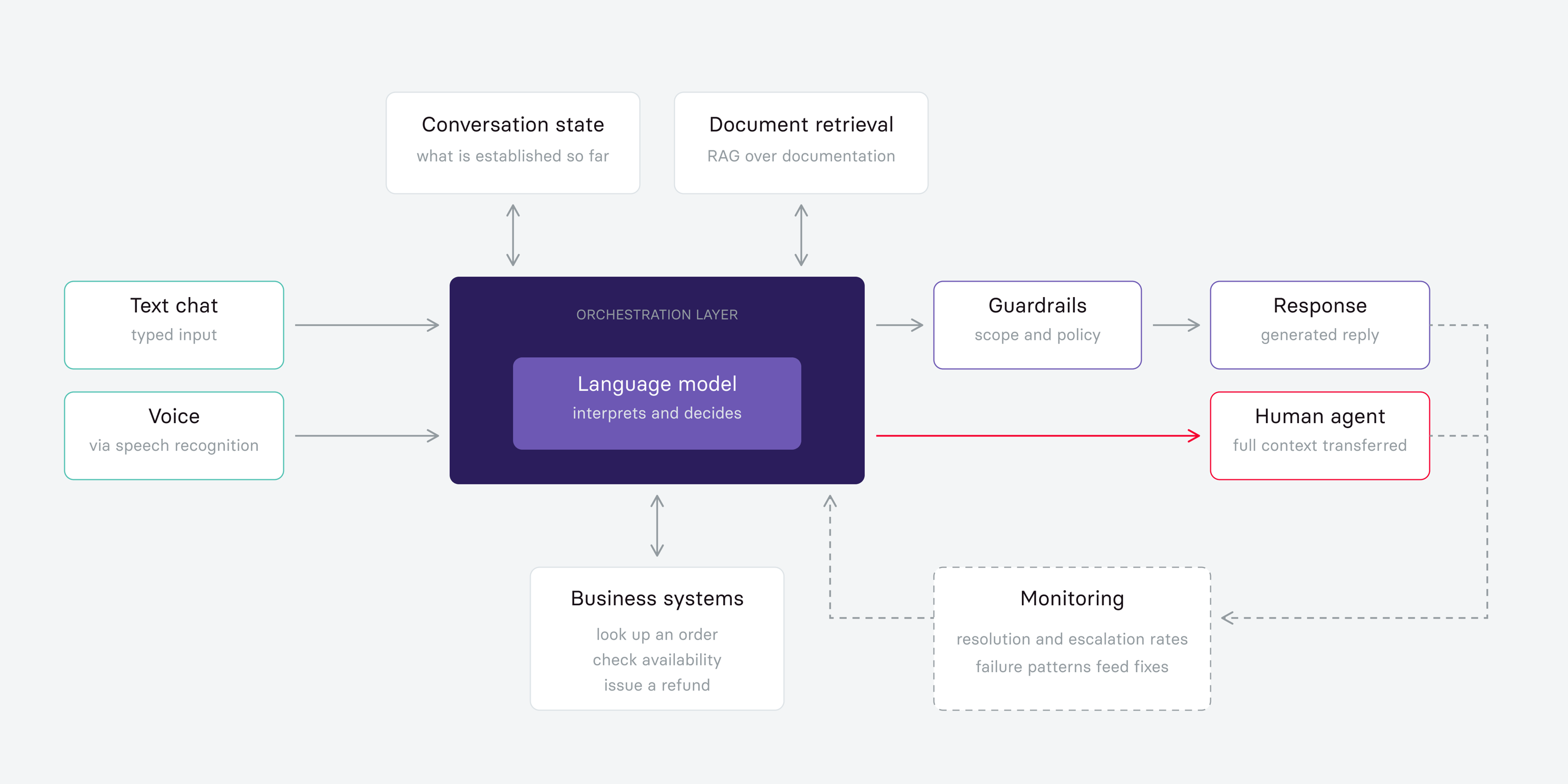
A production system has several components beyond the language model, and most of the reliability comes from those components.
Input processing. Text arrives directly; an automatic speech recognition model transcribes speech. Voice adds difficulty around accents, background noise, and determining when the speaker has finished.
Intent and context interpretation. The system determines what the user wants, using the current message and the conversation so far. Modern implementations use a language model which handles unanticipated phrasing far better.
Conversation state management. The system tracks what has been established, what remains unknown, and where the user is in a multi-step process. Rescheduling an appointment requires knowing which appointment, the preferred window, and whether the new slot is available.
Knowledge retrieval. Factual questions are answered from documentation using retrieval-augmented generation, so responses reflect current material and can cite it.
Tool and system integration. The model is given a set of callable functions: it might look up an order or check availability, then issue a refund if warranted. It decides which action to invoke with which arguments. This is what turns conversation into resolution, and it is where most implementation effort lies.
Response generation with guardrails. The reply is generated within constraints: staying on topic, declining out-of-scope requests, refusing to discuss competitors or offer commitments the business has not authorized, and never inventing policy.
Escalation to a person. The system stops when it keeps failing to help, senses frustration, hits a sensitive topic, or the user just asks for a person. Handover passes full context so the customer does not repeat themselves, which is the most common complaint about poor implementations.
Monitoring and improvement. Conversations are reviewed for how often they're contained or resolved, why they escalate, and how satisfied people end up. Failure patterns feed documentation updates and prompt revisions.
What Tools Build a Conversational AI Assistant?
Language models: Claude, GPT, and Gemini for interpretation and generation, accessed directly or via Bedrock, Vertex AI, or Azure AI Foundry where data residency terms are required.
Speech: Whisper, Deepgram, AssemblyAI for recognition; ElevenLabs, Cartesia, and cloud provider services for synthesis.
Voice orchestration: LiveKit Agents, Pipecat, Vapi, Retell for managing real-time voice sessions with interruption handling.
Retrieval: vector databases and hybrid search as used in any RAG implementation.
Platforms: Amazon Lex and Connect, Google Dialogflow CX, Microsoft Copilot Studio, Rasa for self-hosted deployments, plus support-specific products from Intercom, Zendesk, and Salesforce.
Observability: LangSmith, Langfuse, Helicone for tracing conversations, evaluating quality, and tracking cost per interaction.
What Are the Key Characteristics of Conversational AI?
Context is maintained across turns. The system understands "make it the following week" in relation to what was discussed earlier, which is the difference between a conversation and a sequence of unrelated queries.
Intent is inferred. Unanticipated phrasing is handled, so the system does not depend on users describing their problem in expected words.
Actions are taken in systems. Integration with business systems allows the assistant to resolve requests.
Answers are grounded in current documentation. Factual claims come from retrieved material, which keeps responses accurate as policies change.
Scope is deliberately bounded. Guardrails define what the assistant may discuss and commit to. Systems without them make statements the business is then held to.
Escalation is designed. Handover to a person is a planned path with context transfer, triggered by defined conditions.
What Are the Benefits of Conversational AI?
Immediate response at any hour. Routine inquiries are answered without queuing, which removes the wait that damages satisfaction more than the answer's content improves it.
Lower cost per handled contact. Automated resolution of repetitive inquiries costs a small fraction of an agent-handled contact, and the savings scale with volume.
Human attention redirected to complex work. Agents spend time on cases requiring judgment, empathy, or authority instead of repeating the same answer, which improves both outcomes and job satisfaction.
Multilingual support without proportional staffing. One system can operate across many languages, which would otherwise require hiring in each.
Consistent answers. Every customer receives the same current policy.
Structured insight into demand. Conversation logs quantify what customers ask about, which is a more direct signal of product and documentation gaps than survey data.
What Are the Challenges and Trade-offs of Conversational AI?
Poor implementations damage trust measurably. An assistant that cannot help and will not escalate is worse than no assistant. Users trapped in a loop become resistant to trying again.
Fabricated commitments create real liability. A model that invents a refund policy or promises a delivery date has made a statement customers reasonably rely on. Grounding and guardrails are risk controls.
Integration is the bulk of the work. Connecting to order systems, booking systems, and CRMs, with correct authentication and error handling, typically exceeds the effort of the conversational layer several times over.
Voice is much harder than text. Real-time latency requirements, interruption handling, accent variation, and background noise make voice implementations considerably more demanding.
Escalation design determines perceived quality. Users tolerate an assistant that cannot solve everything; they do not tolerate one that hides the route to a person or discards context on handover.
Evaluation requires deliberate effort. Containment rate alone is misleading, since a system can contain a conversation by exhausting the user. Resolution rate, satisfaction, and repeat-contact rate give a truer picture.
Prompt injection is a live security concern. Users can attempt to manipulate an assistant into revealing system instructions or taking unauthorized actions, particularly when it has access to tools. This needs explicit defense and authorization checks at the tool layer.
Is Conversational AI Better Than a Chatbot?
Factor | Conversational AI | Rule-Based Chatbot |
Understanding input | Interprets unanticipated phrasing | Matches predefined patterns |
Context across turns | Maintained | Usually absent |
Handling the unexpected | Attempts a useful response | Fallback message |
Predictability | Probabilistic; needs guardrails | Fully deterministic |
Build effort | Higher; integration and evaluation | Lower; author the tree |
Running cost | Per-token model cost | Negligible |
Best suited to | Varied inquiries needing resolution | Narrow, fixed, high-volume flows |
FAQ About Conversational AI
Building AI-powered Conversational AI solutions?
Monterail's AI engineering team designs and delivers intelligent software that drives real business outcomes. Let's build together.
EXPLORE AI SERVICESEXPLORE AI SERVICES