What Are Healthcare Technology Solutions?
Much of healthcare's daily friction sits in handoffs: a lab result that waits for a phone call, or a referral that still travels by fax. Technology that removes those handoffs is the goal. The code is rarely the hard part. The rules around it are: who may see the data, and when a piece of software legally counts as a medical device.
The category is wide. Patient-facing products include telemedicine apps and remote monitoring tools. Clinician-facing products include electronic health records and decision-support software. Operational systems handle scheduling and billing behind the scenes.
The term overlaps with its neighbors. Health information technology usually refers to systems that store and exchange records, and medtech to physical medical devices. Healthcare technology solutions spans both, and is often the term used when a provider or startup is looking to have something built.
Why Do Healthcare Technology Solutions Matter?
Regulatory status decides how a product gets built. Some health software is regulated as a medical device. The International Medical Device Regulators Forum (IMDRF), whose definition the FDA uses, describes Software as a Medical Device as "software intended to be used for one or more medical purposes" that works without being part of a hardware device. Settling this question early shapes the entire development process.
They connect systems that were never designed to talk. Hospitals run many systems that do not share data by default. HL7 FHIR, "a standard for exchanging healthcare information electronically," gives new products a common format for reading and writing that data.
How Are Healthcare Technology Solutions Built?
Classification before design. The team first establishes whether the product will handle protected health data and whether any feature makes it a medical device. Those two answers set the documentation and testing requirements for the rest of the project.
Security and privacy by design. In the US, the HIPAA Security Rule requires covered entities and their business associates to put administrative, physical, and technical safeguards around electronic health data, including audit controls and access limited to authorized people.
Interoperability work. Products that exchange data with electronic health records map their data to FHIR resources, the standard's basic building blocks, so a medication or lab result means the same thing on both sides.
A regulated lifecycle where required. Medical device software is typically built to IEC 62304, whose rigor scales with the software's safety class (A to C), inside a quality management system based on ISO 13485.
Validation and monitoring after launch. Regulated products need evidence that they work as intended for their stated purpose, and in the EU, the Medical Device Regulation requires post-market surveillance once the product is in use.
What Tools Do Teams Use to Build Healthcare Technology Solutions?
EHR integration. Epic and Oracle Health (formerly Cerner) offer FHIR-based APIs for third-party apps, and integration platforms such as Redox connect a new product to many EHR systems through one interface.
Cloud infrastructure for health data. AWS, Google Cloud, and Microsoft Azure sign HIPAA business associate agreements covering their eligible services, which lets health products store protected data on their platforms.
Quality and regulatory tooling. Greenlight Guru, Ketryx, and Matrix Requirements manage design controls and requirement traceability for regulated software.
What Are the Key Characteristics of Healthcare Technology Solutions?
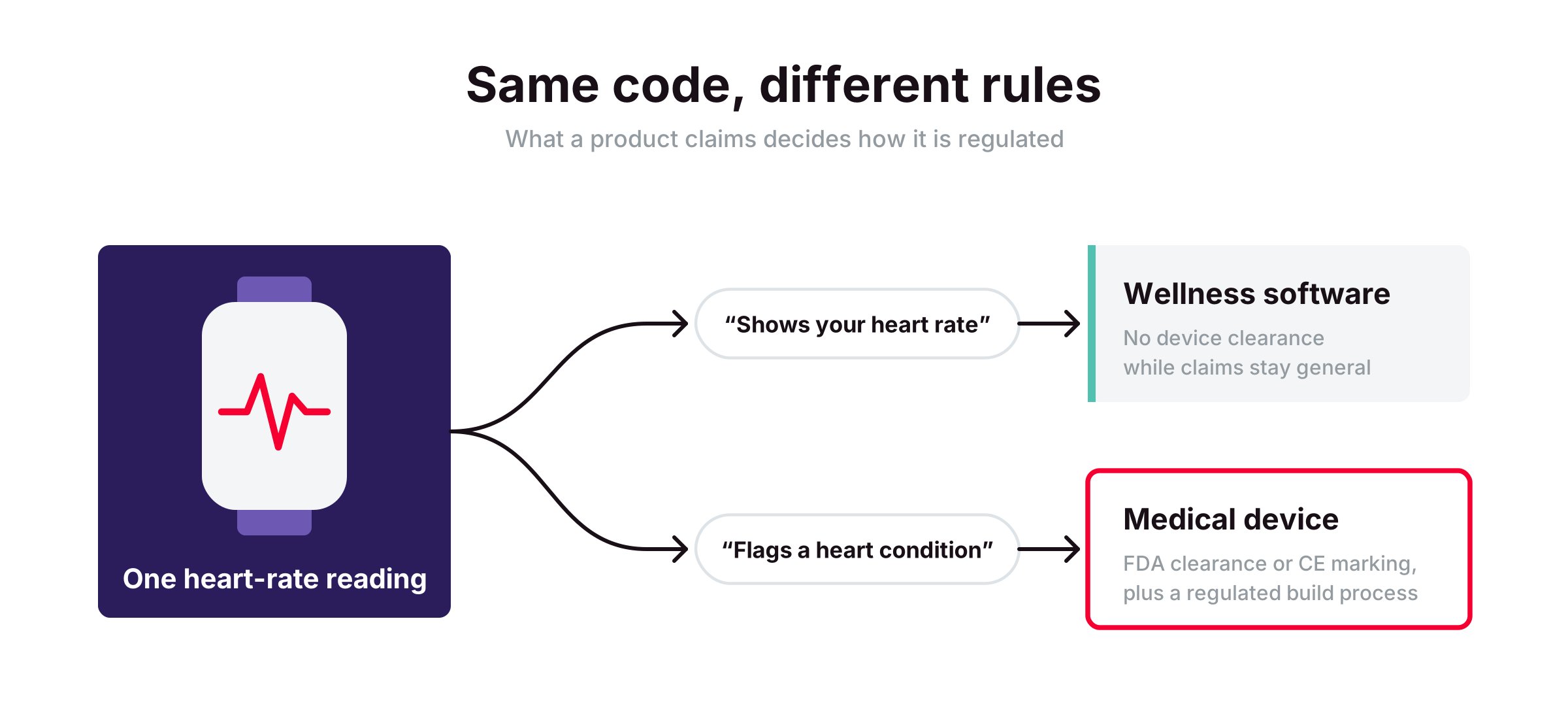
Regulated by intended use. The same heart-rate code can be wellness software or a medical device, depending on what the product claims to do with the reading. Marketing copy can change a product's regulatory class.
Health data has special legal status. In the EU, GDPR treats health data as a special category of personal data, with stricter conditions for processing it than ordinary personal data.
Several user groups with different needs. Patients and clinicians often use the same product in very different ways, so a feature that saves a doctor time can confuse a patient if both see the same screen.
Responsibility sits with the legal manufacturer. For regulated products, the company placing the product on the market under its own name holds regulatory responsibility, even when an outside team builds the software.
What Are the Benefits of Healthcare Technology Solutions?
Care between visits. Remote monitoring and telemedicine let clinicians follow patients outside the clinic, so changes in a condition can surface before the next scheduled appointment.
More clinician time for patients. Automating scheduling and documentation tasks shifts staff time from paperwork back to care.
Data that can be reused. Structured, standards-based data can feed analytics and AI models instead of staying locked inside one system.
New, legal routes to health data. In the EU, the European Health Data Space regulation has been in force since March 2025. From March 2029, its secondary-use rules start to apply for most data categories, letting organizations request health data for permitted purposes, such as research and innovation, with a permit from a national health data access body.
What Are the Challenges of Healthcare Technology Solutions?
Regulatory scope creep. A single new feature, such as flagging abnormal readings, can turn a wellness product into a medical device. Keeping claims narrow avoids that, but limits what the product can promise users and what it can charge for.
Integration varies by site. FHIR standardizes the format, but each EHR vendor and each hospital configures it differently. Integration platforms reduce the per-hospital work, but add another vendor and another contract to the chain that handles patient data.
Slower change after launch. Every update to a regulated product goes through change control, and significant changes may need new regulatory review. That protects patients, but makes even small fixes slower to ship than in other software.
Security versus speed of use. Strong authentication and automatic session timeouts protect patient data, but add friction for clinicians who switch between patients and devices throughout a shift.
What Is the Difference Between Wellness Software and Software as a Medical Device?
Aspect | Wellness software | Software as a Medical Device (SaMD) |
Intended use | General health and lifestyle, such as step counting or sleep tracking | One or more medical purposes, such as diagnosis or informing treatment |
Market access | No device clearance or CE marking needed while claims stay general | FDA clearance or approval in the US; CE marking under the EU Medical Device Regulation |
Development standard | Ordinary software engineering practice | IEC 62304 lifecycle inside an ISO 13485-based quality system |
Changes after release | Shipped at the team's discretion | Run through change control; significant changes may need new regulatory review |
Health data rules | HIPAA or GDPR can still apply when health data is processed | The same data rules apply, on top of device regulation |