The New Default. Your hub for building smart, fast, and sustainable AI software
Staff Augmentation Contract
The agreement that lets a vendor's engineers work inside your team while the vendor stays their employer.
What Is a Staff Augmentation Contract?
A staff augmentation contract is the agreement under which a vendor supplies engineers to work inside a client's team. The client directs their work, while the vendor remains their employer. The contract sets roles and rates and assigns ownership of the work. It also states how specialists are replaced or released.
Monterail has delivered 900+ projects since 2010. Its staff augmentation runs on a Master Services Agreement with a Statement of Work per role, B2B and under NDA, with each specialist added by appendix.
What Does a Staff Augmentation Contract Include?
A staff augmentation contract covers the people and their rights, while the client keeps the roadmap.
What it includes
A Master Services Agreement (MSA) with the long-term terms: confidentiality, liability, payment, governing law, and termination
A Statement of Work (SOW) per role, naming the skills, seniority, start date, and expected hours
Rates, plus the way hours are reported and invoiced
IP assignment that runs from each engineer to the vendor to the client, including subcontractors and work produced with AI tools
Rules for access to the client's systems and data during and after the engagement
Replacement terms for a specialist who leaves or isn't the right fit
Notice periods for adding, scaling down, or ending a role
Offboarding steps: access removal and handover of code and documentation
What it doesn't include
A commitment to deliver a fixed scope or outcome, which belongs in a project-based contract
An employment relationship between the client and the engineer, since the vendor stays the employer
Service levels for a live product, such as uptime, which a maintenance and support agreement covers
When Does a Staff Augmentation Contract Fit?
A staff augmentation contract fits when your own leads will direct the work, and you need specific skills added to the team for months.
It fits when
A tech lead on your side can assign tasks and review the code every day
You need a skill your team lacks, for example, a senior Flutter or DevOps engineer, for a defined period
Headcount needs to rise and fall by role as the roadmap changes
You want the roadmap and the code to stay in-house
It doesn't fit when
You want the vendor to own the outcome. A project contract or a dedicated development team puts delivery on their side.
The work is a one-off deliverable with a clear spec, where a fixed-scope SOW is easier to manage.
The role is permanent and central to the company, so a direct hire pays off over time.
Nobody on your side has time to manage another engineer. In that case, a vendor-managed team removes the gap.
What Are the Benefits of a Clear Staff Augmentation Contract?
A clear contract lets you add or release engineers without renegotiating the whole relationship each time.
Fast changes per role. With one MSA in place, each new specialist needs only a new SOW or appendix.
Code that is yours. An explicit IP assignment covers every contributor, including subcontractors.
Costs you can trace. You pay for reported hours, so invoices match the work done.
Lower people risk. Replacement and notice terms protect the team if someone leaves mid-project.
A clean exit. Offboarding terms make sure access is closed, and knowledge stays with your team.
How Does a Staff Augmentation Contract Work?
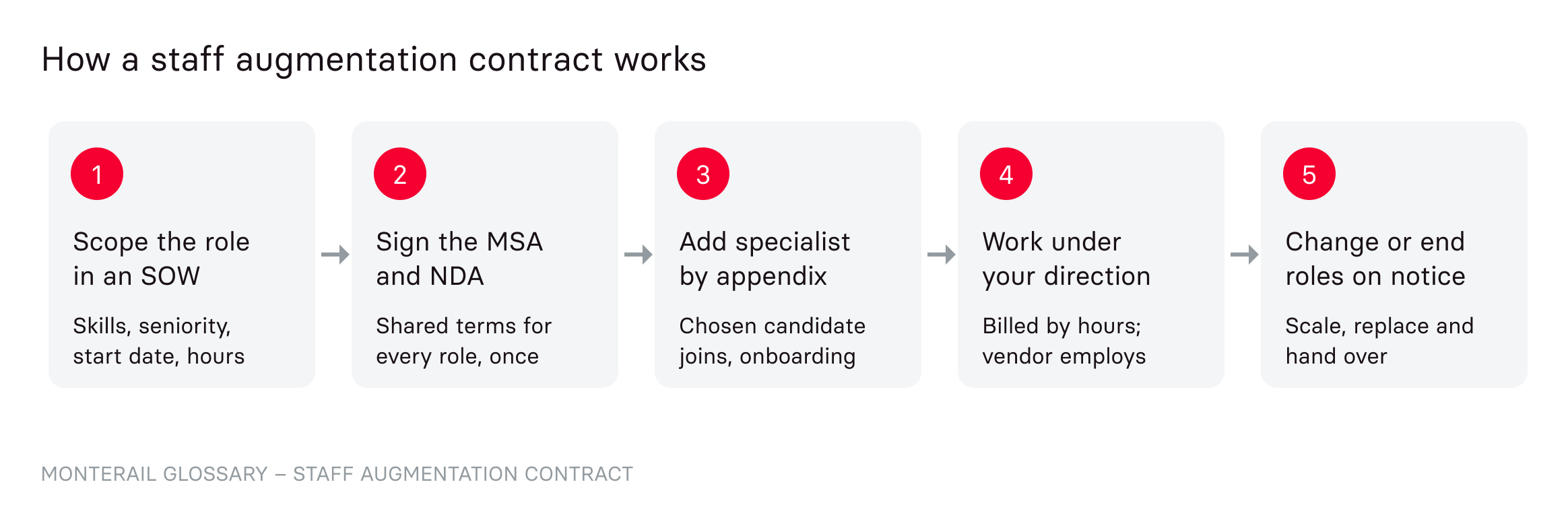
A staff augmentation contract runs in five stages, from scoping the first role to ending or scaling the engagement.
Scope the role in an SOW. The client describes the gap: the skills, seniority, start date and expected hours. This becomes the Statement of Work for that role.
Sign the MSA and NDA. The framework agreement sets the terms that apply to every role, such as confidentiality, liability, and IP. It is signed once.
Add each specialist by appendix. When the client picks a candidate, the vendor adds that person to the contract. Access setup and onboarding start from there.
Work under the client's direction. The specialist follows the client's priorities and processes. Billing runs on hours worked, and the vendor handles pay and time off.
Change or end roles on notice. Roles are added or released under the notice terms. If a specialist leaves, the replacement clause applies, and the specialist provides a handover.
Should You Choose a Staff Augmentation Contract or a Project-Based Contract?
Choose a staff augmentation contract when you want to direct the work yourself, and a project-based contract when you want the vendor to deliver a defined result. The software development outsourcing contract guide covers project contracts clause by clause.
Factor | Staff augmentation contract | Project-based contract |
Who directs daily work | The client's leads | The vendor's team, against the agreed scope |
What you pay for | Hours worked by each specialist | Delivery of scope, on fixed price or time and materials |
Who answers for delivery | The client | The vendor, against acceptance criteria |
Scope changes | No contract change needed: the client reprioritizes | Go through change management |
Scaling | Add or release people per role by appendix or notice | Renegotiate scope, team or budget |
IP ownership | Assigned to the client if the contract says so | Assigned to the client if the contract says so |
Challenges to plan for: With staff augmentation, delivery risk stays with you, so the contract protects you mainly through replacement terms and IP assignment. Your leads also spend time onboarding and reviewing code for every new specialist.
How Does Monterail Approach Staff Augmentation Contracts?
Monterail keeps one framework agreement and adds people to it role by role.
The setup is a Master Services Agreement with a Statement of Work per role, B2B and under NDA. Each specialist is added by appendix, so terms can differ from role to role. Clients pay for the hours the chosen people work, with no separate placement fee and no minimum engagement. Most roles run full-time for three, six, or twelve months.
The client owns the roadmap and daily direction. Monterail handles pay, time off, feedback, and growth for each specialist, and EU-only staffing is available on request. Before signing, a Monterail tech lead runs the technical interview, and the client meets three or four vetted candidates. See how Monterail's staff augmentation works.
When Should You Bring In a Staff Augmentation Partner?
A partner helps when you need a hard-to-hire skill quickly, and your leads can direct the work. It also helps when you want one contract that covers several roles over time. For the model itself, see staff augmentation.
Monterail's IT staff augmentation services place vetted mid- to senior-level engineers across web, mobile, AI, and design roles. Talk to our team about the role you need to fill.
FAQ About Staff Augmentation Contracts
Need expert help with Staff Augmentation Contract?
Monterail builds custom software solutions that leverage the latest technologies. Let's discuss how we can help with your project.
EXPLORE STAFF AUGMENTATION SERVICESEXPLORE STAFF AUGMENTATION SERVICES