Nowy standard. Twoje centrum tworzenia inteligentnego, szybkiego i zrównoważonego oprogramowania AI
Spis treści
Software estimation is an educated guess about a product's timeline and budget that will change as new information emerges. It isn't blind guessing, and it isn't a promise either.
At Monterail, one of the ways we use is to estimate in two stages: a quick ballpark estimate during the first conversations, and a full estimate after discovery workshops.
Below, we explain what goes into each, what you should get at the end, and why the cheapest quote on your desk is rarely the cheapest product.
Executive Summary
A software estimate is a hypothesis about cost and time, accurate only within the information available when it's made.
A ballpark estimate gives you a rough budget and timeline range within days of a first conversation, so you can decide whether to keep talking to a vendor.
A full estimate comes after discovery workshops and breaks the work down by role, phase and scenario (optimistic and pessimistic).
Treat both as tools for decisions, not fixed prices, and judge a vendor as much by how they estimate as by the number they give you.
Why Does a Software Estimate Matter Beyond the Number?
A software estimate tells you roughly what your product will cost and how long it will take, but it also shows you how a potential tech partner thinks. When you bring your idea to a software company like Monterail, the estimation process lets you see:
how the vendor works and communicates,
whether there's a culture fit,
how much they know about your industry,
who your future team members might be.
After you receive the numbers, ask yourself whether you're comfortable with them, and, more importantly, whether you want to work with the people behind them. Without that fit, you probably won't use outsourcing to the fullest.
What Is a Ballpark Estimate in Software Development?
A ballpark estimate is a rough, early range for a software project's budget and timeline, based on a high-level scope and the vendor's experience with similar projects. It isn't a feature-by-feature breakdown, and it doesn't need to be. Its job is to tell both sides whether the project is worth exploring further, and whether, when and with whom it could start.
Even if you've drafted a detailed scope, the team still needs to check it against your timeline, budget and business context. That's why the first conversations focus on questions that shape the estimate more than the feature list does:
Question | How the answer changes the estimate |
|---|---|
Who's your audience? | A broad consumer audience hits edge cases far more often than a niche B2B app, so it needs more testing and user-flow analysis. It also tells us how much weight design should carry. |
What business problem are you solving? | It decides which features are core and come first, and what research and benchmarking we need. |
What services do you need? | Starting from scratch usually means heavy design involvement. The mix of designers, developers, QA and product people decides team composition and which leads we pick. |
Do you have a hard deadline? | A funding round or a seasonal launch sets milestones. To hit the date, we adjust team size or, more often, the scope. |
What's your budget? | A tight budget means reusing components and choosing proven solutions; a bigger one allows a richer feature set and code structured for long-term support. We'd rather compromise on scope than on quality. |
Is there a technical person on your side? | A CTO or technical product owner can review our technical choices. If there isn't one, our tech leads make those calls and explain them in plain language. |
A business analyst then translates your answers into a very high-level technical spec and will usually come back with many follow-up questions. The result is a high-level scope (if you didn't have one), a ballpark based on similar projects we've delivered, and a list of assumptions, such as technology choices or team size, for you to confirm. Both a technical and a business person review it, so it's as accurate as it can be at this point.
How Is a Ballpark Estimate Different From a Full Software Estimate?
The two estimates answer different questions at different stages of the sales process. A ballpark helps you decide whether to keep talking; a full estimate helps you plan and budget the work.
Ballpark estimate | Full estimate | |
|---|---|---|
When | After the first conversations | After discovery workshops |
Input | Your brief, answers to discovery questions, past projects | Detailed scope breakdown, design artifacts, technical decisions |
Output | Rough budget and timeline range, plus assumptions | Hours and budget per role, optimistic and pessimistic scenarios, phases, roadmap |
Who prepares it | Business analyst with a technical reviewer | Designer, frontend and backend developers, business analyst |
Use it to | Decide whether to go further with a vendor | Plan budget, milestones and the first releases |
The gap between the two is normal. Steve McConnell's Cone of Uncertainty shows that at the initial concept stage, even skilled estimators can be off by a factor of four in either direction, and that range narrows only as decisions about the product get made. A feature-by-feature budget at that stage would be mostly guesswork.
What Happens in a Discovery Workshop Before the Full Estimate?
Discovery workshops are where the scope becomes concrete enough to estimate in detail. On every project we've worked on, the scope changed once we sat down and talked through the details. Once the ballpark meets your expectations and you like how we work, we set up product discovery workshops.
For a new product, they typically take two to three days, held in person at our office or run remotely. Ideally, the people who will build your product join: a tech lead, developers, a designer if needed, a business analyst and, for parts of it, a project manager. You'll also meet your account manager, who looks after your business context and passes it on to the team.
During the workshops, we go deep into how each feature should work, discuss the technology, and agree on the MVP. Afterward, we deliver the design artifacts we agreed on and make the key technical decisions. The exact output differs from project to project because it's shaped around your business problem.
What Does a Full Software Estimate Include?
A full software estimate breaks the work down by role, scenario and phase, so you can see where the budget goes and what you get when. For new products, the estimation team usually includes a designer, frontend and backend developers, and a business analyst.
Every estimate comes in two scenarios. The optimistic one assumes everything goes smoothly, with no surprises or changes. The pessimistic one assumes new information emerges along the way and some features turn out harder to deliver. Both are educated guesses, not promises: experience and careful analysis narrow the range, but they can't remove it.
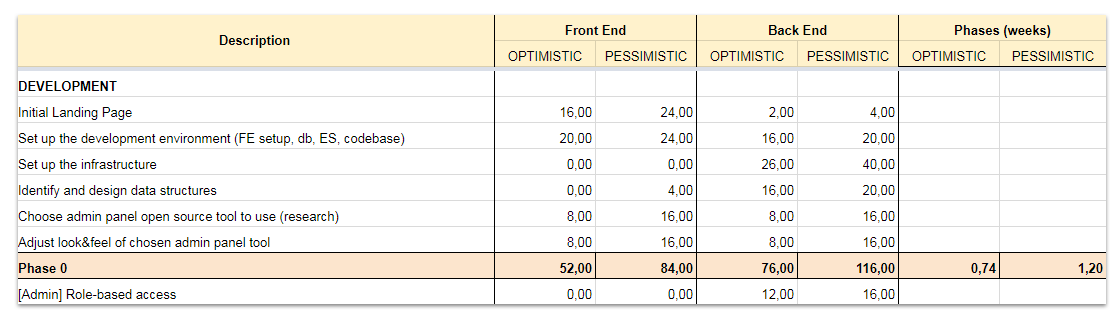
A part of the estimation sheet.
The estimate also splits the work into milestones. Phase 0 covers setting up environments and other prep work; you rarely see it directly, but development can't start without it. Phase 1 usually covers the core features that make up your unique value proposition. Later phases are "baskets of features" planned for their own time periods.
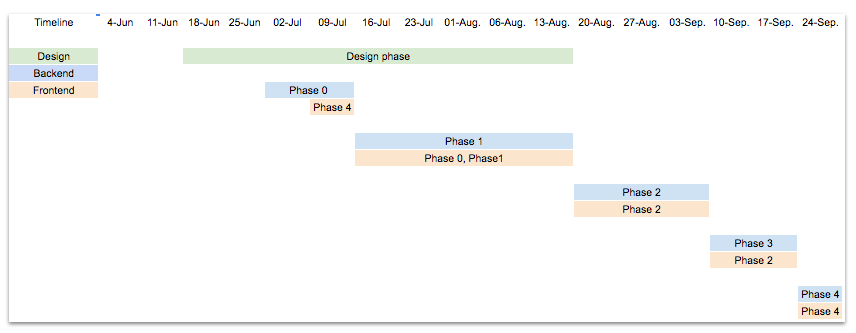
High-level project phases presented on a simple timeline.
All in all, your full estimate should include:
optimistic and pessimistic hour ranges for developers, designers, QA, project managers and business analysts,
an optimistic and pessimistic budget for the team,
time and budget for team meetings such as standups, planning and reviews,
the product scope divided into phases,
a roadmap for the product.
We generally don't estimate in detail further than about six months ahead. In agile development, user feedback and new information keep changing the scope, so a detailed plan for month twelve would mislead more than it helps. The roadmap is there to inform, and we check it against reality as we go.
Why Do Software Estimates Change, and Why Is the Cheapest Quote Rarely the Cheapest?
Software estimates change because a product's full complexity only becomes visible during development. New information, user feedback and market shifts will change both where you end up and how you get there. That's inconvenient for budgeting, but it shouldn't scare you off. An estimate that pretends nothing will change is the bigger risk.
We lose some leads to cheaper offers. That doesn't mean their product ends up costing less. A low quote often comes from a shallow look at the business problem, and it tends to show up later as unplanned costs, missed deadlines, and a team building features to match a number instead of what users need. When you compare quotes, compare the assumptions and the scope behind them, not just the totals.
Key Takeaways
A software estimate is a hypothesis about cost and time, not a fixed price.
A ballpark estimate tells you whether to keep talking; a full estimate tells you how to plan.
Early estimates can be off by a factor of four in either direction, and the range narrows only as decisions get made.
Ask for optimistic and pessimistic scenarios broken down by role and phase.
Compare the assumptions behind competing quotes, not just the totals.
How Should You Use a Software Estimate When Choosing a Development Partner?
A good software estimate comes from understanding your business problem first and counting features second. Use the ballpark to decide whether a vendor is worth a deeper conversation, use the full estimate to plan your budget and phases, and expect both to evolve as you learn. If you'd like a realistic ballpark for your product, and a team that will tell you where the scope should bend to fit your budget, get in touch with Monterail.
Software Estimation FAQ

Grzegorz Hajdukiewicz
Chief Delivery Officer

With over a decade of experience in the IT industry, Grzegorz has a proven track record of delivering complex projects on time and on budget. At Monterail, he leads a team of dozens of developers, designers, project managers, and business analysts, ensuring the successful delivery of software solutions for clients worldwide. Passionate about agile methodologies and continuous improvement, he constantly seeks new ways to optimize the delivery process.