The New Default. Your hub for building smart, fast, and sustainable AI software
Table of Contents
and 6 more
Custom software development costs anywhere from $8,000 to $1.2 million and up in 2026. Both ends of that range are real prices for real projects.
A single-platform mobile app with read-only content and a minimal backend starts around $8,000. An enterprise AI platform with custom MLOps pipelines and automated retraining passes $1.2 million.
That spread is so wide that generalized ‘average software project’ estimates are useless. A better approach is to reconstruct your own number from the five variables that produce it:
complexity tier,
platform and product type,
team location,
compliance load,
post-launch ownership.
Executive Summary
Software cost depends on at least five variables, and most budget overruns happen because a team priced only one of them.
The complexity tier sets the base cost. Platform choice sets the hours. Team location converts hours into dollars.
Compliance changes both the hours and which regions you can legally hire from, and post-launch ownership adds 15% to 30% of the build cost every year afterward.
To stay on budget, price all five before signing, and use the discovery phase to remove financial risk.
This article gives you the current numbers by project type, the drivers that move them, and an honest account of what AI does and does not do to the total.
How Much Do Different Types of Software Development Projects Cost in 2026?
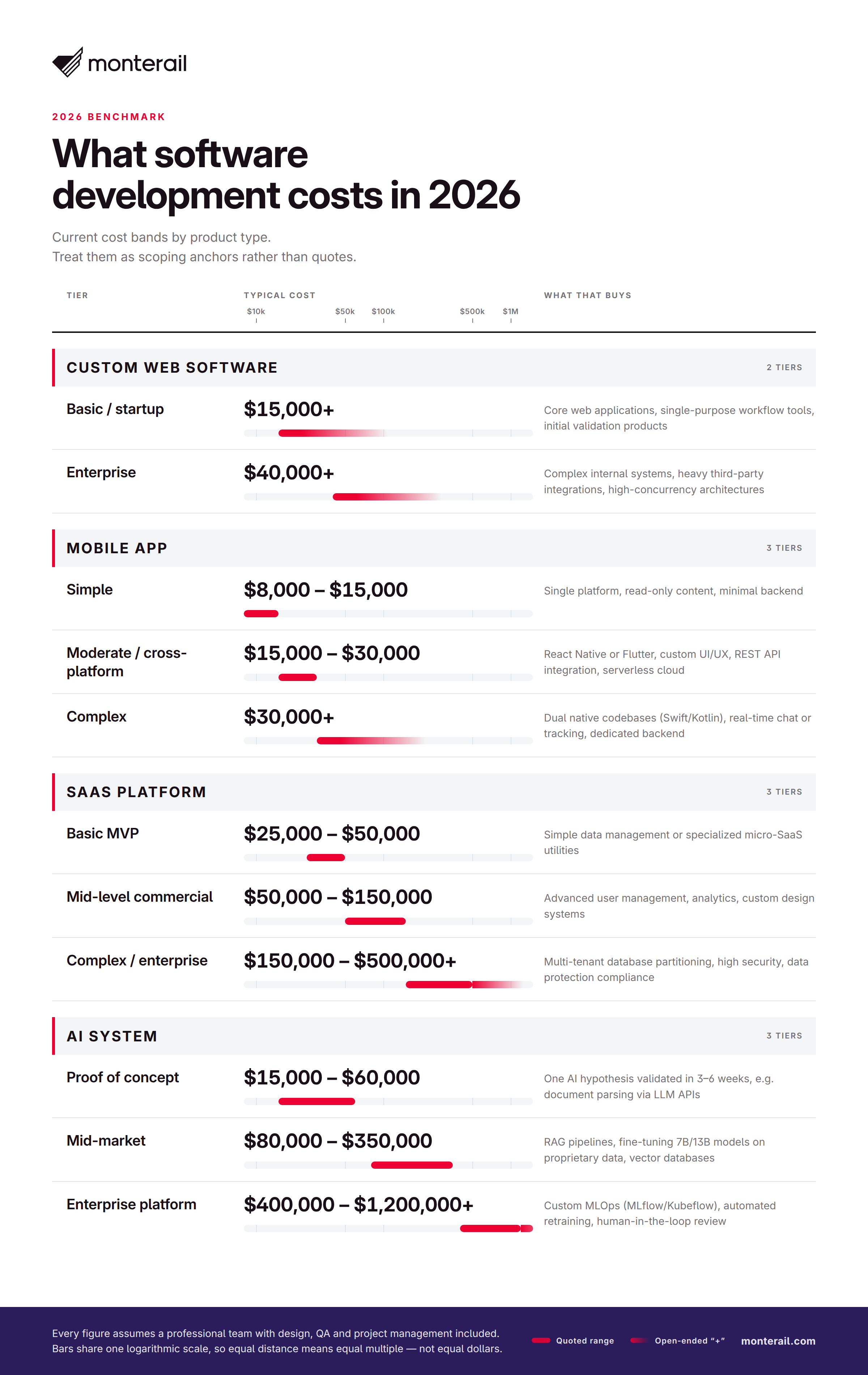
The table below collects current cost bands by product type. Treat them as scoping anchors rather than quotes. Every figure assumes a professional team with design, QA, and project management included.
Why the Same Software Product Idea Can Cost $50,000 Here, and $500,000 Elsewhere
A simple MVP may be built cheaply, but change it to a compliance-heavy build with the same feature list and you get 10x-20x higher costs.
For example, consider a scheduling app that suddenly has to process patient data. Add HIPAA scope and you have added audit logging, access controls, encryption at rest and in transit, a business associate agreement, and a documentation trail, all on top of the same scheduling app feature set.
This happens because the software project cost variables compound. It’s not X + Y, it’s X times Y. A rough model of making a detailed estimate could look like this:
cost = (fixed rate × safety factor × technical complexity) + (compliance and integration surface) + (maintenance, priced separately by hours)
To use the same scheduling app example, if you choose cross-platform over parallel native builds, your hours drop. Depending on where your team is located, the cost of those hours can be wildly different.
Compliance changes both the hours and restricts which regions you can safely hire from, which increases the rate you are multiplying by. One strategic decision at the top of the chain moves the bottom line much more than just adding one or two more features.
Legacy replacement projects sit outside this model entirely and are almost always priced time and materials, because nobody can scope work against an undocumented system before opening it.
Costs of Custom Web Software and General Development
Custom web software covers bespoke internal tools, platforms, and portals. Systems that replace aging internal ops tooling or a mountain of unmanageable spreadsheets.
Basic builds for startups and small companies start around $15,000. Enterprise-grade internal systems with heavy integration and concurrency requirements start at $40,000 and climb from there.
Integration with legacy data is where the money actually goes. Engineers spend weeks reverse-engineering undocumented systems and mapping incompatible data structures before they write a line of new business logic.
The most common budget mismatch here is when an ambitious small company scopes an enterprise-shaped system on a startup-shaped budget. The fix is a discovery phase good enough to tell you which pricing model is honest for your project.
Web product type | Typical cost | What that buys |
|---|---|---|
Basic / startup | $15,000+ | Core web applications, single-purpose workflow tools, initial validation products |
Enterprise | $40,000+ | Complex internal systems, heavy third-party integrations, high-concurrency architectures |
Costs of Native and Cross-Platform Mobile App Development
The ‘native or cross-platform?’ decision is a huge cost lever in mobile development. Building with React Native or Flutter cuts frontend engineering hours by 30% to 45% compared with running two parallel native builds, because one codebase serves both iOS and Android.
However, cross-platform is not always the best solution. Complex platforms with heavy real-time features or deep hardware access will require dual native codebases in Swift and Kotlin, which is why that tier starts at $30,000 rather than $15,000.
Estimate mobile from the bottom up, by feature. Authentication, payments, chat, and AI features each carry a recognizable cost signature, and adding them up produces a defensible number faster than arguing about a total.
App Store and Play Store fees are a rounding error in your budget. Due to forced annual OS release cycles, expect ongoing QA and maintenance costs to accumulate.
Mobile product type | Typical cost | What that buys |
|---|---|---|
Simple | $8,000 – $15,000 | Single platform, read-only content, minimal backend |
Moderate / cross-platform | $15,000 – $30,000 | React Native or Flutter, custom UI/UX, REST API integration, serverless cloud |
Complex | $30,000+ | Dual native codebases (Swift/Kotlin), real-time chat or tracking, dedicated backend |
Costs of SaaS Platform Development
Multi-tenant products follow different cost logic than one-off builds. The main cost driver is backend and business-logic complexity, specifically multi-tenancy, billing, and role management, rather than anything in the interface layer.
A basic SaaS MVP handling straightforward data management runs $25,000 to $50,000. Mid-level commercial SaaS with sophisticated user management, advanced analytics, and a custom design system runs $50,000 to $150,000.
Complex and enterprise SaaS, the CRM and accounting-software end of the market, runs $150,000 to $500,000 and beyond. That tier is where multi-tenant database partitioning and data protection compliance stop being features and become the architecture.
Budget for hosting and maintenance from day one. In SaaS they are a recurring percentage of build cost that arrives every year whether or not you planned for it.
SaaS product type | Typical cost | What that buys |
|---|---|---|
Basic MVP SaaS platform | $25,000 – $50,000 | Simple data management or specialized micro-SaaS utilities |
Mid-level commercial | $50,000 – $150,000 | Advanced user management, analytics, custom design systems |
Complex / enterprise | $150,000 – $500,000+ | Multi-tenant database partitioning, high security, data protection compliance |
Costs of AI and GenAI Systems (RAG, LLMs, and ML Pipelines)
Before you estimate any costs, define whether you’re building an AI feature or an AI-native product, because they are different projects entirely.
A proof-of-concept sprint that validates one hypothesis, such as document parsing through LLM APIs, costs $15,000 to $60,000 and takes three to six weeks.
A mid-market production system with RAG pipelines, fine-tuning on proprietary data, and vector database infrastructure runs $80,000 to $350,000.
An enterprise AI platform with custom MLOps pipelines, automated retraining cadences, and human-in-the-loop review starts at $400,000 and passes $1.2 million.
Applied AI does not mean training a frontier model. The $100 million training run is somebody else's business. Your project sits on top of existing foundation models, which shifts the cost structure away from pure developer hours and toward data curation, token processing, and vector database infrastructure.
Two cost items often go missing in these estimates: inference cost and retraining cadence. Both recur, both scale with usage rather than with your team, and neither shows up in a build estimate.
Compliance overhead under HIPAA, GDPR, or SOC 2 can add tens of thousands before anyone touches a model. Ask for the three-year number.
AI product type | Typical cost | What that buys |
|---|---|---|
Proof of concept | $15,000 – $60,000 | One AI hypothesis validated in 3–6 weeks, e.g. document parsing via LLM APIs |
Mid-market | $80,000 – $350,000 | RAG pipelines, fine-tuning 7B/13B models on proprietary data, vector databases |
Enterprise platform | $400,000 – $1,200,000+ | Custom MLOps (MLflow/Kubeflow), automated retraining, human-in-the-loop review |
What Actually Drives a Software Project Budget Up or Down
Eleven variables account for most of the variance between a quote and a final invoice. Four of them cause most of the damage.
Feature volume and depth - The most direct driver. Each feature needs design, code, tests, and maintenance forever
Team composition - The largest direct expense. Moves with geography, seniority, and whether you staffed architects and QA
UI/UX sophistication - Off-the-shelf components are cheap; bespoke animations and custom design systems raise design and frontend hours together
Third-party integrations - Each API adds auth, data mapping, and error handling, plus licensing fees and exposure to breaking changes
Engineering architecture - A monolith is fast and cheap for an MVP; microservices for millions of users need senior hours upfront
Technical debt and rework - Cut corners now and future budgets go to refactoring instead of revenue features
Requirement volatility - Scope creep is a leading cause of overruns. Every pivot rewrites code, redoes layouts, and recreates test cases
Legacy systems and data - Reverse-engineering undocumented code and migrating millions of records is specialized, slow work
Concurrency and performance - Every additional nine of uptime raises infrastructure and engineering cost non-linearly
Security and compliance - HIPAA, PCI-DSS, and GDPR add access controls, encryption, scanning, and audit prep
Infrastructure and DevOps - CI/CD, staging and production environments, and cloud bills that grow with your user base
Beware of volatile requirements. When requirements change from meeting to meeting and nothing is ever certain in the long-term, estimates need to be re-done.
A clear product vision and a change-management process are cheaper than any engineering optimization you can buy.
Legacy integration is often underestimated as a future cost. Greenfield work is predictable, but excavating a rusty old codebase is not, which is why experienced partners insist on time and materials for this kind of work.
Compliance doesn’t increase your workload so much as it does constrain your architecture, hiring, and documentation all at once.
Early architectural decisions affect your cost base for the longest. Over-engineer your product and you pay for scale you never reach. Under-engineer and you pay to rebuild at exactly the moment your growth starts taking away.
What AI Actually Does to a Software Budget
AI roughly doubles coding speed and does not halve project cost. That gap is the central finding of what is probably the largest dataset anyone has on the question.
Jellyfish, an engineering observability company, tracks the software development lifecycle across roughly 20 million pull requests from 200,000 engineers at 700 companies. Nicholas Arcolano, the company's head of research, described the pattern on The New Default podcast:
Coding speed has roughly doubled with AI adoption, while measurable business output has barely moved.
The reason is that coding is one stage of a much longer process. As Arcolano puts it, there is the first 90% and then the second 90%, and the second 90% is sales enablement, marketing, roadmap adaptation, and everything else that has to change before faster code becomes faster business.
"You can code a lot faster," he says, "but it doesn't mean that your road map is adapted. It doesn't mean your sales process is adapted."
For budgeting purposes: discount the build line only.
AI Is Spiky, So Discount Some Hours and Not Others
Model performance is uneven in ways that map directly onto your cost lines. Verbose, highly structured languages with enormous training corpora, Python and JavaScript in particular, are where the tools are strongest. Infrastructure work is where they are weakest.
Arcolano reports that the infrastructure engineers he talks to tell him the models are bad at writing Terraform, and that the data supports them: safe infrastructure code depends on knowing how your specific servers are set up, and that knowledge was never in the training corpus.
So discount application code hours. Hold DevOps, infrastructure, and platform hours roughly flat. A vendor applying a uniform AI discount across every line of an estimate is either not measuring or not telling you.
Legacy Sprawl Now Costs You Twice
The teams getting real value are the ones that fixed their context and environment problems first, and those are the same problems that made life hard for human developers: sprawling repositories nobody can map, interconnection rules that live in two senior engineers' heads, and deployments that are brittle enough to be scary.
"If you accelerate the machine, all of those flaws are just amplified," Arcolano says. Set a developer up with full context and a safe environment where the tests run and deployment is easy, and both a human and an AI will succeed. Leave the potholes in the road and you have to either fill them or write enough context that an agent knows to drive around them. There are no shortcuts.
The budget consequence is sharp: a messy legacy codebase raises your build estimate the old-fashioned way, and it also disqualifies you from the AI speedup a cleaner codebase would earn. Arcolano's summary of the tooling is worth carrying into vendor conversations: "We're driving cars that don't have seat belts yet. You've got to make your own seat belts."
Execution Got Cheap, So Spend Moved Upstream
"Ideas were cheap and execution was hard," Arcolano says. "Now execution is cheap." The practical effect is that cost moves toward the front of the process. If every developer is twice as effective, the constraint becomes deciding what to build, which raises the question Arcolano poses directly: do you now need twice as many product people and designers?
For anyone planning a 2026 budget, that means discovery, product thinking, and design deserve a larger share than they got in 2023, and prototyping becomes the cheapest risk-removal tool available.
Prototyping, PoC, or MVP? Choosing the Right Validation Step
The most reliable way to control software cost is to spend a small amount proving the expensive thing will work. These three steps answer different questions and are not interchangeable.
Step | Question it answers | Typical use | Output |
|---|---|---|---|
Rapid prototype | Should we build this at all? | Corporate innovation, abstract concepts, stakeholder alignment | A 4-week Go/No-Go decision, made visually, before a six-figure commitment |
Proof of concept | Can this actually work technically? | High-risk technical areas, especially AI and LLM behavior on real company data | Evidence that the risky component performs, at $15,000–$60,000 for AI scope |
MVP | Will people pay for it? | First commercial release | A revenue-generating, production-ready product on scalable technology |
Monterail's rapid prototyping runs on a four-week Go/No-Go format, which lets an enterprise team test an abstract idea visually before allocating a six-figure budget to it.
A PoC is deliberately cheap and deliberately narrow, and in AI work it should run against your real data, because LLM behavior on a clean demo dataset tells you very little about LLM behavior on yours.
An MVP is a production release built on technology that will still be there in three years, such as Ruby on Rails or Vue.js.
The Hidden Costs of Enterprise Software
Total cost of ownership is where initial estimates and reality separate. These items are predictable, routinely omitted from first quotes, and the source of most mid-project escalations.
Quality assurance accounts for 20% to 25% of total development hours. Skipping it upfront does not save that money, it defers it into rework at a worse exchange rate. Product design typically accounts for 15% to 25% of the build budget and is a primary driver of user retention, which makes it one of the few line items with a direct revenue argument attached.
Post-release maintenance for apps and SaaS runs 15% to 20% of the initial build cost annually. Once you add model retraining and compliance monitoring, total post-launch ownership commonly reaches 15% to 30% per year. For AI deployments, inference costs alone (LLM tokens, GPU cloud, vector database hosting) mean a 24-month TCO routinely lands at 1.6x to 2.2x the initial build cost.
Refactoring early and migrating deliberately, for example moving from Vue 2 to Vue 3 on a planned schedule, can save up to 3x in long-term maintenance compared with letting the debt compound. Building audit-ready documentation and security protocols into the code from day one costs far less than retrofitting them for a compliance review.
Token Economics, or The New Line Item on the Engineering Budget
Inference spend has become a meaningful portion of engineering budgets, and it behaves differently from everything around it. Engineering costs were historically fixed headcount, planned once or twice a year. As Arcolano describes the shift, you are now in a world where "you can spend almost infinite money if you like," and the real question is what that buys.
Enterprise buyers should also budget for the compliance premium. Open-source models have become highly capable, but Arcolano notes that enterprise uptake remains low, because it is simply easier to run models through a provider like Amazon Bedrock where the security posture and infrastructure already sit. Companies are paying a premium for that convenience, and it is a legitimate line item rather than waste.
Matching the Pricing Model to the Software Project
Fixed price works when scope is genuinely fixed. Tightly defined short-term MVPs and PoC sprints where timeline and deliverables are set before work starts.
It gives you budget certainty and gives the vendor an incentive to resist scope changes, which is either a feature or a problem depending on how confident you are in the spec.
Time and materials, or a dedicated team model, fits mid-market and enterprise builds that evolve through user testing and agile sprints. It also fits any legacy replacement project, because you cannot fix-price an excavation.
The cheapest fixed-price quote in your inbox is usually the one with the least discovery behind it. The price is low because the risk has not been found yet, and it will surface later as a change order.
Phased rollouts control the same risk from the other direction. Launch the core feature set, validate product-market fit, and only then allocate capital to secondary features. Every phase boundary is a chance to stop spending on something that is not working.
Choosing a Software Partner, And What to Evaluate Beyond the Hourly Rate
Hourly rate is the least informative number in a vendor comparison, because it tells you nothing about how many hours the work will take. Two older signals still hold.
Technical depth should be externally verifiable, through open-source contributions and certified partnerships such as official Vue and Nuxt partner status, which can be checked rather than asserted.
Delivery predictability and client satisfaction, measured through something like Net Promoter Score, matter because a partner who ships on a reliable cadence costs less than a cheaper one who does not.
One newer question deserves a place on the list: ask how the vendor handles repository context and deployment environments. Following the Jellyfish findings, that is the best available predictor of whether their AI tooling produces a real speedup on your project or just a faster path to messier code.
Key Takeaways
Complexity tier moves cost more than platform choice does, but platform choice moves timeline more.
Post-launch ownership, covering maintenance, retraining, and compliance monitoring, commonly runs 15% to 30% of build cost annually and belongs in the first budget conversation.
AI features carry a build-cost-to-TCO gap most quotes do not disclose. AI deployments routinely reach 1.6x to 2.2x the build cost over 24 months, so ask for the three-year number.
AI roughly doubles coding speed but does not halve project cost, and the discount only applies to application code, not infrastructure. A clean, well-documented codebase is what qualifies you for any of it.
The cheapest fixed-price quote is usually the one with the least discovery behind it, and that is where the real risk sits.
What Controls The Software Project Budget In 2026?
Sequencing is what controls a software budget. It means proving the risky thing cheaply before committing to the expensive thing, pricing all necessary cost variables instead of only the most obvious one, and choosing an architecture that matches your growth ambitions.
The Jellyfish data makes the same point about AI that experienced engineering leaders have always made about tooling. Speed comes from the system around the work, not from the tool in the middle of it.
Teams with clean context, reliable environments, and honest scoping compound that benefit. Everyone else buys faster tools and gets a faster version of the problem they already had.
Planning a web, mobile, or AI initiative? Stop guessing at your development runway. Bring your product roadmap to our technical architects and book a meeting to get a granular, defensible cost breakdown built around your actual infrastructure.
Custom Software Development FAQ

Grzegorz Hajdukiewicz
Chief Delivery Officer

With over a decade of experience in the IT industry, Grzegorz has a proven track record of delivering complex projects on time and on budget. At Monterail, he leads a team of dozens of developers, designers, project managers, and business analysts, ensuring the successful delivery of software solutions for clients worldwide. Passionate about agile methodologies and continuous improvement, he constantly seeks new ways to optimize the delivery process.