The New Default. Your hub for building smart, fast, and sustainable AI software
)
AI Cost Intelligence Platform for Construction Finance
A UK-based construction industry founder needed to replace decades of fragmented, spreadsheet-based cost management with a single, enterprise-grade AI platform designed to earn the trust of CFOs and board-level stakeholders. The development team delivered an interactive AI-powered prototype in two weeks and a fully functional MVP in three months, across 500 hours of focused development, with zero rework and no scope collapse.
)
The company and product
AI Cost Intelligence for Construction Finance
The client is a founder launching their first custom software product: a high-ambition, AI-powered cost-intelligence platform designed for large construction enterprises. Mission-critical software operates in a highly specialized, fragmented industry where workflows resist standardization and financial trust is non-negotiable.
Decades of accumulated operational knowledge had been trapped across spreadsheets, legacy tools, and siloed, stage-specific software that covered the full project lifecycle, with no unified system in place.
The engagement was initiated to codify that institutional expertise into a structured, scalable platform managing construction project finances end-to-end. From initial cost planning through final account settlement, without undermining the financial confidence of senior stakeholders who depend on it.
KEY CHALLENGES OF THE PROJECT
Translating institutional knowledge into software logic
Decades of experience-based commercial expertise existed only in spreadsheets, legacy systems, and the minds of long-tenured staff. Capturing that knowledge in a structured, queryable platform without losing its nuance was the foundational challenge.
AI integration in a high-trust environment
Introducing AI into construction finance carried significant risk. Distorted outputs from incomplete or poorly structured data could undermine executive confidence entirely. The product was being evaluated by CFOs and Chairmen who had seen overpromised enterprise AI fail before.
Balancing simplicity with commercial depth
The platform needed to be intuitive enough for everyday project users, while supporting the full complexity of cost planning, RFQ generation, purchase order workflows, and approval structures without falling into the over-engineered trap of incumbent tools.
End-to-end procurement and finance integration
The solution required seamless integration with clients' existing finance platforms, not all of which were designed with flexible or intuitive APIs, to eliminate manual reconciliation and duplicate data entry.
First-time founder scope management
With no prior custom software experience, the founder's ambitions had not yet been tested against real-world software constraints. Delivering within scope, on budget, and without reset required a structured delivery approach from day one.
OUR APPROACH
Delivery Process Built Around De-Risking
The project was delivered in three structured phases, designed to replace assumptions with evidence before a single line of production code was written.
Discovery & Architecture
The engagement began with framework-driven, hypothesis-first workshops designed to surface decades of operational knowledge and translate it into an actionable product specification. Each hypothesis was converted into a prototype feature; each prototype became a proof point. This phase established the architectural foundation and de-risked the scope before development began.
Design & Prototyping
Deep business analytics workshops replaced assumptions with evidence. Weekly iterations and trade-off discussions kept the vision grounded without shrinking it. The discovery phase was designed to feel like momentum. Prototypes were used to validate the product's complexity and to give both the founder and future stakeholders confidence in the product's scope and commercial logic.
Build
Advanced AI features were included in the first deployment. AI-assisted development accelerated iteration cycles throughout. The result was a fully functional product, ready for pilot, with comprehensive documentation, delivered without rework, resets, or scope collapse.
Strategic restraint during pilot preparation
The team identified that the founder's first prospective client was not fully utilizing its existing financial accounting software. The data inputs needed to power the AI layer were incomplete and inconsistently structured. Rather than proceed and risk producing misleading outputs, the team paused the AI rollout to protect the platform's long-term credibility and maintain board-level trust throughout the pilot period.
Collaboration model
The team maintained close alignment with the founder throughout the delivery process, translating a non-technical, industry-specific vision into a clear product structure and user experience. The founder confirmed the team's key strength was exactly this: the ability to make a complex domain legible to a software delivery process.
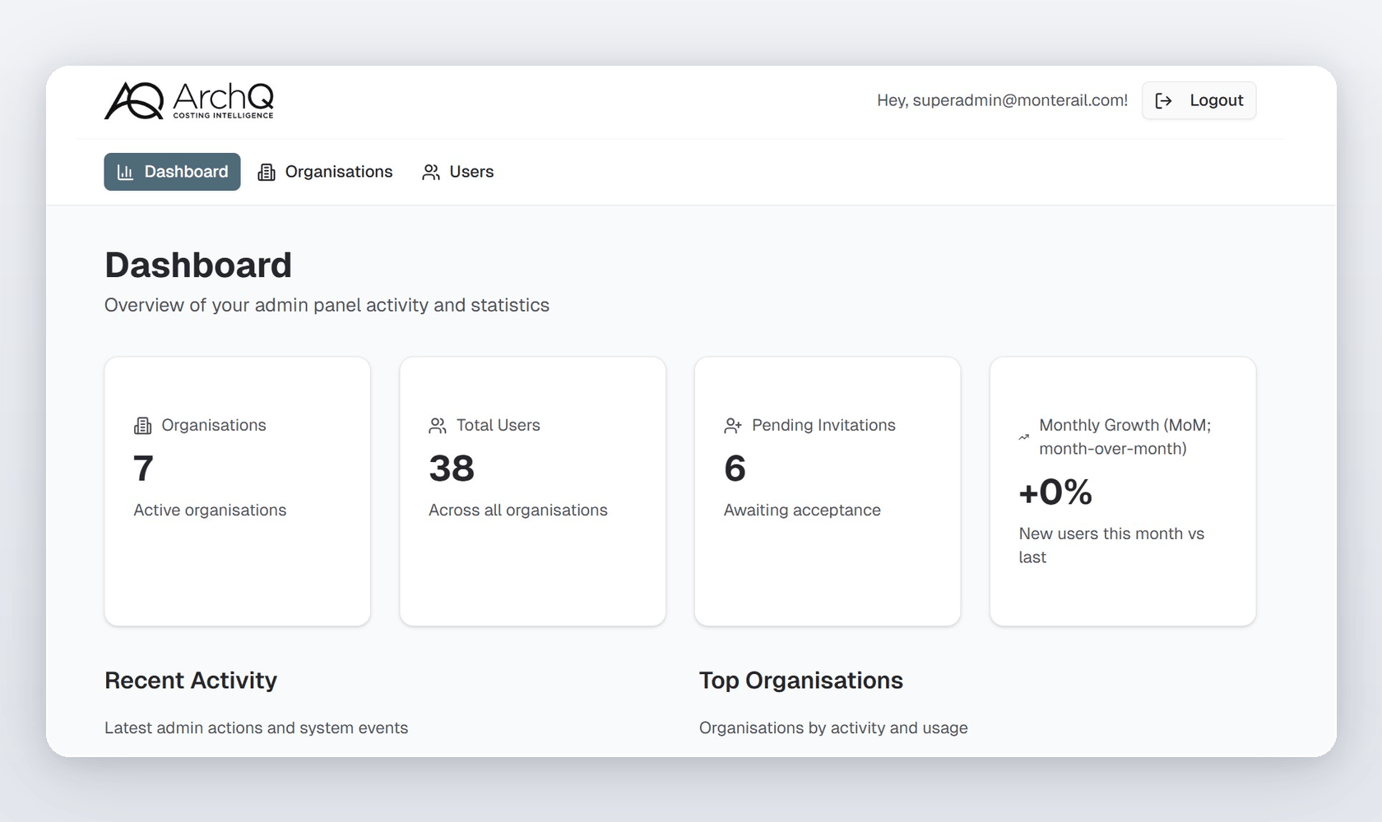
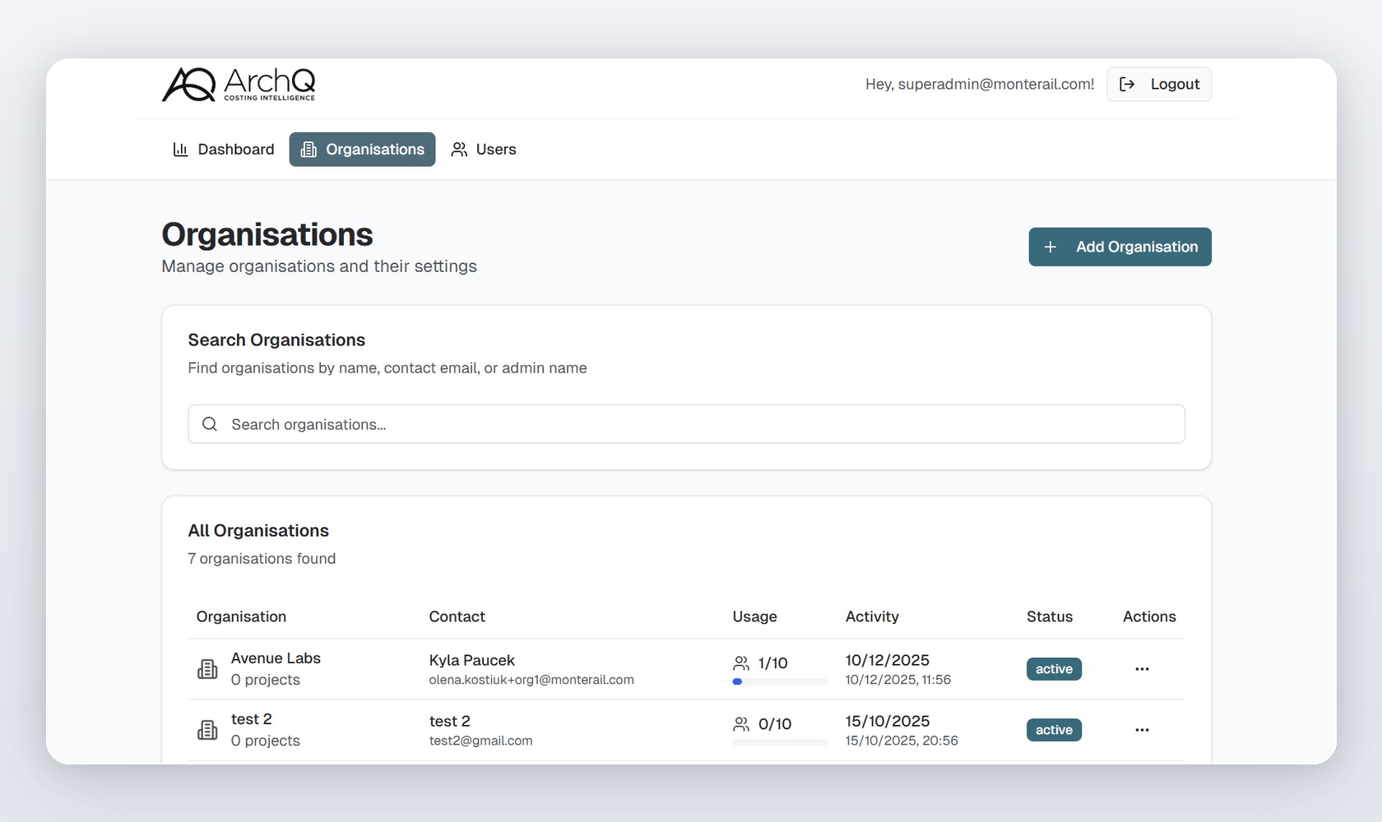
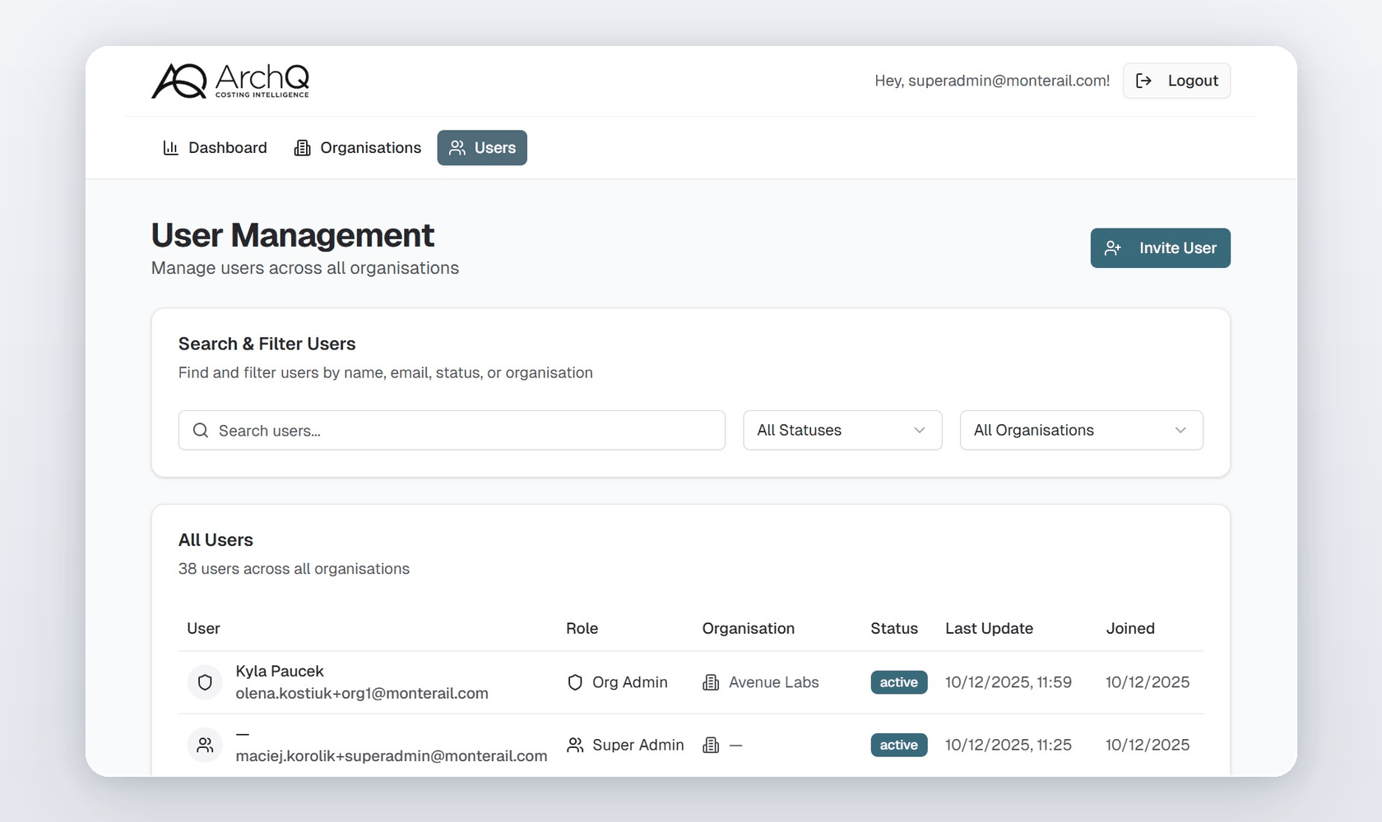
application functionalities
TECHNOLOGIES WE USED
| Layer | Technologies |
|---|---|
| Frontend | Next.js 15.4.8 (App Router), React 19, TypeScript 5, Tailwind CSS v4, Radix UI (via Shadcn UI), React Hook Form, Recharts (data visualization) |
| Backend | Vercel AI SDK v5.0.81 (AI orchestration), Next.js API routes (serverless functions), Supabase (PostgreSQL 15 + RLS), Zod v4.1.1 (runtime validation) |
| Database | Supabase (PostgreSQL 15, Row-Level Security), Private Supabase Storage for file uploads, JSONB for AI metadata storage |
| Cloud & DevOps | Vercel (hosting, CI/CD), GitHub Actions (deployment pipeline), Supabase CLI (local dev + migrations) |
| AI / ML | OpenAI GPT-4o-mini (primary model), Vercel AI SDK |
| Security | Supabase Auth (JWT + refresh tokens), Row-Level Security (RLS) policies, JWT-based RBAC (super_admin/admin/manager/qs), Private storage buckets, Server-only API keys, Organisation-scoped multi-tenancy |
THE RESULTS
From Prototype to Board-Approved MVP in 3 Months
Following a three-month development cycle, the project team delivered measurable outcomes:
An interactive, AI-powered prototype was delivered two weeks after project kick-off.
A fully functional MVP was delivered in three months, within a 500-hour development budget.
Zero rework was required following delivery, no reset, no scope collapse.
The platform successfully passed the initial pilot review at the CFO and board levels without disrupting existing financial workflows.
The founder confirmed full confidence in the product's underlying logic, citing the team's ability to capture and codify complex industry knowledge as a core delivery outcome.
CLIENT’S TESTIMONIAL
)

Deep industry understanding, delivered at speed
I was impressed with the speed at which Monterail was able to grasp a complex and niche industry and translate that into a clear and practical system structure. I have confidence in their understanding of both the product vision and commercial context.
KEY TAKEAWAYS
Readiness matters more than speed
Pausing the AI rollout during pilot preparation because the underlying data was incomplete protected the platform's credibility with the CFO and board-level stakeholders. The short-term delay prevented the kind of false signal that could have permanently discredited the system.
Legacy data is an asset, not a liability
Two decades of fragmented costing data, once structured and extracted, became the training foundation for the platform's ML layer. Treating historical knowledge as a future input for intelligence changes the economics of AI adoption in established industries.
Prototype before production eliminates rework at scale
Replacing assumptions with evidence during discovery before a line of production code was written, delivered a first-attempt prototype that required no rework. For first-time software founders, this approach is the difference between clarity of scope and scope collapse.
Sustainable simplicity for disciplined design
The platform had to serve everyday project users and CFO-level stakeholders simultaneously. Achieving that without over-engineering required sustained trade-off discipline throughout every sprint, not a one-time architectural decision.
THE DEVELOPMENT TEAM
About the Development Team
Monterail assembled a cross-functional team purpose-built for the challenge. Our business analysts mapped the domain, designers shaped the user experience, and frontend and backend developers brought it to life. The AI development team unlocked intelligent capabilities, while QA and project management kept quality and delivery on track. A complete team, from first insight to final release.

Read more case studies like this
show allshow all


Transforming HR strategies with AI innovation
Monterails' team of experts transformed HR analytics for Fortune 500 companies by integrating an AI-powered solution to analyze employee feedback and insights. The new system pinpoints key themes and sentiment in employee surveys, boosting HR efficiency and allowing teams to focus on strategic initiatives rather than manual data analysis.
Startup
USA
HR tech
AI integration
Mobile app development
Web app development


How Monterail Built an Enterprise-Ready Employee Recognition Platform for Cooleaf
Cooleaf partnered with Monterail in 2013 to build an MVP for what became a US employee recognition and rewards platform. Throughout the ongoing cooperation, Monterail migrated the platform from AngularJS to React Native Web, rebuilt the backend in Ruby on Rails, and added integrations, including Power BI. Cooleaf now serves 110,000 active users across 103 organizations in 6 regions, processing 7.8 million points per month, and was acquired by ITA Group.
Enterprise
USA
HR tech
Legacy modernization
Mobile app development
MVP development
React.js
React Native
Ruby on Rails

Want to build AI for high-stakes decisions?
We partner with companies to design, build, and scale digital products that solve real-world challenges just like we did in this case.
Grzegorz Hajdukiewicz | Chief Delivery Officer
Schedule a callSchedule a call