The New Default. Your hub for building smart, fast, and sustainable AI software
AI Automation Services
Outside expertise that puts AI models to work on the manual steps inside one business process.
What Are AI Automation Services?
AI automation services are engagements that hand repetitive, text-heavy steps of a business workflow to AI models. Examples include reading incoming documents and drafting first versions of reports. The work spans everything from choosing the workflow to running the automated version in production. People keep reviewing and handling exceptions, while the hours spent on manual processing drop.
Monterail has delivered 900+ projects since 2010 and runs AI automation in four stages: Diagnose, Prove, Ship, and Partner. Clients own everything the team builds.
What Do AI Automation Services Include?
An AI automation engagement covers one workflow, from checking whether AI suits it to running the automated version in production.
What it includes
A review of the workflow and its data that picks the highest-return use case, or concludes that AI is the wrong tool
A working prototype on your own data, validated with the people who will use it and benchmarked before a go or no-go decision
A production build connected to the systems the workflow already touches, such as an ERP or a document store
Validation steps that check model output before it reaches a customer or a downstream system
Monitoring and retraining pipelines, with security controls built into the production system
Documentation and training that let your team run the automation
Model updates and ongoing optimization after launch
What it doesn't include
Model usage fees and cloud hosting, which the providers bill
Licenses for third-party workflow or RPA platforms
Historical data that doesn't exist yet, since a model needs past examples to be tested against
Redesign of processes in departments the automated workflow doesn't touch
When Do AI Automation Services Fit?
AI automation fits a workflow where staff spend many hours reading and drafting, and where a person or a rule can tell a good result from a bad one.
It fits when
One workflow takes many staff hours to read and summarize information you already hold
A reviewer or a validation rule can check every output
You have past examples of the workflow to test a model against
The automation has to run inside systems you already use
It doesn't fit when
The task follows fixed rules on structured input. Rule-based tools or intelligent automation built on RPA handle it at lower cost.
A SaaS tool you already pay for ships the same AI feature, so switching it on gets you there sooner.
The software would have to choose its own next steps toward a goal. That calls for agentic AI and the guardrails that come with it.
Nobody can say where the workflow's data lives or who owns it, so a data audit makes a better first project.
What Are the Benefits of AI Automation Services?
AI automation services return staff hours from manual reading and drafting, and they show whether the automation works on your data before you spend production budget.
Budget follows evidence. A prototype on your data ends in a go/no-go decision, so production money goes only to automation that meets its benchmarks.
Hours return to the team. Drafting and first-pass categorizing move to the model, and staff spend their time reviewing and handling exceptions.
The automation runs where people already work. It connects to existing systems, so nobody has to adopt a new app to benefit.
Your team owns the result. The code and prompts stay with you, so a later switch of model or vendor doesn't turn into a rebuild.
Upkeep is planned from the start. Model updates and optimization continue after launch instead of waiting for something to break.
How Does an AI Automation Engagement Work?
A Monterail AI automation engagement runs in four stages: Diagnose, Prove, Ship, and Partner.
Diagnose (2–4 weeks). The team maps the workflow and the data behind it, then picks the use case with the highest return. If AI is the wrong tool for the job, this is the stage where the team says so.
Prove (4–6 weeks). A working prototype runs on your own data and is validated with the people who will use it. Performance benchmarks support a go/no-go decision before production work starts.
Ship (8–16 weeks). The team builds the production system and connects it to the tools the workflow already uses. Monitoring and retraining pipelines go in alongside the security controls, and handover includes documentation and training for your team.
Partner (ongoing). Models and prompts are updated as data and model versions change. Optimization continues, and the team supports scaling as the business grows.
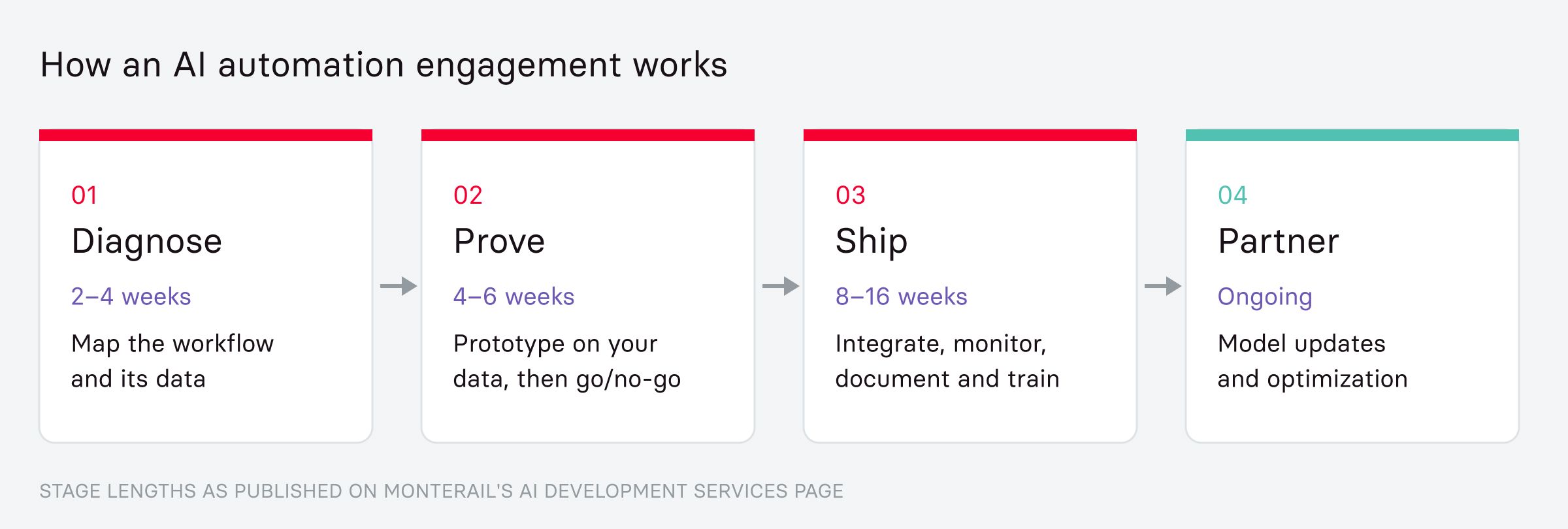
Stage lengths are published on Monterail's AI development services page.
Should You Build Custom AI Automation or Use AI Features in Your Existing Tools?
Build custom AI automation when the workflow spans several systems or follows your own rules, and use built-in AI features when one tool already covers the task.
Factor | Custom AI automation (built with a partner) | AI features built into existing SaaS tools |
Fit to the workflow | Built around your steps and review points | Designed for the vendor's typical customer |
Data control | You choose where data is processed, including private deployment | Data is processed on the vendor's infrastructure under its terms |
Time to start | Weeks of assessment and prototyping before production | Available once the feature is switched on |
Work across systems | Reads from and writes to several of your systems in one flow | Limited to the data inside that one tool |
Ongoing cost | Build cost, then model usage and maintenance | Included in, or added to, the subscription price |
Ownership | You own the code and prompts | The vendor owns the feature and can change or retire it |
Challenges to plan for: A Prove stage can end in a no-go, so treat its budget as the price of a decision instead of a down payment on production. The people who run the workflow today also need time for interviews and prototype testing, often during their busiest weeks.
How Does Monterail Approach AI Automation?
Monterail maps each workflow with the people who run it and proves the automation on client data before building for production.
Simfoni, a spend automation platform for large enterprises, wanted its customers to stop assembling spend reports by hand. A three-person Monterail team built a proof of concept that analyzes large spend datasets with Claude on AWS Bedrock and turns them into ready-to-send PowerPoint decks. A validation step cross-checks the model's numbers. Simfoni put it into its live product as Insights AI, and a report that took hours of manual work now takes one click.
Simfoni's Fortune 500 clients also spent 3 to 5 weeks per RFP cycle. Monterail interviewed 8 procurement leads to find where AI removes manual effort, then shipped four AI tools that worked inside existing workflows from day one. RFP drafting time fell by about 80% and manual categorization by 66%, with 12 weeks from discovery to production.
For Cooleaf, an employee engagement platform, enterprise clients spent 40 to 100 hours per account each quarter working through eNPS survey responses. Monterail built an LLM analysis layer into the platform, and manual analysis per account dropped to near zero.
When Should You Bring In an AI Automation Partner?
A partner helps when you know which workflow costs the most hours but nobody on the team has taken a model from prototype to monitored production. It also helps when the automation must connect to several internal systems. If your engineers can build the workflow and only lack AI experience, staff augmentation adds that skill to your team.
Monterail's AI automation services start with a short Diagnose stage that tells you whether AI fits before production budget is committed. Talk to our AI team about the workflow you want to automate.
FAQ About AI Automation Services
Need expert help with AI Automation Services?
Monterail builds custom software solutions that leverage the latest technologies. Let's discuss how we can help with your project.
EXPLORE WEB DEVELOPMENT SERVICESEXPLORE WEB DEVELOPMENT SERVICES