The New Default. Your hub for building smart, fast, and sustainable AI software
B2B SaaS Platform Development
Building subscription software sold to companies, where every customer is an organization with its own admins, users and settings.
What Is B2B SaaS Platform Development?
B2B SaaS platform development is building subscription software that businesses buy for their teams, with each customer company as a separate account. Beyond the core workflow, the platform needs company-level admin tools, roles, single sign-on and audit logs. It also needs billing per seat or contract, and integrations with the tools customers already use.
Monterail has delivered 900+ projects since 2010, including 12 years on Cooleaf, a recognition platform used by 103 organizations, among them Fortune 500 companies.
What Does B2B SaaS Platform Development Include?
B2B SaaS platform development covers the product plus everything a company needs to roll it out to its staff.
What it includes
An account model where each customer organization is a separate tenant, often with workspaces inside it
Roles and permissions per company, built on role-based access
Single sign-on through the customer's identity provider
An admin console where customer admins manage users and seats
Seat-based or contract-based billing and invoicing
Integrations with the tools customers already run, such as BI or HR systems
Audit logs and data export
Security audits and support for customers' security reviews
What it doesn't include
Formal certification audits such as SOC 2 or ISO 27001, which accredited auditors carry out
Sales and customer success operations
Cloud hosting fees
Separate code versions for individual customers, which multiply maintenance
When Does B2B SaaS Platform Development Fit?
B2B SaaS platform development fits when companies, not individuals, will buy and roll out your software.
It fits when
Your customers are organizations that buy seats or licenses for their teams
Buyers need admin control over their own users and data
Your product has to plug into systems your customers already run
You plan to sell to larger companies with procurement and security reviews
It doesn't fit when
Individual consumers sign up and pay with a card. A B2C product needs a lighter account model.
You serve one company only. That is internal or custom enterprise software.
You haven't confirmed that companies will pay for the workflow. A validation phase or an MVP comes first.
The value lies in a one-off data migration or integration. That is a project, not a platform.
What Are the Benefits of B2B SaaS Platform Development?
The main benefit is a product that passes procurement and grows with each customer, from a pilot team to a company-wide rollout.
Larger contracts. Seat-based plans grow as customers roll the product out to more teams.
Enterprise readiness. SSO and audit logs answer the first questions in security reviews.
Lower support load. Customer admins manage their own users and settings.
Stickier accounts. Integrations with a customer's systems make the product part of daily work.
One codebase for all customers. Configuration replaces per-client code, so every customer gets each release.
How Do You Build a B2B SaaS Platform?
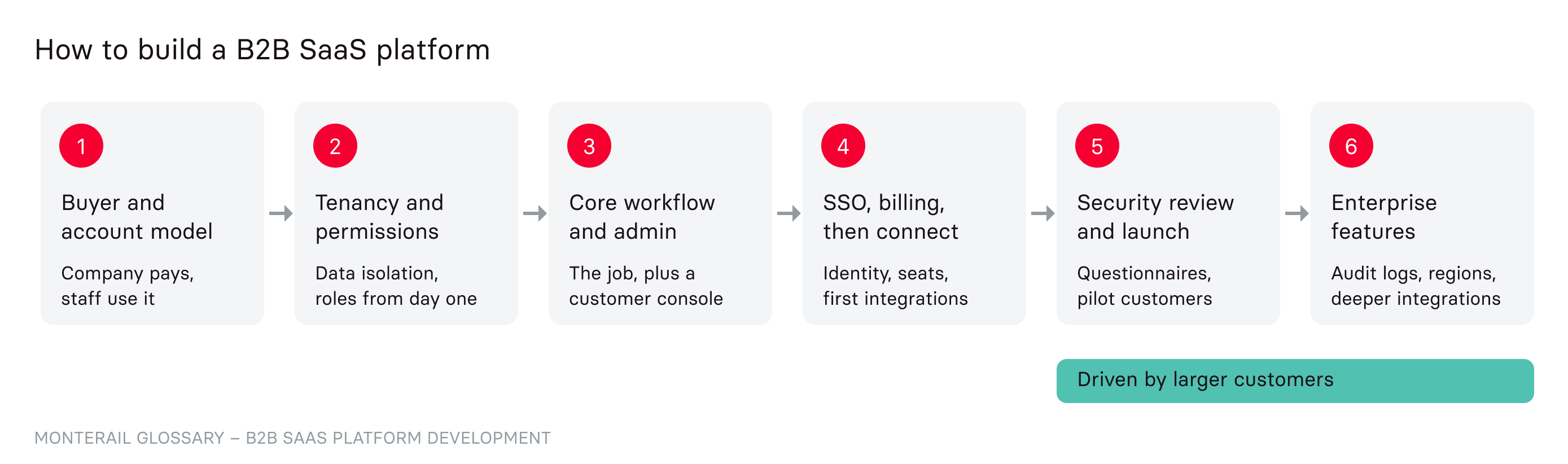
Building a B2B SaaS platform takes six steps, from defining who buys it to adding enterprise features as larger customers arrive.
Define the buyer and the account model. Separate who pays (the company) from who uses it (its staff). Decide how organizations and their users relate, with workspaces where teams need them.
Design tenancy and permissions. Choose how each company's data is isolated, using multi-tenant architecture. Define the roles customers will need from the start.
Build the core workflow and admin tools. Ship the job the product does for teams, plus a console for customer admins.
Add SSO and billing, then integrations. Connect identity providers and set up seat or contract billing. Then build the integrations your first customers ask for.
Pass security review and launch. Prepare for buyers' security questionnaires and audits, then roll out to pilot customers.
Expand with enterprise features. Add audit logs, regional hosting, advanced roles and deeper integrations as larger customers sign.
How Is B2B SaaS Development Different From B2C SaaS Development?
B2B SaaS is built for companies that buy for teams, while B2C SaaS is built for individuals who buy for themselves. The difference shapes the account model, the pricing and the security work.
Factor | B2B SaaS | B2C SaaS |
Buyer vs user | A company pays, its staff use it | The same person pays and uses it |
Sales motion | Demos, pilots, procurement and contract talks | Self-serve sign-up |
Account structure | Organizations with admins and many users | Individual accounts |
Pricing | Per seat or by annual contract | Monthly or annual plans per person |
Security demands | Security reviews and SSO | Standard account security |
Integrations | With customers' business systems | Mostly with consumer apps and payments |
Challenges to plan for: Enterprise customers ask for custom features, and saying yes in code instead of configuration splits the product. Security reviews also add weeks to every larger deal, so the evidence they need should be ready before sales asks for it.
How Does Monterail Approach B2B SaaS Platform Development?
Monterail builds B2B platforms to scale from first customers to enterprise accounts, with integrations and security treated as product features.
Cooleaf began in 2013 as an MVP and settled on white-labeled recognition and rewards software for corporate clients. To become enterprise-ready, it had to operate in several regions and onboard enterprise organizations, and new integrations such as Power BI had to work without hurting performance. Monterail worked with two teams, 17 people in total, and comprehensive security audits became a requirement for winning enterprise clients. Cooleaf now serves 103 organizations and was acquired by ITA Group in 2024.
SuitePad, which makes in-room hotel tablets, needed its platform connected to five major property management system (PMS) vendors, each with its own requirements and sometimes certification tests. Monterail built the backend integrations and helped coordinate with the vendors. SuitePad now has 90,000 licenses under contract.
When Should You Bring In a B2B SaaS Development Partner?
A partner helps when you need to reach enterprise readiness, such as SSO and security reviews, faster than your team can learn it. It also helps when integrations with customers' systems are blocking deals.
Monterail's web application development services cover B2B platforms from discovery to enterprise rollout. For architecture choices, see SaaS architecture.
Talk to our team about the platform you want to build.
FAQ About B2B SaaS Platform Development
Need expert help with B2B SaaS Platform Development?
Monterail builds custom software solutions that leverage the latest technologies. Let's discuss how we can help with your project.
EXPLORE WEB DEVELOPMENT SERVICESEXPLORE WEB DEVELOPMENT SERVICES