The New Default. Your hub for building smart, fast, and sustainable AI software
DevOps Services
DevOps services bring in an external team to automate the software release process and manage the cloud environment it runs in.
What Are DevOps Services?
DevOps services set up and run the automation and infrastructure that take code from a developer's commit to production. A provider builds deployment pipelines and codifies cloud infrastructure, then adds the monitoring that keeps releases safe. The goal is frequent, reliable releases at a predictable infrastructure cost.
Monterail has delivered 900+ projects since 2010, including Seat Unique's move from Google Cloud to AWS, on a ticketing platform that handles thousands of sales per hour at peak.
What Do DevOps Services Include?
DevOps services cover the path from code to production, plus the infrastructure the product runs on.
What it includes
An assessment of current infrastructure and the release process
Infrastructure as code for cloud environments
CI/CD pipelines with automated tests and deployments
Separate staging and production environments that mirror each other
Cloud migration between providers or from on-premise servers
Monitoring and alerting, with centralized logs
Load testing and performance tuning
Cloud cost reviews and right-sizing
Security hardening, including secrets management and access control
What it doesn't include
Cloud provider bills, which the client pays directly
Application feature development
Round-the-clock on-call coverage, unless contracted separately
Formal compliance audits such as SOC 2 or ISO 27001
When Do DevOps Services Fit?
DevOps services fit when releases are slow or risky, or when infrastructure grew faster than anyone planned for.
It fits when
Deployments are manual, and each release needs a specific person to run it
Outages or slow pages show up during traffic peaks
Cloud bills keep rising, and nobody can explain why
You are moving between cloud providers or off your own servers
It doesn't fit when
The product runs on a fully managed platform that already handles deployments. That platform covers most of the need.
Your in-house team includes experienced DevOps engineers with time to spare.
The product is a short-lived prototype. A simple manual deploy is enough until it proves itself.
The main bottleneck is code quality. Better pipelines won't fix untested code, so testing comes first.
What Are the Benefits of DevOps Services?
The main benefit is that releasing software becomes routine, which lets teams ship smaller changes more often.
Faster releases. Automated pipelines take a change from merge to production without manual steps.
Fewer failed deployments. Every change passes the same tests before it goes live.
Quicker recovery. Monitoring and rollbacks shorten the time from a problem to a fix.
Lower cloud costs. Right-sizing and autoscaling match spending to current load.
Repeatable environments. Infrastructure as code rebuilds any environment from the same definition.
How Do DevOps Services Work?
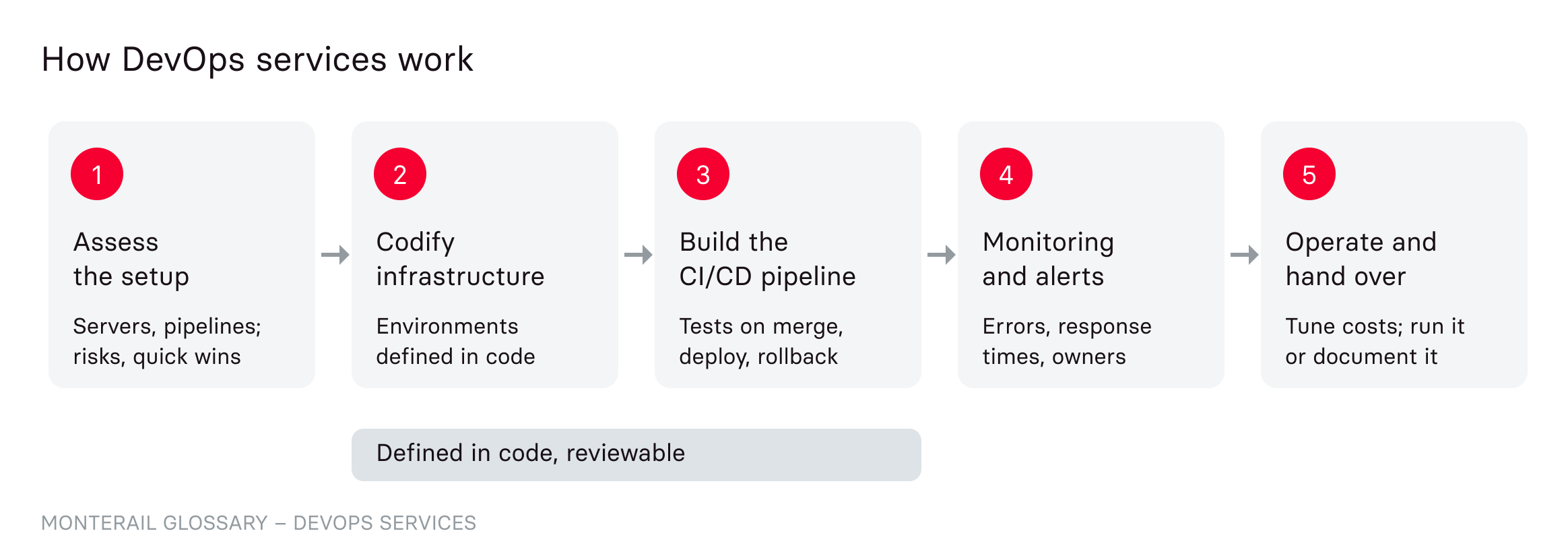
A DevOps engagement runs in five steps, from assessing the current setup to handing over a system the team can run.
Assess infrastructure and delivery. Engineers map the current servers and pipelines, then look at how releases happen today. The output is a prioritized list of risks and quick wins.
Codify the infrastructure. Cloud resources are defined in code, so each environment can be recreated and reviewed like the application itself.
Build the CI/CD pipeline. Every merge triggers builds and automated tests. Passing changes deploy to staging, then to production with a rollback path.
Add monitoring and alerts. Dashboards and alerts cover errors and response times. The team agrees on who responds to which alert.
Operate, optimize and hand over. The provider tunes performance and cloud costs. It then either keeps operating the setup or hands it to the client's team with documentation.
Should You Use a DevOps Partner or Hire In-House?
Use a DevOps partner for setup work, migrations and teams without a full-time DevOps need. Hire in-house when infrastructure is a constant, central part of the product.
Factor | DevOps partner | In-house DevOps hire |
Time to start | Weeks, with an existing engineer | A full recruiting cycle |
Breadth of experience | Patterns from many client setups | Deep knowledge of one system |
Cost | Pay for the work needed, including part-time | A full salary, even in quiet months |
Availability | Covered by a team during vacations | One person, unless you hire several |
Knowledge retention | Depends on documentation and handover | Stays inside the company |
Best for | Setups, migrations, audits and small teams | Large, constantly changing infrastructure |
Challenges to plan for: A partner's setup is only as maintainable as its documentation, so require infrastructure as code and a written handover. An in-house hire becomes a single point of failure unless a second person learns the system.
How Does Monterail Approach DevOps Services?
Monterail treats infrastructure as part of the product, sized for peak traffic and documented for the team that runs it.
Seat Unique sells premium event tickets, and peak sales seasons bring thousands of sales per hour. Monterail migrated the platform from Google Cloud to AWS and ran extensive load testing for high-traffic events. In 2025, the platform sold over 193,000 premium tickets to more than 56,000 customers and reached 1 million monthly visitors.
When Monterail took over Admyt's parking app, it ran on fifteen servers with slow server-to-server communication. The team optimized and rewrote that communication, cutting synchronization time from 20–30 seconds to 30 milliseconds and making the app easy to scale.
When Should You Bring In a DevOps Partner?
A partner helps when releases depend on one person or a manual checklist. It also helps before a cloud migration or a traffic peak you can't afford to get wrong.
Monterail places DevOps engineers inside client teams through IT staff augmentation services, and its software development services cover infrastructure alongside the product. Talk to our team about your release process.
FAQ About DevOps Services
Related Terms
Need expert help with DevOps Services?
Monterail builds custom software solutions that leverage the latest technologies. Let's discuss how we can help with your project.
EXPLORE WEB DEVELOPMENT SERVICESEXPLORE WEB DEVELOPMENT SERVICES