Nowy standard. Twoje centrum tworzenia inteligentnego, szybkiego i zrównoważonego oprogramowania AI

Spis treści
Evan You, the creator of Vue.js, told us in 2020 that Vue 3's biggest challenge was becoming a solid choice for large-scale applications without losing its beginner-friendly learning curve.
We spoke with him a few weeks after Vue 3 shipped on September 18, 2020, about the community, how the core team works, how he funds full-time open source work, and what he would do differently. His answers below are unchanged from the original interview.
We've added an update on which of his 2020 plans shipped, and what that means for teams still running Vue 2.
Executive Summary
In 2020, Evan You named scaling Vue for large applications as Vue 3's main job, and the Composition API and TypeScript support as the way to do it.
Most of the plans he described have since shipped: Vue 2.7 backported the Composition API in 2022, Vue 3 became the default version the same year, and his compiler-driven performance work is now Vapor Mode, in Vue 3.6 release candidates.
Vue 2 reached end of life on December 31, 2023, so teams still on it need a migration plan. The interview also shows what running an independent open source project takes: remote work with few meetings, top-down direction with bottom-up features, and a funding mix that keeps technical decisions free of business pressure.
What Did Vue 3 Change When It Was Released in 2020?
Vue 3 was a ground-up rewrite that kept Vue's familiar API while making it faster, smaller and better suited to large codebases. According to the official Vue 3 release announcement, the headline changes were:
Vue 3 is tree-shakable, so features your app doesn't use are dropped from the build. The core team measured bundles up to 41% lighter.
A rewritten virtual DOM, guided by compiler hints, made initial renders up to 55% faster and updates up to 133% faster.
The Composition API lets you group code by feature instead of by option type, and pull shared logic into reusable functions (composables). The Vue docs highlight better logic reuse, more flexible code organization and better TypeScript type inference.
The built-in Teleport component renders part of a component's template elsewhere in the DOM, which is useful for modals and tooltips. It replaced third-party "portal" libraries.
For the full list of breaking changes, see the official Vue 3 migration guide.
What Did Evan You See as Vue 3's Biggest Challenges and Opportunities?
How big is the Vue community right now? It’s hard to measure the community size, but our devtools extension has 1.37 million current users so I think that’s a lot :)
Is Vue being adopted at the same rate as it has been in the past? Judging from the npm download growth and devtools user growth, the curve doesn’t seem to be slowing down!
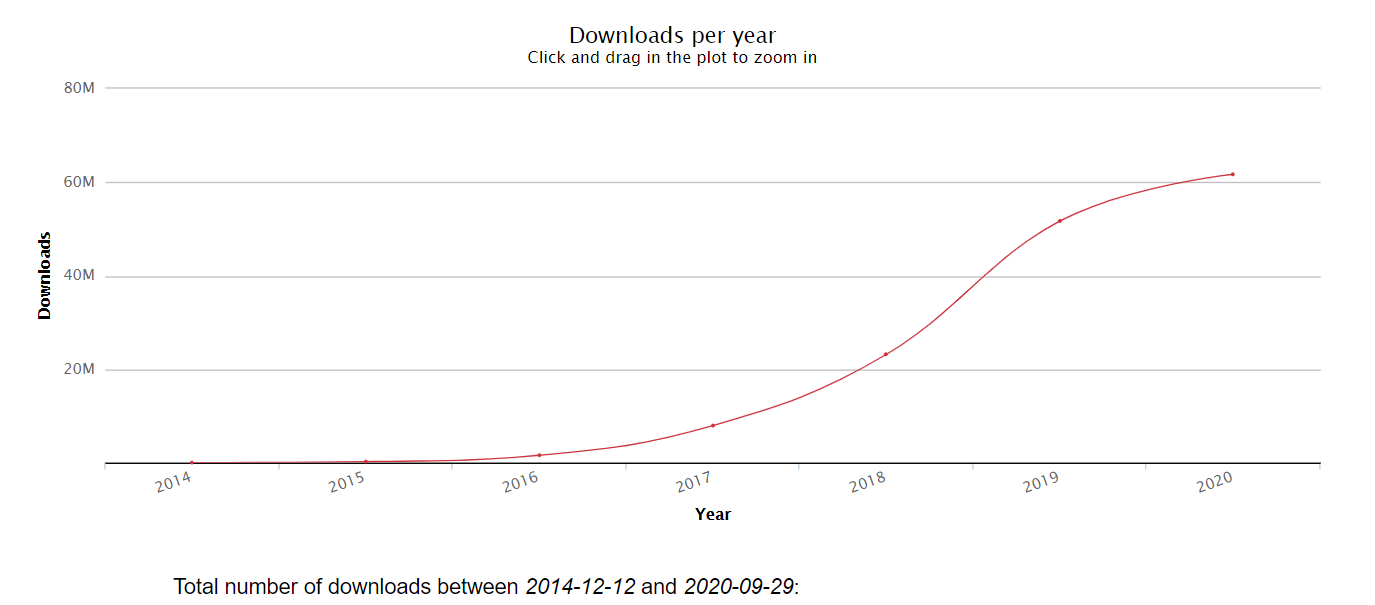
Vue's npm downloads, December 2014 to September 2020. Source: npm-stat
What are the challenges and opportunities for Vue 3? The biggest challenge is making it a more solid choice for large-scale applications while retaining the same beginner-friendly learning curve. I think we are making really good progress on this front with the Composition API and better TypeScript support in Vue 3.
Vue has been praised for its low entry threshold and flexibility compared to React. Has this perception changed over the years? I think that perception still holds. Vue 3 mostly adds new features so the low entry threshold is still there, and in fact, Vue 3 is even more flexible than Vue 2. The biggest recent change in React is the introduction of hooks, but personally, I don’t think it lowers the entry threshold since it actually requires a very solid grasp of JavaScript to use it effectively.
Are there any projects built with Vue that stand out as exceptionally exciting in your eyes? Guillaume (@Akryum) is working on our new devtools (built using Vue of course) which brings some really exciting new features :)
How Does the Vue.js Core Team Work and Make Decisions?
How big is the core team? Currently around 20 active members.
In the era of remote working, it might be good to learn from organizations like yours. How does the team work together? What tactics and tools do you use to deal with time zone differences? The team is fully remote, but the time zone difference isn’t that big of a problem because we don’t do meetings very often. We hold a bi-weekly team meeting with voluntary attendance and meeting notes, and the rest of the communication happens via Discord (internal) or GitHub (public).
What does the decision process look like? Is it team-based? Is it community-driven? Is it bottom-up or top-down? How do you decide which features to introduce, and which bugs to fix? Higher-level direction is typically top-down, but individual features are often bottom-up. Major new ideas are usually explored and discussed inside the team first, in order to validate and polish them without too much distraction. Once we make an idea public though (via our RFC process), it becomes community-driven and we iterate based on community feedback. As the team lead, I make the final calls on what to ship, but every decision takes team and user feedback into account.
What Did Evan You Say About Vue's Future, Funding, and Building an Open Source Framework?
What is your main focus now in terms of evolving Vue? I believe there are still more interesting things we can do with the compiler + runtime combined approach, both in terms of performance and authoring experience. Another area with big potential improvements is server-side rendering, where we can leverage the compiler to drastically reduce duplicated JS payload and hydration cost.
What are the future plans? For now, we want to make sure Vue 3 is stable and help the ecosystem adapt to the new version. We also plan to backport compatible features to 2.7 for users who can’t afford to do a major migration. I do have some ideas in the backlog but we will probably give it some time before introducing major new features.
In the documentary about Vue by Honeypot, Thorsten Lunborg and Scott Tolinski talk about the freedom that comes with being an organization not tied to any corporations and not fixating on Return on Investment. What is your take on this freedom? I believe such freedom is important, since it ensures the technical direction of the framework is completely independent of business decisions, so that the project can really be focused on serving its users.
After leaving your 9-5 job to do something that resonates with you deeply, what is the biggest reward for you? Building something that people find helpful or being able to set your own course and make big decisions, etc.? I’d say it’s the feeling of being in control - once I’ve experienced that I can never imagine going back to big companies again.
How do you fund your efforts? Is Patreon enough? Is the core team maintained through this funding? Today my income sources are a mix of Patreon, GitHub sponsors, revenue share from our educational content partners, and ads. It’s a pretty healthy mix that can fully sustain my full-time work on Vue. Core team members have varying levels of time commitment — we fund one full-time (@sodatea) via OpenCollective, and core team members taking on major part-time commitments can also expense from OC. Most of the core team members have their own full-time jobs and participate on a voluntary basis.
If someone was to ask you what are the most important aspects of building an open-source framework, what would you advise? Know what you are getting into. Writing the code is the easy part - most of the work is in maintenance and community building.
Looking back, what would you have done differently? I’d start building a team earlier. Vue wouldn’t be where it is today without the amazing team members and contributors.
Which of Evan You's 2020 Plans for Vue Have Shipped?
Nearly all of them. The table below matches what Evan described in 2020 with what the Vue team has released since.
What Evan You planned in 2020 | What happened |
|---|---|
Make Vue 3 stable and help the ecosystem adapt | Vue 3 became the default version on npm and in the docs on February 7, 2022. |
Backport compatible features to Vue 2.7 | Vue 2.7 "Naruto" shipped in July 2022 with the Composition API and |
Reduce SSR hydration cost | Vue 3.5 (September 2024) added lazy hydration for async components and |
Push further on the compiler + runtime approach | Vapor Mode, an opt-in compilation mode that skips the virtual DOM, is in Vue 3.6 release candidates. As of November 2026, Vue 3.5 is still the latest stable line. |
For a current sense of scale, the vue package had about 25 million npm downloads in the week of November 8–14, 2026, according to the npm downloads API.
How Evan funds his work has changed too. In October 2024, he founded VoidZero, a company building JavaScript tooling (Vite, Vitest, Rolldown and Oxc), with a $4.6 million seed round led by Accel. A $12.5 million Series A followed in October 2025. VoidZero says Vue continues as an independent project, which fits the freedom from business decisions he describes in the interview.
Key Takeaways
In 2020, Evan You saw scaling Vue for large applications, without a steeper learning curve, as Vue 3's main challenge.
The Composition API and better TypeScript support were his answer, and Vue 2.7 later backported the Composition API.
The Vue core team works fully remotely with few meetings and turns big ideas into public RFCs once they're validated internally.
Evan's advice for open source creators: writing the code is the easy part, and maintenance and community building are the real work.
Vue 2 has been end-of-life since December 31, 2023, so teams still on it should plan their Vue 3 migration.
What Should Teams Still Running Vue 2 Do in 2026?
Plan the migration to Vue 3 now. Vue 2 reached end of life on December 31, 2023, and 2.7.16 was its final release. Since then, Vue 2 apps get no security fixes from the core team. You can buy time with paid extended support such as HeroDevs' Never-Ending Support, but that postpones the migration cost rather than removing it.
The effort usually depends less on your own components than on your dependencies. UI libraries, state management and plugins that never got a Vue 3 version are what turn a routine upgrade into a partial rewrite. Audit those first, and use Vue 2.7's Composition API to move code toward Vue 3 patterns before you switch versions.
Monterail has been building with Vue since its early days and publishes the State of Vue.js report. If you're weighing a Vue 2 to Vue 3 migration, we can help you scope it and plan the order of work.
Evan You and Vue 3 FAQ

Grzegorz Hajdukiewicz
Chief Delivery Officer

With over a decade of experience in the IT industry, Grzegorz has a proven track record of delivering complex projects on time and on budget. At Monterail, he leads a team of dozens of developers, designers, project managers, and business analysts, ensuring the successful delivery of software solutions for clients worldwide. Passionate about agile methodologies and continuous improvement, he constantly seeks new ways to optimize the delivery process.