The New Default. Your hub for building smart, fast, and sustainable AI software

AI-First Resource Management Tool for SPIE Belgium
SPIE Belgium had outgrown the patchwork of off-the-shelf tools managing its workforce. Disconnected systems, manual data reconciliation, and a lack of real-time visibility into field workers' availability were creating constant operational friction. Monterail delivered a custom, AI-first web platform in a 7-week fixed-price engagement. We replaced a fragmented SaaS combo with a single owned solution integrated directly into SPIE's internal systems.
)
THE COMPANY AND THE PRODUCT
From SaaS Bottlenecks to AI-Driven Efficiency
SPIE Belgium is a subsidiary of SPIE Group, the independent European leader in multi-technical services for the energy and communications sectors. The Belgian division employs approximately 1,550 people across 13 business units and 14 locations (Belgium and Luxembourg), managing large-scale infrastructure projects including power grid expansions and industrial facilities. Operating in high-stakes construction and energy sectors, SPIE required extreme precision in resource allocation, regulatory compliance, and workforce scheduling.
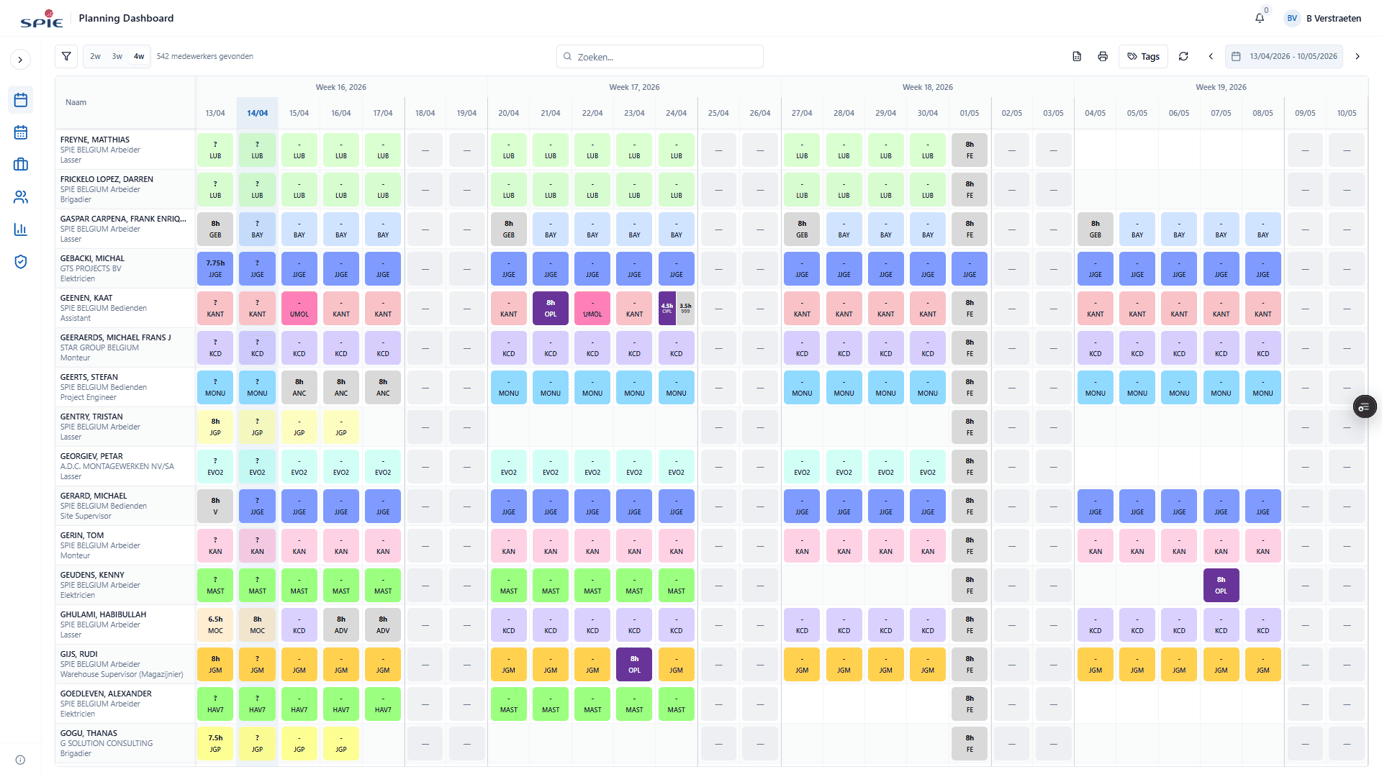
The Division Industry unit, which initiated this project, manages teams of field technicians deployed across complex, multi-project environments. To meet these specific needs, we have provided an enterprise-grade, privacy-first resource platform that replaced fragmented SaaS workflows with a centralized AI-driven system, automating data sync for hundreds of workers.
KEY CHALLENGES OF THE PROJECT
No single source of truth
for worker availability across projects.
Manual reconciliation burden
Staff spending significant time each week cross-referencing disconnected files to track who was where and when.
Broken holiday workflows
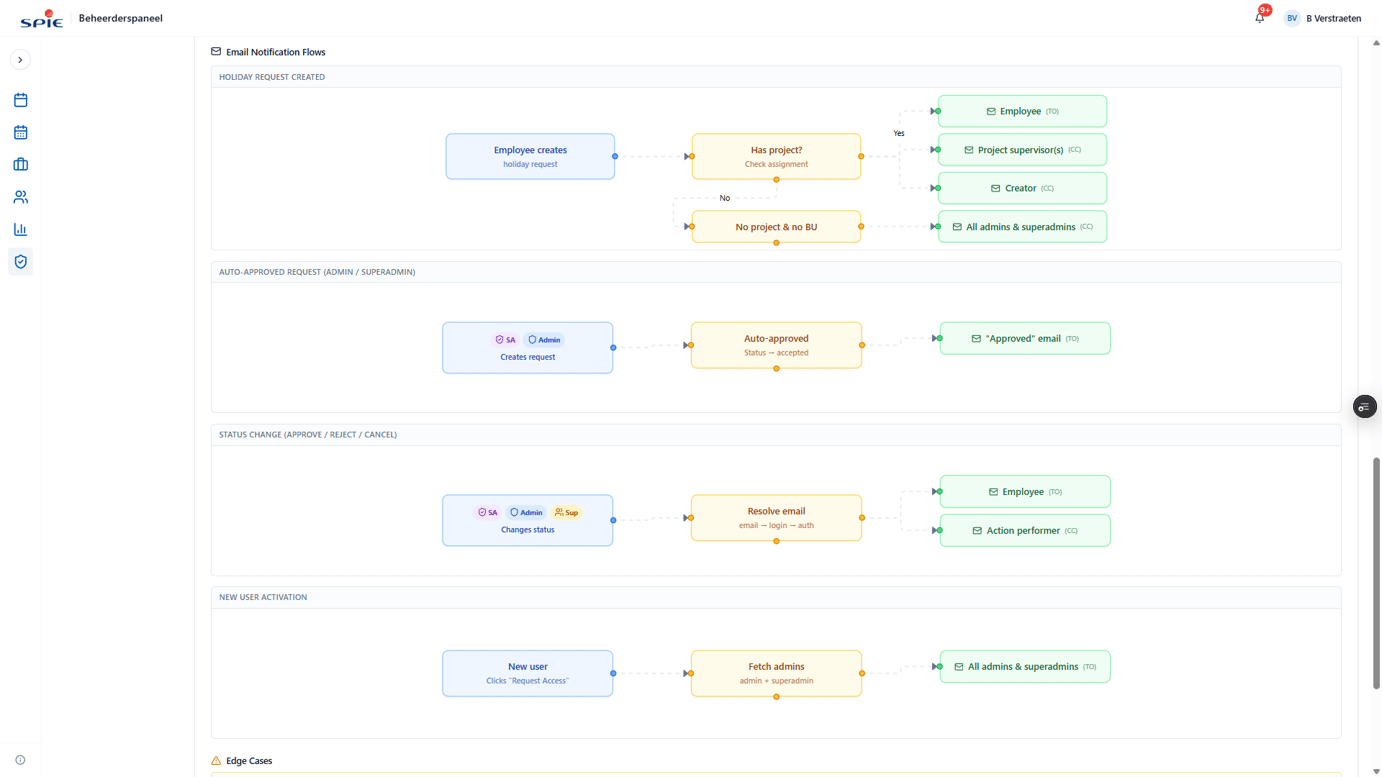
Leave requests managed via email chains with no integration into scheduling or the internal ERP.
No conflict detection
Scheduling clashes and skill mismatches were discovered reactively, after they caused problems
Integration gaps
Existing SaaS tools couldn't sync with Microsoft Dataverse, where project and contact data lived.
Scale Requirements
The system needed to manage 600 active workers and 250 platform users without performance degradation.
Data Fragmentation
Lack of real-time visibility into the availability of 600 active workers led to reactive scheduling and frequent operational errors.
OUR APPROACH
From One-Day Prototype to Enterprise-Grade Security
In a strategic partnership with Lutasin, an external consulting firm specializing in the manufacturing industry, we enhanced our operational credibility.
Given the sector's complexities, Lutasin's domain knowledge and specialized industry insights ensured the tool addressed the nuances of construction scheduling, labor laws, and real-time conflict detection
We bypassed the traditional long-cycle development using the Accelerated Iterative Design approach to immediately move to a production-ready tool in record time.
Discovery & Rapid Prototyping
The project began with a one-day prototype. This rapid POC was built to confirm that the proposed Supabase architecture could handle the complex resource logic and data volumes required by SPIE's domain experts.
Fixed-Price MVP
Monterail moved directly to a 7-week fixed-price MVP. The team worked closely with Bram Verstraeten (Senior Project Manager, SPIE Division Industry) as the domain expert and product owner throughout.
Iterative Development
Following the POC, we entered an iterative phase to refine the feature-rich version. The project bypassed traditional long-cycle development by adopting a structured, six-phase iterative delivery approach to systematically move the AI layer from a validated concept to a production-ready module.
AI-First Strategy
Instead of building a standard CRUD application, we adopted an AI-first approach. The architecture was designed from the start to support proactive, data-driven decisions by structuring data to enable future capabilities such as skill-gap detection and conflict prediction.
Privacy & Security
Given SPIE's involvement in sensitive sectors such as nuclear energy, the architecture was built with enterprise-grade security and data ownership as core requirements. By moving away from third-party SaaS and building on Supabase (PostgreSQL + Auth + Real-time), SPIE owns its own data rather than having it distributed across vendor systems.
The Iterations
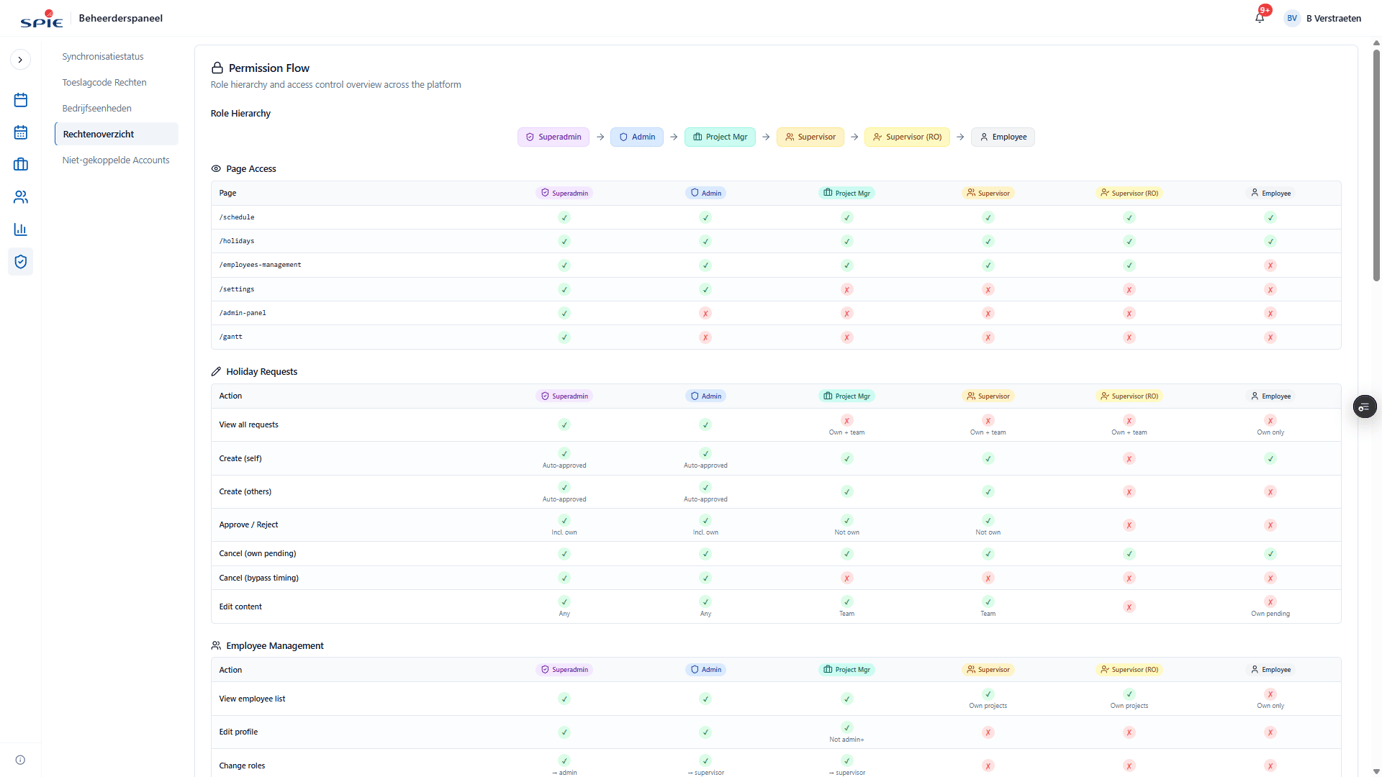
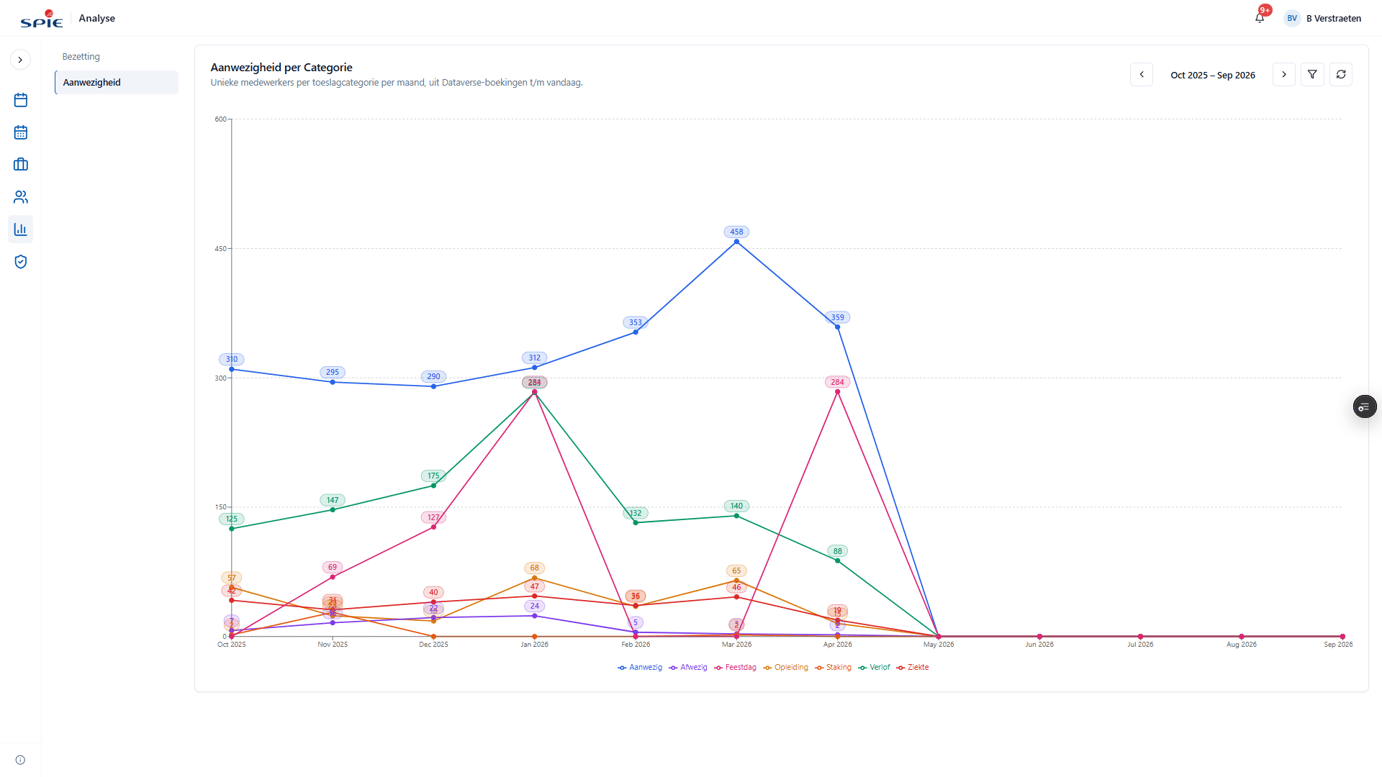
We added 13 releases over 4 months, including: Microsoft SSO via Azure AD, Training Planner module, Business Unit separation with multi-tenant support, holiday day counter with CSV upload, Gantt chart view, color-coded project scheduling, and A3 print optimization.
APPLICATION FUNCTIONALITIES
TECHNOLOGIES WE USED
| Layer | Tech stack |
|---|---|
| Frontend | Next.js 14, shadcn / Radix UI, for a high-performance, responsive UI |
| Backend and Database | Supabase (PostgreSQL + Auth + Real-time), Pro Plan, for its ability to provide a scalable, stable, and production-ready backend (PostgreSQL + Auth + Real-time) at a fraction of the cost of legacy enterprise suites. |
| AI / ML Approach | AI-First Architecture, prioritizing data structures that support future predictive modeling capabilities like skill-gap detection, road-surfacing mismatch alerts, conflict forecasting, and detection |
| Security / Privacy | A custom Supabase backend owned by SPIE, Supabase Pro was selected specifically for enterprise-grade security, Microsoft SSO via Azure AD was used for aligning with SPIE's corporate authentication standards |
THE RESULTS
From Concept to Enterprise Prototype in 24 Hours
SPIE's off-the-shelf scheduling tool failed to accommodate the complexity of construction-scale resource management. We replaced the Rework.nl platform with a custom solution, enabling SPIE Belgium to transition from manual chaos to automated precision. The platform replaced a combination of tools with a single owned system, eliminating the data silos that had made real-time visibility impossible. The platform operates on a unified source of truth that is integrated directly with SPIE's internal ERP.
1-day prototype, from concept to a functional, enterprise-grade prototype in 24h, significantly reducing initial R&D costs
7 weeks and fixed price MVP
13 releases in 4 months
100 hours reclaimed per week equals eliminating one full workweek of manual data reconciliation and file tracing
600+ managed resources, real-time visibility, and conflict detection for the entire Belgian workforce
100% real-time data synchronization accuracy achieved by removing the "data lag" that previously caused scheduling conflicts
Feature gains, like automated holiday/absence management workflows with partial-day support and smart conflict detection
Reduction in costs and annual savings through replacing costly SaaS subscriptions with a single custom-owned solution
CLIENT’S TESTIMONIAL

)
Proactive, Scalable Resource Management
We moved from reactive scheduling to proactive, data-driven decisions. The ability to see a prototype in one day and scale it to an enterprise-ready solution so quickly was a game-changer for our resource management.
KEY TAKEAWAYS
Custom software becomes cost-effective when workarounds become a full-time job
Large enterprises often reach a point where the overhead of managing disconnected SaaS tools exceeds the cost of building a unified solution. ProSPIE replaced five separate tools and their associated manual workflows with one owned platform.
A fixed-price MVP de-risks the investment
A 7-week engagement gave SPIE a working, production-deployed system before committing to open-ended development. Stakeholders could validate the core scheduling logic against real operational data before the Phase 2 scope was defined.
Domain expertise is non-negotiable at this scale
The scheduling logic for construction-scale labor, including conflict detection, multi-project allocation, and regulatory compliance, cannot be mapped by a tech team alone. Our strategic partnership with Lutasin provided the deep manufacturing domain knowledge. Tight collaboration with specialized industry insights enabled us to successfully deliver a viable solution.
AI-first architecture is a structural decision, not a feature
Building with predictive capabilities in mind, skill-gap detection, and conflict forecasting means designing data structures that support those use cases from day one, not retrofitting them later.
THE DEVELOPMENT TEAM
Monterail and Lutasin
Monterail and Lutasin assembled a lean, cross-functional team purpose-built for a 7-week fixed-price delivery, consisting of a PM, approximately 1.5 FTE developers, and a QA engineer. Lutasin acted as our strategic consulting partner, providing manufacturing domain expertise and industry insights that were invaluable in handling complex workforce coordination.

Read more case studies like this
show allshow all
)
)
AI Cost Intelligence Platform for Construction Finance
A UK-based construction industry founder needed to replace decades of fragmented, spreadsheet-based cost management with a single, enterprise-grade AI platform designed to earn the trust of CFOs and board-level stakeholders. The development team delivered an interactive AI-powered prototype in two weeks and a fully functional MVP in three months, across 500 hours of focused development, with zero rework and no scope collapse.
SMB
Fintech
MVP development


Transforming HR strategies with AI innovation
Monterails' team of experts transformed HR analytics for Fortune 500 companies by integrating an AI-powered solution to analyze employee feedback and insights. The new system pinpoints key themes and sentiment in employee surveys, boosting HR efficiency and allowing teams to focus on strategic initiatives rather than manual data analysis.
Startup
USA
HR tech
AI integration
Mobile app development
Web app development

Escape the SaaS Trap with AI-First Custom Systems. If your team is spending more time managing your tools than your projects, it's time to consolidate. We provide solutions that predict conflicts before they happen.
Grzegorz Hajdukiewicz | Chief Delivery Officer
Get in touch to get a scopeGet in touch to get a scope