The New Default. Your hub for building smart, fast, and sustainable AI software

Companies looking to outsource software development are widening their search past the usual India-versus-Ukraine comparison, and Poland keeps showing up in the results. Outsourcing software development to Poland costs $25 to $99 per hour, roughly half the US rate, while drawing from a developer pool that ranks third globally on HackerRank and second in the International Olympiad in Informatics medal count. That combination of price and skill is why Microsoft, IBM, Google, Oracle, and ABB have all set up R&D centers in the country. This article answers the questions that matter before you sign anything: what outsourcing software development to Poland costs in 2026, how deep the talent pool really is, and what day-to-day work with a Polish development team looks like once the contract is signed.
Executive Summary
Blended rates for Polish software teams typically run $45-90 per hour, on average, with mid-level engineers around $40-60/hr and seniors at $55-100/hr, climbing toward $90-100/hr for specialized skills like AI/ML or security engineering. Three factors move that number the most: the seniority mix your project needs, how specialized the tech stack is, and whether you're buying staff augmentation or a fully dedicated team. On talent depth, Poland now has up to 600,000 active IT professionals, the largest technical workforce in Central and Eastern Europe, concentrated in a handful of cities and skewed toward mid-to-senior experience rather than junior volume.

Why Companies Are Outsourcing to Poland Right Now
Poland's Deep IT Talent Pool and Technical Skill
Poland produces more skilled developers than its domestic market can absorb at Western European or US rates. EU labor mobility, combined with a strong outsourcing industry, means that surplus talent is available to foreign clients at a fraction of US pricing. The result is a labor pool where price is set by local market conditions, but skill is benchmarked internationally: Poland ranked third worldwide on HackerRank's coding-challenge accuracy and speed metrics, and Polish developers make up roughly a quarter of the one million software professionals working across the CEE region.
56.4% of the country's IT specialists studied computer science rather than transitioning in from adjacent fields. The market is also senior-heavy: above 72% of surveyed Polish IT professionals hold mid-level seniority or above, which matters if your project needs people who can make architecture decisions without heavy oversight from your side.
Poland boasts over 500,000–580,000 IT professionals, accounting for ~25% of all software talent in Central & Eastern Europe. Polish developers consistently rank near the top globally in competitive programming platforms like HackerRank, Google Code Jam, and SkillValue. (Source: Outsourcing vs Nearshoring to Poland: The Complete 2026 Guide for Tech Leaders)
Optimal Cost-to-Quality Ratio
Polish senior engineering rates run $55–$100/hr, roughly 30–50% below US and Western European onshore pricing, without a step down in architecture or security standards. The bigger savings usually show up downstream: rigorous code reviews, scalable design practices, and direct communication keep rework low, so teams spend less time and budget on redo phases later in the project.
Factor | Poland | Ukraine | India | Western Europe (in-house) |
Hourly rate range (senior) | $55-100/hr | $40-60/hr | $35-65/hr | $120-250/hr equivalent loaded cost |
Timezone overlap | Full overlap with CET/CEST, workable with UK, limited with US East Coast | Full overlap with CET/CEST | Partial, typically afternoon-only for EU/US clients | Full by definition |
English proficiency | Ranks in the EU's top five on the EF English Proficiency Index | Strong, comparable to Poland | Strong but variable by region and vendor | Native or near-native |
EU legal / data alignment | Native GDPR compliance as an EU member state | EU candidate status, not full EU alignment; requires contractual data-transfer terms | Requires Standard Contractual Clauses or equivalent transfer mechanisms | Native, no additional mechanism needed |
Typical ramp-up time | Days to a few weeks, given the senior-heavy bench | Similar to Poland | Fast for junior/volume roles, slower for senior specialists | Months, constrained by local hiring competition |
EU Regulations and Intellectual Property
Poland's EU membership means GDPR compliance, data privacy protections, and IP law are built into most agreements by default, which reduces the cross-border legal work that offshore contracts require through separate data-transfer clauses. It also operates under EU intellectual property law and the patent treaties that come with it, and meets US data security and IP protection standards, both relevant if you're sending proprietary code or data across borders. Most mature Polish vendors layer additional enterprise security on top, operating under ISO 27001 and SOC 2 frameworks, though these certifications still need to be confirmed vendor by vendor rather than assumed from EU membership alone. Beyond the legal and security baseline, Poland's rule of law and political stability make it a low-risk environment for outsourcing, with a low likelihood of the kind of nationwide disruption that can stall projects in less stable markets. The economy has grown steadily for two decades.
Cultural Fit, Communication, and Location
Poland ranks in the top tier globally on the EF English Proficiency Index, so language friction is rarely a real obstacle in daily work. Polish engineering teams also tend to work in a flat-hierarchy style: engineers proactively flag vague requirements or push back on inefficient technical decisions rather than executing a flawed spec without comment. That communication strength pairs with a workable schedule: Poland offers full business-hour overlap with European clients on CET and a partial overlap with the US East Coast, usually 4-6 hours depending on daylight saving alignment. Its major cities, Warsaw, Kraków, Wrocław, Poznań, and Gdańsk, host large R&D centers for global tech companies including Google, Microsoft, IBM, and Amazon.
How Poland's Talent Market Delivers Value
The rates and quality Poland delivers come from a specific structural setup: a dense network of technical universities in Warsaw, Kraków, Wrocław, and Poznań, more than two decades of outsourcing maturity since EU accession in 2004, and a market built around established software houses rather than a freelance-heavy supply chain.
That structure changes how projects actually run. A staff-augmentation or dedicated-team model staffed with senior engineers produces fewer handoff delays and gives the client's tech lead direct access to people who can make decisions, not just execute tickets. The measurable effect is shorter ramp-up time and less rework during the first few sprints, which lowers total project cost even though the hourly rate sits above South Asian alternatives.
Still, check the specifics before signing a contract: ISO 27001 certification, documented GDPR-compliant data handling procedures, clear NDA and IP-transfer clauses, and unambiguous code-ownership terms in the contract itself. EU membership makes GDPR compliance the legal default, but it doesn't automatically mean a specific vendor has the security certifications your industry requires.
What Outsourcing to Poland Looks Like Day to Day
Staff Augmentation
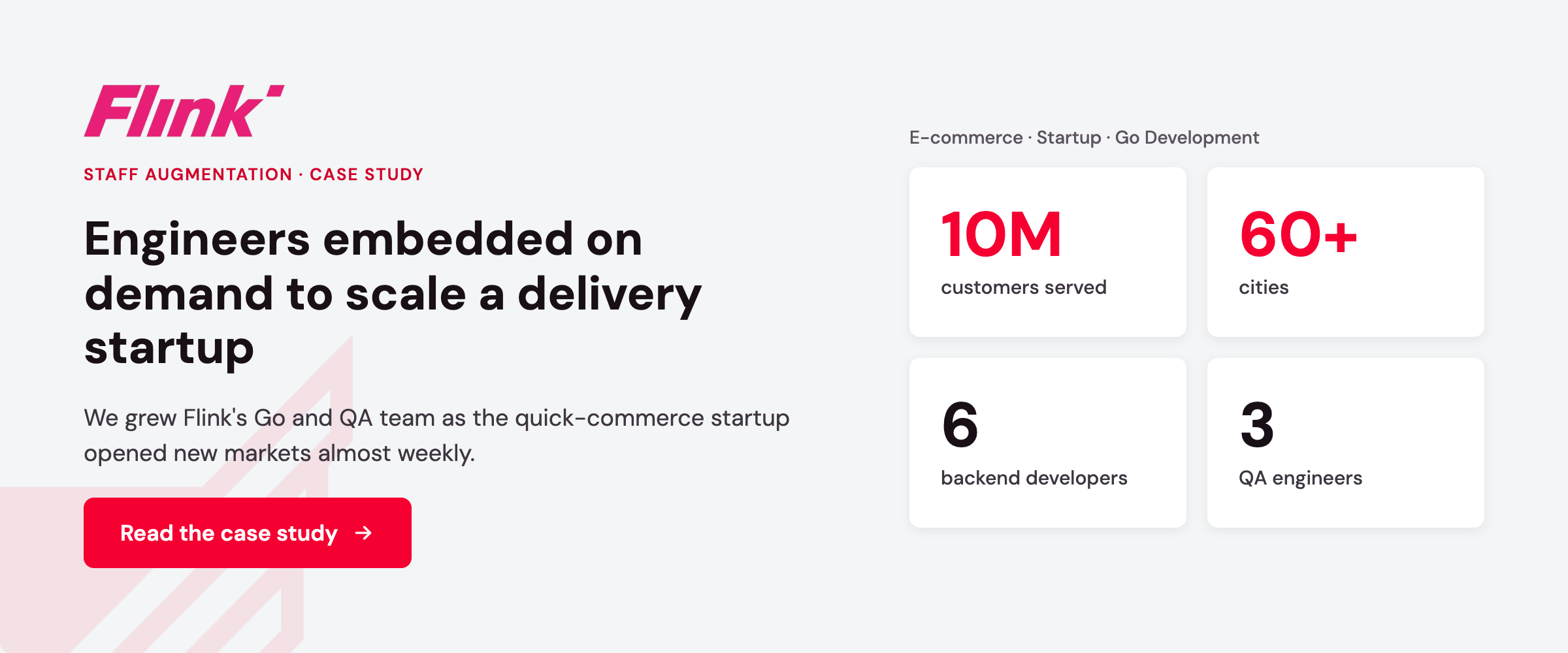
This model places vetted engineers directly inside an existing Scrum team, reporting to the client's own PM or tech lead. It works mid-sprint, closing a skills gap or capacity crunch that would otherwise take months to fill through local hiring. The constraint is real: augmentation only works if the client already has the internal process maturity to onboard and manage new engineers quickly. Teams without a functioning sprint cadence or a PM who can absorb new headcount tend to see slower integration than the model promises.
Dedicated Team for a Full Product Build
Here, a Poland-based team owns a defined scope end-to-end: design, development, and QA. It fits greenfield builds and major rewrites where the client doesn't have in-house engineering leadership to run the project directly. The trade-off is that this model needs clear scope and requirements going in; it's a weaker fit for products where the vision is still evolving week to week, since a dedicated team optimizes for delivering against a defined target rather than exploring one.
Regulated-Industry Builds Requiring EU Data Residency
For HealthTech and FinTech products where GDPR-compliant hosting is a contractual requirement rather than a preference, working with an EU-based team removes a category of legal complexity that offshore-to-non-EU relationships have to solve through contracts and data-transfer mechanisms instead. A client still needs to verify a vendor's specific certifications, hosting arrangements, and audit history rather than assuming compliance follows automatically from location.
What You Need to Know Before Outsourcing to Poland
The hourly rate is only part of the cost. Treating it as the whole number is the most common budgeting mistake. Management overhead, onboarding time, and communication tooling add to the number on the invoice. Poland prices as a mid-to-premium nearshore market: buyers coming from a South Asian outsourcing background sometimes expect India-level pricing and are surprised when Polish quotes land closer to Western European junior rates.
Integration requirements come first in practice. Existing tooling access, VPN setup, and security policy alignment need to be sorted before a new team can be productive, and delays here are usually organizational rather than technical.
GDPR compliance is the default because Poland is an EU member state. HIPAA and SOC 2 are separate certifications a vendor has to earn on its own, and holding one doesn't guarantee the other.
Scalability conditions matter for longer engagements: how easily the vendor can flex team size up or down, and whether the contract structure actually allows for that or locks the client into a fixed headcount regardless of changing scope.
Institutional trust and change management round out the list, and this is where buyers underestimate friction the most. How smoothly a Polish team integrates often comes down to cultural fit and spoken English quality in daily standups, beyond what shows up in written documentation. Timezone overlap also needs a reality check: CET lines up well with the UK and near-perfectly with Western and Central Europe, but the overlap with US Pacific time is close to zero despite the general framing of Poland as a "European" nearshore option.
Key Takeaways
Poland's rate band sits between Western Europe and South or East Asia, making it a mid-market nearshore choice rather than a low-cost one.
EU membership resolves data-residency and GDPR questions structurally, whereas offshore relationships have to resolve the same questions through contract language.
Timezone overlap is strong for European and UK clients, workable but limited for the US East Coast, and effectively nonexistent for US West Coast or APAC buyers.
Talent depth is real but concentrated in a handful of hubs, so rates and availability vary meaningfully by city rather than by country as a whole.
The main cost risk isn't the hourly rate; it's choosing the wrong engagement model, staff augmentation versus dedicated team, for the internal capacity the client actually has.
What Determines Outsourcing Success: Location or Internal Capacity?
Choosing where to outsource is often treated as the whole decision, but it's really a proxy for a different question: how much process and oversight capacity the client already has in-house. Poland cuts certain categories of risk well: legal exposure through GDPR alignment, coordination friction through timezone overlap. It still doesn't decide the engagement model on its own; that has to match what the client's team can actually absorb. A well-run staff augmentation contract with a weak internal process will underperform a dedicated team with a strong one, regardless of which country the engineers sit in.
 Operational fit matters more than the number on the rate card. Long-term partner fit beats winning a single procurement round on price. Buyers who treat the location decision as a stand-in for due diligence on process and scope tend to end up re-negotiating six months in. Schedule a call with Monterail to determine which engagement model fits your internal capacity before comparing vendor quotes.
Outsourcing software development FAQ

Grzegorz Hajdukiewicz
Chief Delivery Officer

With over a decade of experience in the IT industry, Grzegorz has a proven track record of delivering complex projects on time and on budget. At Monterail, he leads a team of dozens of developers, designers, project managers, and business analysts, ensuring the successful delivery of software solutions for clients worldwide. Passionate about agile methodologies and continuous improvement, he constantly seeks new ways to optimize the delivery process.