The New Default. Your hub for building smart, fast, and sustainable AI software

Table of Contents
Most companies use AI tools. Most of them aren't getting much out of it. The gap between near-universal adoption and minimal business impact is growing because companies treat AI as a tool problem when it's actually a process problem. You can give every developer Copilot and Cursor and still ship more slowly than before if the workflows around those tools stay the same.
Executive Summary
Nearly 97% of developers now use AI coding assistants daily. Only 39% of enterprises report measurable business impact, and most of those say AI accounts for less than 5% of earnings, according to McKinsey’s State of AI report. The tools aren't the problem. The issue is that most organizations bolt AI onto workflows designed for a different era, then wonder why results don't follow. Companies that are pulling ahead have rebuilt four foundational systems, verification layers, team structures, measurement frameworks, and culture, rather than adding AI on top of a broken process. The gap isn't closing on its own.
What Is the AI Adoption Gap?
The AI adoption gap is the disconnect between having AI tools and actually using them to change how work gets done. Whether your team runs Copilot, Cursor, or Claude isn't the question. The question is whether AI produces repeatable business value at scale: faster delivery, higher quality, measurable ROI.
The AI value gap goes a step further. Organizations are generating more code, content, and artifacts with AI, but that activity isn't translating into business impact. Local productivity goes up. System-level performance stagnates under growing complexity.
Here's what that looks like in practice. Two engineering organizations, both running the same AI coding assistants, both spending roughly $800 per developer per month on tokens:
The first ship AI-generated code to production daily. Developers use AI to refactor legacy systems, write test suites, and migrate deprecated libraries, all while maintaining 24/7 reliability for millions of users. Code reviews are faster. Technical debt is dropping. The team ships features at a pace that seemed impossible 18 months ago.
The second generates more code than ever. Almost none of it reaches production. Pull requests pile up in review queues. Bugs slip through because reviewers are overwhelmed. AI accelerates their worst patterns, copy-paste solutions, architectural shortcuts, untested edge cases. Despite using identical tools and spending similarly, they're moving more slowly than before they adopted AI.
Same tools. Opposite outcomes. The difference isn't the AI, it's the system built around it.
"We see companies failing at AI not because they picked the wrong tool, but because they plugged a powerful accelerator into a process that was already broken. AI doesn't fix broken systems — it exposes them faster."
— Michał Nowakowski, Solution Architect and AI Expert, Monterail
"Stage vs. Hallway": Why AI Demos Don't Survive Contact with Production
Tech conferences run impressive AI demos, autonomous agents refactoring entire codebases, and AI architects designing microservices in real time. In the hallways afterward, engineers tell a different story: immature tooling, brittle systems, reliability gaps that appear the moment these ideas meet real workloads.
Gartner’s 2025 AI Hype Cycle makes this divergence explicit.
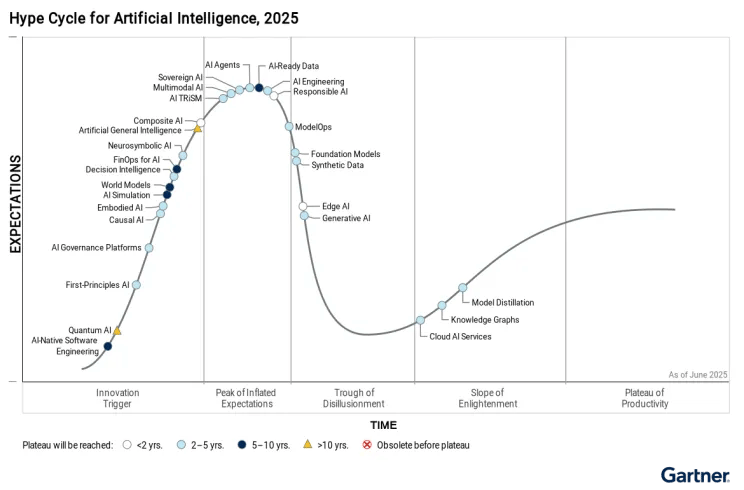
This is another dimension of the gap. The conditions that make AI look impressive in demos are almost never the conditions companies operate in.
Gartner's 2025 AI Hype Cycle makes this explicit. Generative AI is already sliding into the Trough of Disillusionment, while AI agents remain near the Peak of Inflated Expectations, on a collision course with scalability, reliability, and governance constraints.
The pattern is familiar: across innovation cycles, very few technologies reach the Plateau of Productivity quickly. Off-stage conversations surface the problems that demos ignore — data quality issues undermining fraud detection, agent frameworks collapsing under production load, and governance risks intensifying under the EU AI Act.
Production systems have non-negotiable requirements: 24/7 uptime, predictable behavior, auditability, and regulatory compliance. These constraints fundamentally reshape how AI must be built, deployed, and operated. That's why experienced operators insist production is a distinct phase, not a continuation of experimentation.
Red Hat offers a useful reference point. For decades, the company has taken open-source technologies that shine in demos and hardened them for enterprise use, long support lifecycles, strict SLAs, regulated environments, and mission-critical workloads. The same philosophy applies to AI: focus shifts from novelty to operations. Immutable infrastructure. Automated failover. Deep observability. Security certifications. The opposite of "move fast and break things", and exactly what production demands.
What works on stage rarely works at scale. Organizations that accept this early standardize faster and build a compounding advantage.
The Three Layers Where AI Adoption Gets Stuck
AI adoption doesn't fail all at once. It stalls in predictable places, at each transition between how individuals work, how teams coordinate, and how organizations operate. Each layer has its own ceiling, and its own reason most companies never break through it. The AI adoption gap plays out across three distinct layers.
Layer 1: Individual experimentation
Developers fold AI into personal workflows, exploratory prototypes, one-off scripts, and "vibe coding." Adoption is high, but value stays localized and inconsistent. In many organizations, this happens without visibility: developers use unauthorized tools to move faster, producing Shadow AI. There's no shared prompt library, no documentation of what works, and no systematic way to identify high-value use cases.
Layer 2: Team adoption
Teams establish shared practices, prompt libraries, code-review standards for AI output, quality gates, and guardrails. Work becomes collaborative. This is where value starts to scale, but only if workflows are redesigned rather than just augmented. Most organizations hit a wall here. They layer AI onto processes built for a different equation: in the old era, writing code was expensive, and reviewing it was cheap. AI inverts that. Code generation is cheap; review and validation are expensive. Without redesigning for this reality, bottlenecks move downstream. Double the code output with AI, and if QA stays manual and deployment pipelines stay brittle, you've created a larger backlog of unverified code.
Layer 3: Organization-scale adoption
AI spans end-to-end business workflows, from requirements and design through AI code generation, testing, deployment, and observability. It's no longer bolted onto legacy processes; it's embedded in the operating model itself. These organizations don't deploy AI at the edges of individual workflows. They embed it at the intersections: where requirements become designs, designs become code, and code becomes running systems.
Most companies are stuck between layers one and two. The companies pulling ahead are already at layer three, and the distance between them is growing.
Why the Gap Keeps Widening: Five Reinforcing Mechanisms
The gap widens for one core reason: companies treat AI as an adoption problem when it's a process-debt problem. Five mechanisms reinforce this.
Mechanism 1: AI amplifies what's already true about your team
AI doesn't fix broken teams. It exposes them. A codebase with clean architecture, solid tests, and clear documentation becomes pure compound advantage with AI, it understands the patterns, suggests compliant code, and accelerates work that already ships. A codebase with inconsistent architecture, sparse documentation, and flaky tests doubles the chaos. AI suggests changes that look right but break in production.
Strong teams compound their advantage. Weak teams compound their confusion.
Mechanism 2: Token spend is a vanity metric
There's a narrative that "$500–$1,000 per day per engineer on tokens" signals good AI adoption. It doesn't. Token spend measures activity, not outcomes.
High spending correlates with both wins and losses. A team generating massive exploratory code that never ships burns tokens without creating value. A team using AI to eliminate bottlenecks, automate code reviews, generate test coverage, and refactor legacy systems might spend the same amount and deliver 10x the impact.
The DX research is clear: utilization is a signal, not a goal. What matters: faster cycle times, higher quality, lower defect rates, better developer satisfaction.
Mechanism 3: Throughput is capped by review, debug, and coordination bottlenecks
Developers generate code faster with AI. But if code review is still manual, QA is still slow, and coordination is still meeting-heavy, that acceleration is wasted. McKinsey's research on AI in software development makes this clear: the constraint has shifted from writing code to verifying it.
Organizations that don't redesign workflows for this hit a ceiling fast. Those that use AI-assisted review, automated scope verification, and tighter feedback loops break through to a new level of throughput.
Mechanism 4: Code quality and entropy
Without a dedicated quality layer, productivity plateaus or collapses as trust in AI-generated changes erodes. Developers start rejecting AI suggestions. Adoption fragments.
The winning pattern: use AI to review AI-generated code. Automate scope checks, security scans, and compliance validation. Treat generation and verification as distinct concerns with separate tooling.
Mechanism 5: ROI expectations are tightening and polarizing the market
Leadership patience is running out. Companies are past the experimental phase and demanding measurable payback faster. High performers with clear metrics and proven impact get more budget, more headcount, more momentum. Pilots without measurable results get cut.
McKinsey's benchmarking is explicit: organizations that can demonstrate tangible business value are scaling aggressively, while those stuck in exploration mode face budget freezes or outright pullbacks. The gap is no longer just technical. It's economic.
How to Win: The 4 Pillars of an AI-Ready Organization
Understanding why companies diverge doesn't automatically close the gap, and the space between diagnosis and execution is exactly where most organizations stall. They know what they need: better verification, tighter workflows, clearer metrics. They've read the McKinsey reports and seen the DX benchmarks. They still can't move, because they keep reaching for tactical fixes, a new tool here, a training session there, hoping incremental changes will somehow produce transformational results. They won't.
The organizations that have reached Layer 3 took a different path. Rather than patching a broken system, they rebuilt four foundational pillars, structural components that can't be added one at a time but must be engineered as an integrated whole. These pillars don't just enable AI adoption; they create the conditions in which AI compounds over time rather than fragmenting into a scattered collection of individual workarounds.
"I've seen teams go from excited to disillusioned in three months — not because AI underdelivered, but because no one redesigned how code gets reviewed and shipped. You can 10x generation speed and still slow the whole team down if verification stays manual."
Maciej Korolik, Senior Frontend Developer and AI Engineering Manager, Monterail
Pillar 1: A hybrid code verification layer
Winners build quality infrastructure specifically for AI-generated code: automated review tools that catch AI-specific failure modes (hallucinated APIs, insecure patterns), scope verification systems that confirm PRs actually solve the stated problem, and AI-powered QA that generates test cases at the speed of code generation.
Hybrid verification combines traditional static analysis (linters, type checkers), dynamic testing (automated test suites), and AI-specific heuristics (hallucination detection, architectural compliance checks).
Pillar 2: Smaller pods, evolving roles
High-performing organizations move to teams of 3–5 people with clearer ownership, faster feedback, and fewer handoffs. Roles shift:
Product managers are becoming more technical. They write precise specs and acceptance criteria that AI can execute against. Spec-driven development ceases to be a ceremony and becomes the primary interface between human intent and machine output.
QA engineers are moving away from manual testing. Their focus shifts to designing test strategies and building automation that enables continuous validation. The goal is not to test faster, but to make testing automatic.
Developers are becoming orchestrators and verifiers. They're no longer measured by how much code they write, but by system quality, architectural clarity, and the strength of the verification they put in place.
Pillar 3: Measure outcomes, not activity
A minimum viable measurement framework has three layers:
Utilization: Are people actually using the tools? Adoption rates, acceptance rates, and usage frequency show where friction exists, but not whether value is being created. High usage with low impact is just an expensive activity.
Impact: Time saved per developer, lower defect rates, faster reviews, shorter cycle times, higher deployment frequency, better maintainability, improved developer satisfaction.
Cost: What matters isn't how much you spend on AI, but what you get back. Measure AI cost per developer, ROI, and human-equivalent hours saved. High spending is justified when outcomes exceed it.
The clearest predictor of success: teams that can draw a direct line from AI usage to business outcomes keep pulling ahead.
Pillar 4: Psychological safety as the multiplier
All the tooling and processes in the world mean nothing if culture kills adoption at the root.
Google's Project Aristotle identified psychological safety as the foundation of team effectiveness, the belief that you won't be punished for speaking up, making mistakes, or asking for help.
In AI adoption, this becomes existential. If developers fear judgment for using AI ("you're lazy"), fear blame for AI mistakes ("you should have caught that"), or hide their workflows ("someone will think I'm incompetent"), adoption goes underground. Shadow AI spreads. Institutional learning stops. Value fragments.
The other four dynamics amplify this effect:
Dependability: Can you count on teammates to deliver quality work on time?
Structure & clarity: Are goals, roles, and execution plans clear?
Meaning: Does the work matter personally to each team member?
Impact: Do team members believe their work creates meaningful change?
AI doesn't replace these cultural foundations. It stress-tests them. In high-trust environments, AI accelerates collaboration and compounds team intelligence. In low-trust environments, it accelerates dysfunction.
Anti-Patterns That Widen the Gap
Knowing what winners do is only half the picture. The other half is recognizing the traps that keep laggards stuck, patterns so common they've become normalized, even though they actively sabotage AI adoption. Here's what to avoid:
"Buy the tool and hope."
Leadership procures AI coding assistants but never redesigns workflows around them. The tool accelerates nothing because the system can't absorb the acceleration. Without workflow redesign, you're burning budget on underutilized licenses.
Spend-based KPIs.
Measuring success by token spend or seat licenses is activity theater. High token spend might mean you're generating massive value, or it might mean developers are burning cycles on exploratory code that never ships. Without tying utilization to outcomes, spend is just cost with no accountability.
Generating more than can be reviewed.
If generation outpaces verification, you're not moving faster; you're building an inventory of unvetted code that will eventually collapse under its own weight. Review debt is the new technical debt, and it compounds just as fast.
Spec-driven development as theater.
Exhaustive specifications that no one reads, elaborate approval gates that slow everything down, bureaucracy mistaken for rigor. If specs don't actually enable better AI output or faster delivery, they're ceremonial.
The Staff Engineer Curse.
Senior engineers are the least likely to adopt AI tools. They're comfortable with existing workflows, skeptical of shortcuts, and don't feel the same productivity pressure as junior developers. The problem: they hold the institutional knowledge, the architectural decisions, the domain expertise, the hard-won lessons. If they don't encode that knowledge into AI-native workflows (documentation, architectural decision records, prompt libraries), it never scales. It stays in their heads. When they leave, they leave with them.
How to Close the Gap: The 3-Wave Rollout
Most organizations can't build all four pillars at once. The organizations that moved from Layer 1 to Layer 3 followed a sequence: fix the foundations first, then build the quality infrastructure, then scale end-to-end.
Wave 1: No-regrets foundations (2–6 weeks)
Before AI can deliver value, the basics must work. Most organizations discover their development infrastructure isn't ready for AI-generated code at scale.
Start here:
Standardize devs' environments, so AI has a consistent context across the team. Inconsistent toolchains create inconsistent AI outputs.
Strengthen deterministic validation: better tests, stricter linters, clearer CI/CD gates. AI will generate code that passes syntax checks but fails logic checks; your infrastructure needs to catch this automatically.
Document the why, not just the what - AI needs rationale and context to be useful. Undocumented architectural decisions become AI blind spots.
Speed up review loops. If reviews take three days, AI-generated PRs will just sit in queues longer. Fast generation needs fast verification.
What this accomplishes: it stops the bleeding. No ROI yet, but the structural blockers are gone.
"Before we touch any AI tooling with a client, we ask one question: can your team consistently review and ship code that's already in the queue? If the answer is no, adding AI just makes the pile bigger."
— Michał Nowakowski, Solution Architect and AI Expert, Monterail
Wave 2: Quality layer (6–12 weeks)
This is where you build Pillar 1. With foundations in place, add AI-specific quality infrastructure that operates at the speed of generation.
Focus areas:
Introduce AI-assisted review and QA workflows. Use AI to review AI - automate first-pass checks for hallucinations, security issues, and architectural compliance.
Implement scope verification: does this PR actually solve the stated problem? This prevents "technically correct but functionally wrong" code from reaching production.
Reduce rework by catching issues earlier and faster. The goal is to compress the feedback loop so developers know within minutes, not days, if their AI-generated code is mergeable.
Raise review quality without slowing down velocity. Manual review becomes a bottleneck at AI speed - automation is the only way to maintain rigor while increasing throughput.
What this accomplishes: the flywheel starts spinning. Faster generation plus faster verification equals measurable throughput gains. This is where organizations typically see the first material impact on cycle time and deployment frequency.
Wave 3: Scale end-to-end (quarter+)
AI stops being a tool that developers use and becomes infrastructure embedded across the entire software lifecycle.
Requirements → AI helps clarify and refine specifications, transforming ambiguous requests into structured, testable acceptance criteria.
Design → AI recommends architectural patterns grounded in established conventions, historical decisions, and organizational standards.
Code → AI generates implementations informed by domain knowledge, existing codebases, and team practices.
Test → AI produces test cases, validates coverage, and identifies edge-case scenarios that are easy to miss manually.
Deploy → AI supports rollout strategies, monitors live deployments, and can trigger automated rollbacks based on observability signals.
Operations & Observability → AI continuously monitors production systems, surfaces anomalies, and recommends remediation actions in real time.
This is Layer 3. AI becomes part of the operating model, not just a tool in the developer's toolkit.
KEY TAKEAWAYS
The gap is a process problem, not an adoption problem. Nearly every developer already has AI tools. The organizations falling behind aren't missing software — they're missing redesigned workflows.
AI amplifies existing team dynamics. Clean architecture and strong fundamentals multiply with AI. Technical debt and poor fundamentals accelerate chaos.
Verification is the new bottleneck. Code generation is cheap. Validation is expensive. Organizations that don't build hybrid verification layers hit throughput ceilings regardless of AI spend.
Winners operate across three layers. Individual experimentation and team practices are table stakes. The gap only closes when AI is embedded across end-to-end business workflows.
Culture determines whether investment becomes returns or waste. Without psychological safety, clear goals, and trust, AI adoption goes underground and institutional learning stops.
Why AI Rewards the Foundational Work?
AI is not magic, and it's not a silver bullet. Behind every successful implementation lies something far less glamorous: process mapping, workflow redesign, rigorous quality systems, the foundational work most organizations want to skip. The uncomfortable truth is that AI is a mirror. Feed it clean architecture and strong fundamentals, and it multiplies your capabilities. Feed it technical debt and unclear processes, and it accelerates the chaos.
The gap will keep widening, not because of technological differences, but because of organizational willingness to do unglamorous work: documenting the why behind decisions, building verification layers, measuring outcomes rather than activities, and maintaining the human judgment that turns raw AI capability into reliable business value. There are no shortcuts. The winners simply stopped looking for them.
There are no shortcuts. The winners stopped looking for them.
FAQ on AI GAP
)
Michał Nowakowski
Solution Architect and AI Expert at Monterail

Michał Nowakowski is a Solution Architect and AI Expert at Monterail. His strong data and automation foundation and background in operational business units give him a real-world understanding of company challenges. Michał leads feature discovery and business process design to surface hidden value and identify new verticals. He also advocates for AI-assisted development, skillfully integrating strict conditional logic with open-weight machine learning capabilities to build systems that reduce manual effort and unlock overlooked opportunities.

Maciej Korolik
Senior Frontend Developer and AI Expert at Monterail
Maciej is a Senior Frontend Developer and AI Expert at Monterail, specializing in React.js and Next.js. Passionate about AI-driven development, he leads AI initiatives by implementing advanced solutions, educating teams, and helping clients integrate AI technologies into their products. With hands-on experience in generative AI tools, Maciej bridges the gap between innovation and practical application in modern software development.