The New Default. Your hub for building smart, fast, and sustainable AI software
AI Agent Integration
Wiring an AI agent into the business software where it looks up information and completes tasks.
What Is AI Agent Integration?
AI agent integration connects an AI agent to the software an organization already runs, such as a CRM or ERP. The agent can then read live records and take approved actions inside those systems. The work covers access permissions, tool connectors, audit logs and human approval steps. Agents then finish tasks inside current workflows.
Monterail has delivered 900+ projects since 2010, and the AI tools it shipped for Simfoni worked inside the client's existing workflows from day one.
What Does AI Agent Integration Include and Exclude?
An integration engagement covers everything between a working agent and the systems it needs to use, and leaves the agent's core design and the connected systems themselves to separate work.
What it includes
Mapping which systems the agent reads from and which actions it is allowed to take in each
Connectors to those systems through their APIs or MCP servers, including wrappers for older systems with limited APIs
A dedicated identity for each agent, with permissions limited to its job and aligned with corporate sign-on
Validation of agent output before anything is written to a system of record
Human approval steps for actions that are costly to undo
Logging of every agent action, plus monitoring once the agent is live
What it doesn't include
Designing and building the agent itself, which runs as a separate development project
Licenses for the connected business systems, such as the CRM or ERP
Model and cloud usage fees
Re-platforming a connected system that has no usable API, which is a modernization project of its own
When Does AI Agent Integration Fit?
AI agent integration fits when an agent works in a demo but cannot yet reach the systems where the work happens.
It fits when
Staff copy information between an AI tool and other business systems by hand
The agent needs current records, such as orders or tickets, instead of an export from last month
The workflow touches systems of record where every change needs an audit trail
The systems involved expose APIs or MCP servers the agent can call
It doesn't fit when
The task lives inside one SaaS product that already ships its own agent, so turning on the vendor's feature is quicker.
The target system has no API and no reliable data export. An API or modernization project comes first.
The agent only answers questions from documents, which a retrieval-augmented generation setup handles without access to change records.
Nobody has agreed who approves the agent's actions. Settling ownership first saves a rebuild of the approval flow later.
What Are the Benefits of AI Agent Integration?
The main benefit is that an agent's work lands directly in the systems people already use, so its output turns into completed tasks instead of text someone has to copy over.
The agent works where people already are. An agent behind a button in an existing screen asks nothing of the user, a pattern The New Default guest Noé Achache describes in Why Custom AI Chatbots Lose Users.
Decisions use current data. A connected agent reads records at the moment it acts, so its output reflects today's orders or tickets.
Each action stays within agreed limits. Role-scoped permissions and approval steps define what the agent can change on its own.
Every change traces back to one agent. A dedicated identity and an action log show who changed what, which audits and incident reviews depend on.
Connectors are reusable. An integration built as an MCP server can serve several agents, so the second use case costs less than the first.
How Does AI Agent Integration Work?
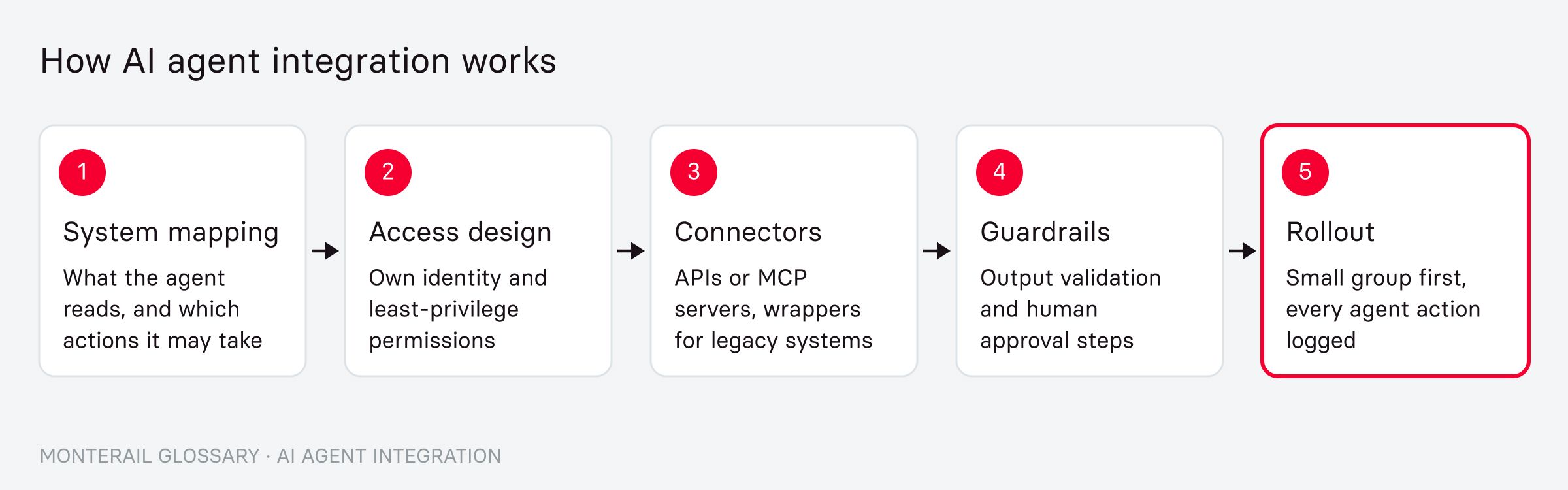
AI agent integration runs in five steps, from mapping the systems involved to a monitored rollout.
System mapping. The team lists the systems the agent needs, what it reads from each and which actions it may take. Each action is rated by how hard it is to undo.
Access design. Each agent gets its own identity and only the permissions its job requires. Neo4j's Andreas Kollegger makes the same case for scoping agent tools by role in Why AI Agents Need Knowledge Graphs.
Connector build. The team builds or configures connectors to each system through its API or an MCP server, and adds a thin service layer for older systems whose APIs fall short.
Guardrails and approvals. Everything the agent produces is checked before it reaches a system of record, and costly actions wait for a person to approve them. Donato Capitalla explains why LLM output should be treated as untrusted input in LLM Application Guardrails.
Rollout and monitoring. The integrated agent goes to a small group first, with every action logged. Failures are reviewed before access widens.
What Is the Difference Between an Integrated AI Agent and a Standalone AI Assistant?
An integrated agent reads from and acts in business systems under set permissions, while a standalone assistant works in a separate chat window and depends on people to move information in and out.
Factor | Integrated AI agent | Standalone AI assistant |
Where it works | Inside existing tools and workflows | In a separate chat interface |
Data it sees | Live records from connected systems, limited by role | Whatever the user pastes or uploads |
What it can do | Update records and trigger workflows, within approval rules | Produce text that a person then acts on |
Audit trail | Each action logged against the agent's own identity | System changes are made and logged by people |
Setup effort | Weeks of connector and access work | Ready once licenses are assigned |
Security exposure | The agent's system permissions need guarding | Centered on what users paste into the tool |
Challenges to plan for: Every write permission an agent holds can be misused if a malicious email or document slips instructions into its input, so integration budgets need security testing and approval steps that slow some actions down. Connectors also need upkeep whenever a connected system changes its API.
How Does Monterail Approach AI Agent Integration?
Monterail builds AI layers into the platforms clients already run, validating output before it reaches users. The two examples below are AI features integrated into live products, and the same integration work carries over to agents.
For Cooleaf, an employee engagement platform and a 12-year Monterail client, enterprise customers spent 40 to 100 hours per account each quarter going through eNPS survey responses. Monterail built an LLM analysis layer directly into the platform, and manual analysis dropped to near zero. Cooleaf’s customer success team, which supports key accounts with analytics, became 40% more efficient.
For Simfoni, Monterail connected Claude on AWS Bedrock to customers’ spend data and added a validation step that cross-checks the numbers the model produces. The proof of concept went into the live product as Insights AI, where one click produces a ready-to-send report.
Simfoni CTO Alan Buxton explains on Monterail's The New Default how guardrails for unfamiliar data matter in spend classification, where models meet "data that it's never been trained on before."
When Should You Bring In an AI Agent Integration Partner?
A partner helps when an agent must act across several systems of record at once. It also helps when those systems are older and lack clean APIs, or when security reviews will examine every permission the agent holds. If your team only needs an engineer who has built agent access controls before, staff augmentation adds that skill.
Monterail's AI development services cover the path from a working prototype to AI running inside the systems your teams already use. Talk to our AI team about the workflow you want an agent to join.
FAQ About AI Agent Integration
Need expert help with AI Agent Integration?
Monterail builds custom software solutions that leverage the latest technologies. Let's discuss how we can help with your project.
EXPLORE AI SERVICESEXPLORE AI SERVICES