The New Default. Your hub for building smart, fast, and sustainable AI software
Data Encryption
Data encryption is the process of converting readable data into ciphertext with an algorithm and a key, so that only holders of the right key can turn it back.
What Is Data Encryption?
Encryption decides whether stolen data is worth anything to the person who stole it. A laptop left in a taxi or a database dump posted online is a serious incident when the files are readable, and a much smaller one when they are ciphertext without the key.
The algorithms themselves are public and well tested. AES, the standard for most stored data, was published by NIST in 2001 and is still the default choice today. What keeps encrypted data safe is the secrecy of the key, so most of the practical work in encryption is deciding who holds the keys and where they live.
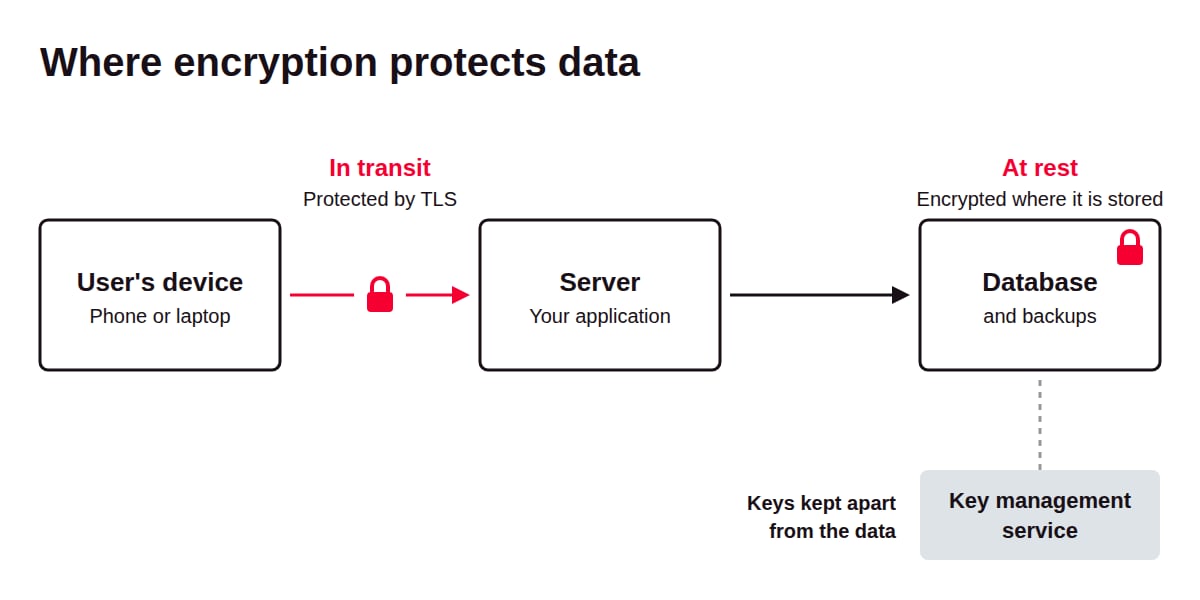
In software products, encryption shows up in two main places. Data in transit is protected while it moves between a user's device and a server, usually with TLS. Data at rest is protected where it is stored, in databases and backups.
Why Does Data Encryption Matter for Software Products?
Encryption is one of the few security controls that still protects data after other defenses have failed, which is why regulators name it directly.
It limits what a breach exposes. Firewalls and access controls aim to keep attackers out. Encryption assumes some will get in anyway and makes sure what they copy is unreadable without keys they do not have.
Data protection law gives it specific weight. Under GDPR Article 34(3)(a), a company does not have to notify affected individuals of a breach if the data was rendered unintelligible to unauthorized people, with encryption named as the example. The supervisory authority may still need to be told under Article 33. In US healthcare, HHS guidance treats health data encrypted to NIST standards as "secured," and HIPAA's breach notification rule applies only to unsecured data.
How Does Data Encryption Work?
An encryption algorithm combines readable data with a key to produce ciphertext, and the matching key reverses the process.
Algorithms and keys. The algorithm is the fixed recipe, such as AES. The key is a long random value, typically 128 or 256 bits for AES, that makes each encryption unique. Without the key, recovering the data means trying every possible key, which is not feasible at those lengths.
Encryption in transit. When a browser connects to a site over HTTPS, the two sides use TLS to agree on a fresh session key and encrypt everything they exchange with it. TLS 1.3, published in 2018, is the current version, though TLS 1.2 is still widely deployed.
Encryption at rest. Stored data can be encrypted at several levels, from the whole disk down to individual sensitive fields such as a national ID number. The narrower the layer, the fewer people and processes ever see the plaintext.
Envelope encryption. Large systems do not encrypt every record with one master key. Each piece of data gets its own data key, and those data keys are themselves encrypted by a master key held in a key management service. Rotating the master key then means re-encrypting only the small data keys instead of all the data.
Key management. Keys are generated, stored, rotated on a schedule, and eventually destroyed. Regular rotation limits how much data any single key protects, so one leaked key exposes less.
What Tools Do Teams Use for Data Encryption?
Most teams do not write encryption code themselves. They rely on managed services for keys and certificates, and on the encryption built into their databases and cloud storage.
Cloud key management services: AWS Key Management Service (KMS), Google Cloud KMS, and Azure Key Vault. These store master keys and handle envelope encryption for the provider's other services, logging every use of a key for audit.
Self-hosted secrets and encryption services: HashiCorp Vault (now part of IBM) and Thales CipherTrust Manager. These suit companies that run across several clouds or on-premises, or that need keys held outside any single cloud provider.
TLS certificate management: Let's Encrypt, AWS Certificate Manager, and cert-manager for Kubernetes. These issue and renew the certificates that TLS depends on, so encryption in transit does not lapse when a certificate expires.
What Are the Key Characteristics of Strong Data Encryption?
Strong encryption comes from using standard algorithms correctly, and most of what that means is visible in how keys are handled.
Public, peer-reviewed algorithms. Security should depend on the key alone, with the method open to inspection. Home-grown or proprietary ciphers are a warning sign, because they have not survived years of public attack.
Authenticated encryption. Modern modes such as AES-GCM both hide the data and detect tampering. If an attacker flips a single bit of the ciphertext, decryption fails instead of returning corrupted data that looks valid.
Keys stored apart from the data. A key sitting in the same database or code repository as the ciphertext protects almost nothing. Strong setups keep keys in a dedicated service or hardware security module (HSM), a tamper-resistant device built to hold keys.
Crypto-agility. Systems are built so an algorithm or key length can be swapped without redesigning the application. This matters now because today's public-key algorithms will need replacing as quantum computing matures.
What Are the Benefits of Data Encryption?
The main benefit is that a copy of the data stops being a copy of the information, and the business case builds from there.
Smaller breach consequences. A stolen backup or a lost device holding encrypted data becomes an inventory problem instead of a disclosure. The response becomes rotating credentials and replacing hardware instead of contacting every affected customer.
Easier enterprise sales. Security questionnaires and audits such as SOC 2 ask directly how data is encrypted at rest and in transit. A clear answer, backed by managed key services and logs, shortens procurement reviews.
Control over who can read data in the cloud. With customer-managed keys, the cloud provider stores the data, but the customer's own policies decide who may use the key, and every use is logged. Disabling the key cuts off access to that data at once.
Safe disposal. Destroying an encryption key makes every copy of the data encrypted with it unreadable, including copies in old backups. This technique, called crypto-shredding, is often the only practical way to erase data spread across many systems.
Access boundaries inside the company. Field-level encryption means a support agent or analyst with database access still cannot read a customer's card number or health record unless their role is granted the key.
What Are the Challenges of Data Encryption?
The math is rarely where encryption fails. The hard parts are managing keys and living with what encryption does to everyday features.
Keys become the target. Once data is encrypted, whoever controls the keys controls the data. A managed KMS centralizes that control and logs it, but every encrypt and decrypt call now depends on that service being available, and high-volume workloads pay per request.
Encrypted fields are hard to search. A database cannot filter or sort on a field it cannot read. Deterministic encryption, which always turns the same input into the same ciphertext, allows exact-match lookups again, but it lets an observer see which records share a value.
Disk encryption does not stop application-level attacks. When an attacker steals an application's credentials, the database decrypts data for them as it would for any other user. Field-level encryption with separate keys closes that gap, at the cost of more code and more keys to manage.
Losing a key means losing the data. No support ticket recovers ciphertext without its key. Backing keys up in more places protects against loss, but each extra copy is one more place a key can leak from.
Quantum computers threaten today's public-key algorithms. Attackers can record encrypted traffic now and decrypt it later once the hardware exists. NIST published its first post-quantum standard, ML-KEM (FIPS 203), in August 2024, but switching to it means larger keys and handshakes and changes across every system that negotiates encryption.
What Is the Difference Between Symmetric and Asymmetric Encryption?
Symmetric encryption uses one shared key to lock and unlock data, while asymmetric cryptography uses a public key to lock and a separate private key to unlock. Most production systems use both together.
Symmetric encryption | Asymmetric (public-key) cryptography | |
Keys | One secret key, shared by both sides | A key pair: a public key anyone can have, a private key only the owner holds |
Common algorithms | AES, ChaCha20 | RSA, elliptic-curve schemes, ML-KEM |
Speed | Fast enough for bulk data | Far slower, used on small payloads |
Typical job | Encrypting stored data and session traffic | Exchanging session keys and verifying identity |
Key distribution | Both sides need the key before communicating | The public key can be shared openly |
In a TLS connection, asymmetric encryption sets up a shared session key, and symmetric encryption then protects the rest of the traffic.
FAQ about Data Encryption
Need expert help with Data Encryption?
Monterail builds custom software solutions that leverage the latest technologies. Let's discuss how we can help with your project.
GET IN TOUCHGET IN TOUCH