The New Default. Your hub for building smart, fast, and sustainable AI software
Data Pipeline
An automated process that carries data from where it is created to where it is used, reshaping it on the way.
What Is a Data Pipeline?
A data pipeline is an automated sequence of steps that moves data from its source systems to a destination where it can be used, transforming it along the way. It handles extraction, validation, transformation, and loading, and runs on a schedule or continuously without manual intervention.
The need arises because data is created in one shape and consumed in another. An application database is designed for fast individual record writes. An analytics query needs to aggregate millions of records across several systems at once. Running that query against the production database would be slow and would degrade the application. The pipeline is what bridges the two.
A pipeline is defined as much by its reliability as by its logic. Sources go offline, and schemas change without notice. Records arrive malformed, and jobs fail halfway through. A pipeline that works when everything behaves is a script. A pipeline that detects failure and can be re-run without corrupting its destination is engineering.
What Can Data Pipelines Do for My Business?
Analytics dashboards and machine learning models depend on data arriving reliably in a usable form. So does every operational report.
Strategic Advantage: Reliable pipelines are what make data-informed decisions possible at an organizational level. Without them, analysis is a manual exercise repeated by hand, so it happens rarely and inconsistently. With them, the same numbers are available to everyone continuously, which is the difference between an organization that reviews performance quarterly and one that responds weekly.
The Problem It Solves: It eliminates manual data assembly, which is slow and hard to repeat. It also resolves the conflict between operational and analytical workloads by moving analysis off production systems onto infrastructure built for it.
How Does a Data Pipeline Work?
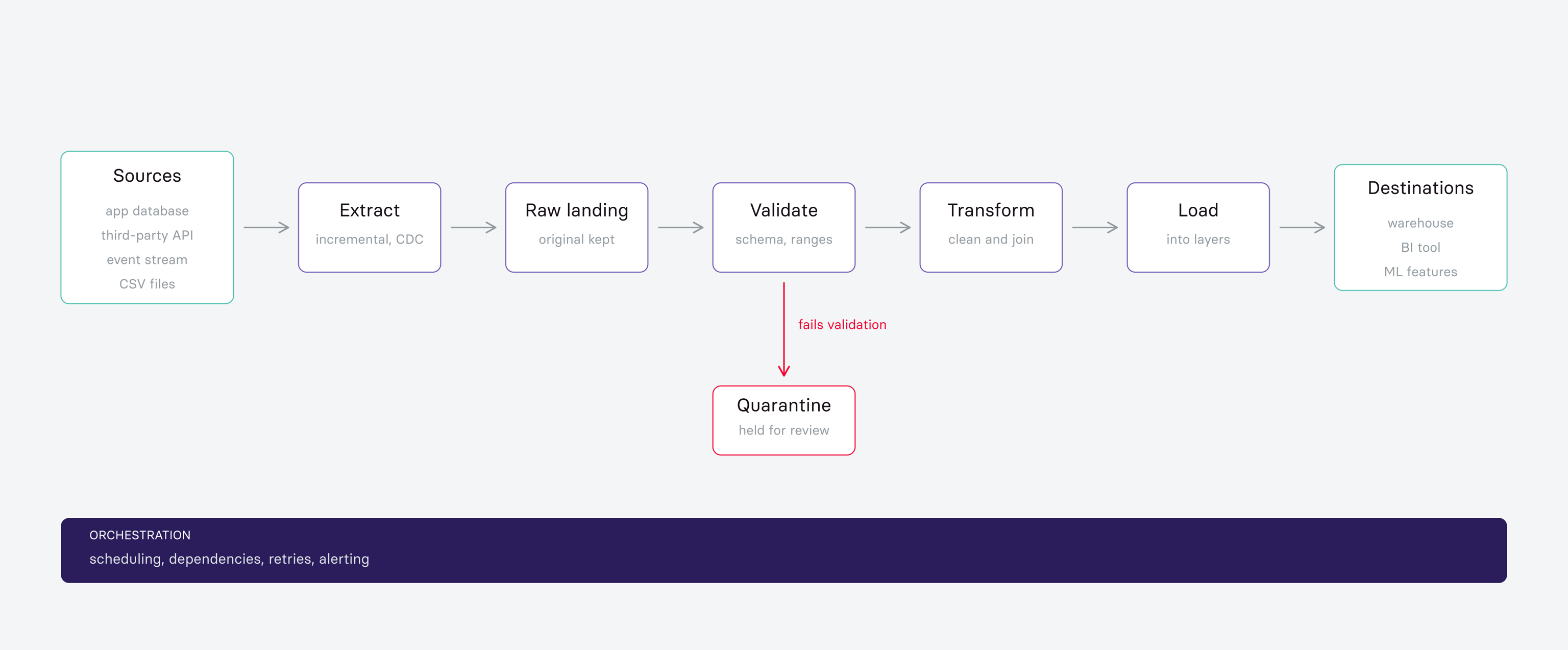
A pipeline is a sequence of stages with defined failure behavior, orchestrated so dependencies run in the right order.
Extraction. Data is pulled from sources: application databases, third-party APIs, event streams, files, SaaS platforms. Incremental extraction (taking only records changed since the last run) is the norm, since full reloads become impractical as volume grows. Change data capture reads the database transaction log directly, avoiding queries to production tables.
Ingestion and landing. Raw data is written to storage in its original form before any transformation. Keeping this raw copy matters: when a transformation bug is found months later, the original data is still available to reprocess.
Validation. Incoming data is checked against expectations for schema, type, range, null rate, and volume. Upstream changes are the most common cause of pipeline failure, and validation turns silent corruption into a caught error.
Transformation. Data is cleaned, deduplicated, joined across sources, and reshaped into models designed for querying. This is where business logic lives: revenue definitions, customer segment rules, currency conversion, and calendar alignment.
Loading. Transformed data is written to its destination (a warehouse, a lakehouse, a search index, or a feature store) organized in layers, from raw through cleaned to business-ready aggregates.
Orchestration. A scheduler manages execution order, dependencies, retries, and alerting. Modern orchestrators track not only which jobs ran, but also which datasets are current, so downstream steps wait for valid inputs instead of a clock.
Monitoring and data quality. Beyond job success, pipelines monitor freshness, row counts, distribution shifts, and referential integrity. A job that completes successfully while loading nothing is a failure that success-based alerting misses entirely.
How Do Batch, Streaming, and Micro-Batch Data Pipelines Compare?
Batch processing. Data is processed in scheduled groups, usually hourly or daily. Simpler to build and reason about, and adequate for most reporting and analytics.
Stream processing. Records are processed continuously as they arrive, within seconds. Necessary for fraud detection, real-time personalization, and operational alerting, and much harder to build correctly because of out-of-order arrival and the need to manage state.
Micro-batch. Small batches run every few minutes, giving near-real-time freshness with much of batch processing's simplicity. This is the right compromise for a large share of cases where teams initially assume they need streaming.
What Is the Typical Technology Stack for a Data Pipeline?
Orchestration: Apache Airflow, Dagster, Prefect, Mage.
Extraction and loading: Fivetran, Airbyte, Stitch, Meltano for managed connectors; Debezium for change data capture.
Transformation: dbt as the dominant tool for SQL-based transformation in the warehouse; Apache Spark for large-scale distributed processing; Polars and DuckDB for efficient single-machine work.
Streaming: Apache Kafka, Apache Flink, Amazon Kinesis, Google Pub/Sub, Redpanda.
Storage destinations: Snowflake, BigQuery, Databricks, Amazon Redshift, ClickHouse; open table formats including Apache Iceberg and Delta Lake.
Data quality: Great Expectations, Soda, dbt tests, Monte Carlo and Elementary for observability.
Catalog and lineage: DataHub, OpenMetadata, Atlan, Collibra.
What Are the Key Characteristics of a Data Pipeline?
Automated and scheduled. Execution requires no human involvement, which is what makes consistent, frequent data delivery possible.
Idempotent. Re-running the same step produces the same result without duplicating data, which makes recovery from partial failure safe.
Validated at boundaries. Data is checked as it enters and leaves each stage, so upstream changes are caught instead of propagated into reports.
Raw data retained. The original extract is kept, allowing reprocessing when transformation logic is corrected or extended.
Dependency-aware. Steps run in the correct order, and downstream work waits for valid upstream output.
Observable. Freshness and volume are monitored, and so is quality, because the most damaging failures complete successfully.
Version-controlled. Pipeline logic lives in a repository with review and testing, treated as software.
What Are the Benefits of Data Pipelines?
Consistent, trustworthy numbers. Business logic is defined once in the pipeline, so different teams stop arriving at different figures for the same metric.
Analysis without impact on production. Moving analytical workloads off operational databases removes the risk that a heavy query degrades the customer-facing application.
Data available quickly enough to act on. Automated refresh replaces manual assembly, changing the reporting cycle from whenever someone has time to continuous.
Errors caught before they reach decisions. Validation stops malformed or incomplete data at the boundary, before it surfaces as an inexplicable figure in a board report.
A shared foundation for machine learning. Models need reliable, reproducible feature data. The same pipeline infrastructure serves both analytics and machine learning, which avoids parallel data plumbing.
Analyst time spent on analysis. Data professionals who aren't manually collecting and cleaning data can focus on the questions the data was collected to answer.
What Are the Challenges and Trade-offs of Data Pipelines?
Upstream schema changes break pipelines constantly. Source systems change without notifying downstream consumers. Validation catches it; nothing prevents it, which makes this a permanent maintenance cost rather than a solvable problem.
Silent failures are the dangerous ones. A job that succeeds while loading zero rows, or that quietly drops records, is worse than one that crashes, because nobody investigates. Monitoring freshness and volume catches these.
Streaming is much harder than it looks. Out-of-order events, late arrivals, exactly-once semantics, and state management make streaming pipelines more complex to build and operate. Many teams adopt streaming and discover that micro-batch would have met the actual requirement.
Transformation logic accumulates undocumented complexity. Business rules embedded across dozens of transformation steps become difficult to understand or change, particularly once the people who wrote them have moved on.
Cost scales with inefficiency. Cloud warehouses charge for compute, so poorly written transformations and unnecessarily frequent full refreshes produce large bills. Incremental processing is a cost decision as much as a performance one.
Reprocessing history is expensive. Correcting a transformation bug means re-running against historical data, which is slow and costly for large datasets. Retaining the raw layer is what makes it possible at all.
When Should You Use ETL Instead of ELT?
Factor | ETL | ELT |
Order of operations | Transform before loading | Load raw, then transform in place |
Where transformation runs | Separate processing layer | The destination warehouse |
Raw data availability | Usually discarded | Retained for reprocessing |
Reprocessing history | Requires re-extraction | Re-run transformation on stored raw data |
Suits | Constrained destinations, pre-load filtering | Cloud warehouses with elastic compute |
Current prevalence | Legacy and specific cases | The default modern approach |
FAQ About Data Pipelines
Building AI-powered Data Pipeline solutions?
Monterail's AI engineering team designs and delivers intelligent software that drives real business outcomes. Let's build together.
EXPLORE AI SERVICESEXPLORE AI SERVICES