The New Default. Your hub for building smart, fast, and sustainable AI software
EHR and FHIR Integration
Connecting a health app to hospital record systems, usually through the FHIR data standard.
What Is EHR and FHIR Integration?
EHR and FHIR integration connects a healthcare application to electronic health record (EHR) systems so the two can exchange patient data. Modern connections usually run on HL7 FHIR, a standard that exposes health data through web APIs. Clinicians see the app's data inside their usual workflow. The app reads clinical records without manual re-entry.
Monterail has delivered 900+ projects since 2010, including 75+ health products, and builds health software to standards including HIPAA and the European Health Data Space (EHDS).
What Does EHR and FHIR Integration Include?
An EHR integration engagement covers the product side of the connection, from scoping the data to monitoring it in production, while the hospital controls access to its own system.
What it includes
Integration scoping: which records the product reads, which it writes back and which EHRs its customers run
A choice of integration path: SMART on FHIR, direct vendor APIs or an integration middleware platform
FHIR API connections using SMART on FHIR authorization
Data mapping that turns EHR records into the product's own data model
Security controls for patient data, from encryption at rest and in transit to immutable audit logs
Testing in vendor sandboxes and staging environments with production-like constraints
Monitoring and maintenance after launch
What it doesn't include
EHR vendor developer-program fees and middleware subscriptions
Configuration on the hospital's side, such as activating the app inside its EHR
Business associate or data-sharing agreements, which the client and the hospital sign
Building or replacing the EHR system itself
When Does EHR and FHIR Integration Fit?
EHR integration fits when a product's value depends on clinical data or on clinicians using it inside their existing systems.
It fits when
Clinicians need your product's data inside the EHR they already use, without switching screens
The product needs medications or lab results from the hospital record to work
You sell to US hospitals or health systems that expect a standards-based connection during procurement
Your EU roadmap includes EHR interoperability under the European Health Data Space
It doesn't fit when
The product is a consumer wellness app with no clinical users. Phone health platforms such as Apple Health or Google Fit can supply the data it needs.
You are still validating the workflow, in which case manual entry or CSV uploads can carry the first pilots.
One clinic needs a monthly data export, and a scheduled file transfer covers that at lower cost.
Dozens of EHRs need connecting at once. An integration middleware platform absorbs the per-vendor differences faster than direct connections.
What Are the Benefits of EHR and FHIR Integration?
EHR integration puts a product's data where clinicians already work, which often decides whether a hospital adopts the product at all.
Clinician adoption. Data that appears inside the EHR spares clinicians a second login and a second screen, so they are more likely to use it.
No double entry. Records move between systems automatically, which cuts manual re-keying and the transcription errors that come with it.
Richer product features. Access to medications and lab results lets the product personalize alerts or care plans with clinical context.
Security reviews start from a known standard. SMART on FHIR uses OAuth 2.0 scopes, so hospital IT reviews an established authorization model instead of a custom one.
How Does EHR and FHIR Integration Work?
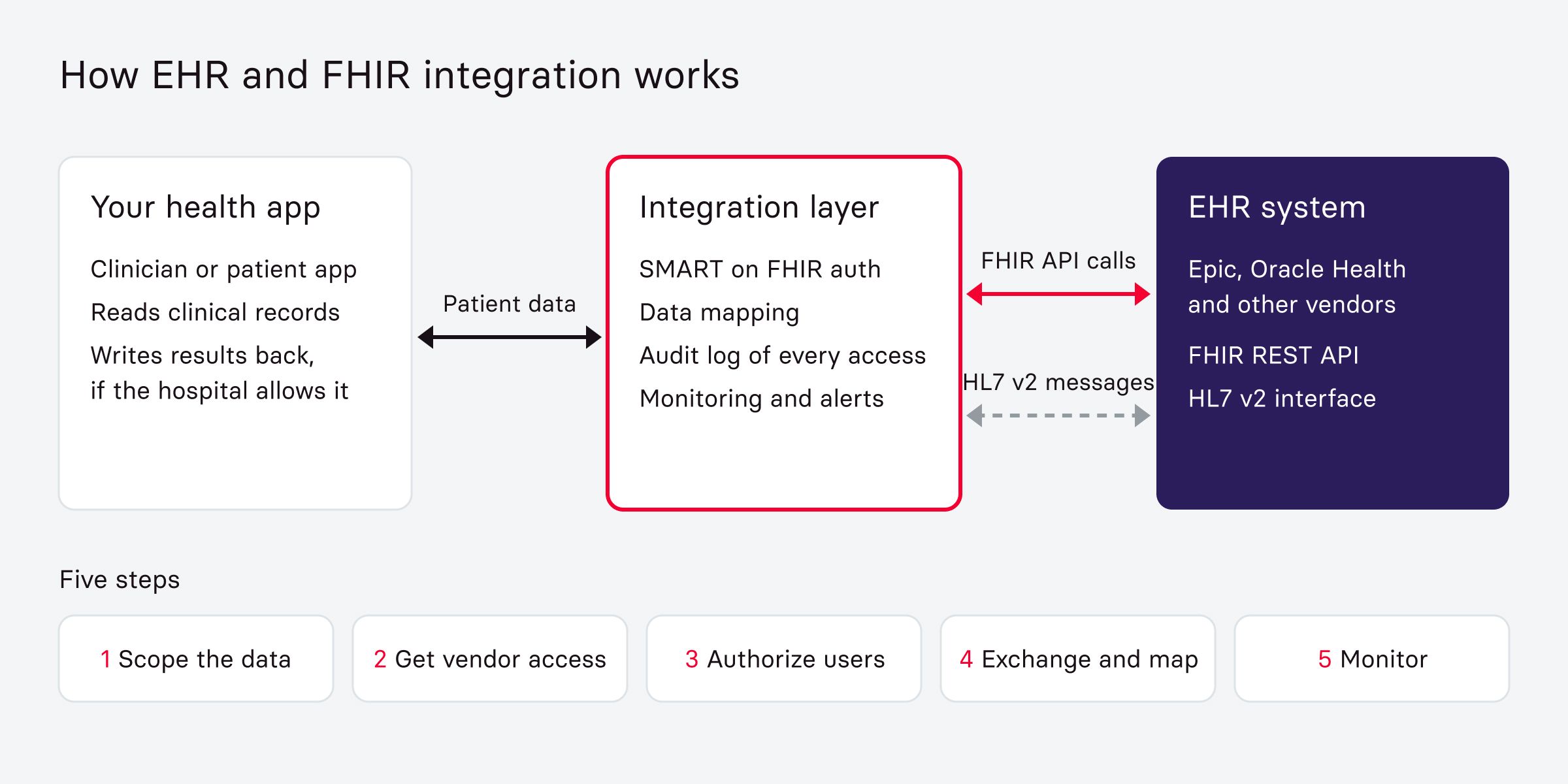
An EHR integration works in five steps, from scoping the data to monitoring the live connection.
Scope the data. The team defines which FHIR resources the product needs, such as Observation or MedicationRequest, and whether it only reads them or also writes back. Narrow scopes are easier for hospitals to approve.
Get vendor access. The app is registered with each EHR vendor's developer program, for example, Epic on FHIR, and built against its sandbox. Production access comes later, once a hospital customer approves the connection.
Authorize users. SMART on FHIR uses OAuth 2.0, so the app receives scoped access tokens instead of storing passwords. It can also launch from inside the EHR with the current patient already selected.
Exchange and map the data. The app calls the EHR's FHIR REST API, or receives HL7 v2 messages through an interface engine where a hospital still relies on them. A mapping layer then converts the data into the product's own model and absorbs differences between vendor implementations.
Monitor and maintain. Audit logs record every access to patient data, and alerts flag failed calls before clinicians notice missing information. EHR upgrades can change how an API behaves, so the connection needs ongoing maintenance.
For a deeper walkthrough, including how to choose between SMART on FHIR, vendor APIs, and middleware, see Monterail's EHR integration guide for HealthTech startups.
What Is the Difference Between HL7 v2 and FHIR?
HL7 v2 is the older, message-based standard still running inside many hospital systems, while FHIR is the newer, API-based standard that most new product integrations are built on.
Factor | HL7 v2 | HL7 FHIR |
Data model | Event-driven messages, such as an admission or a lab result | Resources, such as Patient or Observation, accessed through an API |
Transport | Usually exchanged over hospital networks through an interface engine | RESTful web APIs over HTTPS, using JSON or XML |
Main use | Admissions, orders, lab reporting, and billing inside a hospital | Apps reading and writing patient data, including patient-access apps |
Authorization | Set up through network and interface configuration | OAuth 2.0 through SMART on FHIR |
Developer tooling | Specialist interface engines and HL7 parsers | Standard web development tools and open-source FHIR libraries |
Regulatory direction | Remains widely installed in hospital systems | US rules on certified health IT call for standardized APIs |
Challenges to plan for: Vendor approval and hospital IT reviews can take longer than writing the integration code, so request access early in the project. Each EHR connection also carries ongoing maintenance, because vendor upgrades can change how an API behaves. For the wider landscape of systems around the EHR, see health information technology.
How Does Monterail Approach EHR and FHIR Integration?
Monterail treats an EHR connection as part of the product's architecture, with the same security controls as the rest of a health product.
Those controls are listed on Monterail's healthcare compliance and security page: encryption at rest and in transit, role-based access control and immutable audit logs. Monterail's HealthTech Director, Piotr Zając, sets out the integration approach in the EHR integration guide. It starts vendor approvals earlier than feels necessary and builds for production environments from the start.
The same integration discipline runs through Monterail's connected-device work. For Remedee Labs, makers of a wristband that earned CE marking as a Class IIa medical device and FDA Breakthrough Device designation, Monterail built native apps that sync with Apple Health and Google Fit. Machine learning then personalizes each stimulation session using sleep, activity, and sun-exposure data.
When Should You Bring In an EHR Integration Partner?
A partner helps when your first hospital customer is waiting on the integration. It also helps when your team hasn't worked with FHIR or EHR vendor programs before. If you only need one engineer with interoperability experience inside your team, staff augmentation adds that skill.
Monterail's healthcare software development services cover health products from discovery to regulated release. Talk to our HealthTech team about the systems your product needs to reach.
FAQ About EHR and FHIR Integration
Need expert help with EHR and FHIR Integration?
Monterail builds custom software solutions that leverage the latest technologies. Let's discuss how we can help with your project.
EXPLORE HEALTHTECH SERVICESEXPLORE HEALTHTECH SERVICES