What Is Health Information Technology?
A patient's history only helps if it reaches the person treating them. Health IT is the plumbing that carries it there, from the lab to the doctor and from one hospital to the next, so decisions are made on the full record instead of whatever the patient remembers.
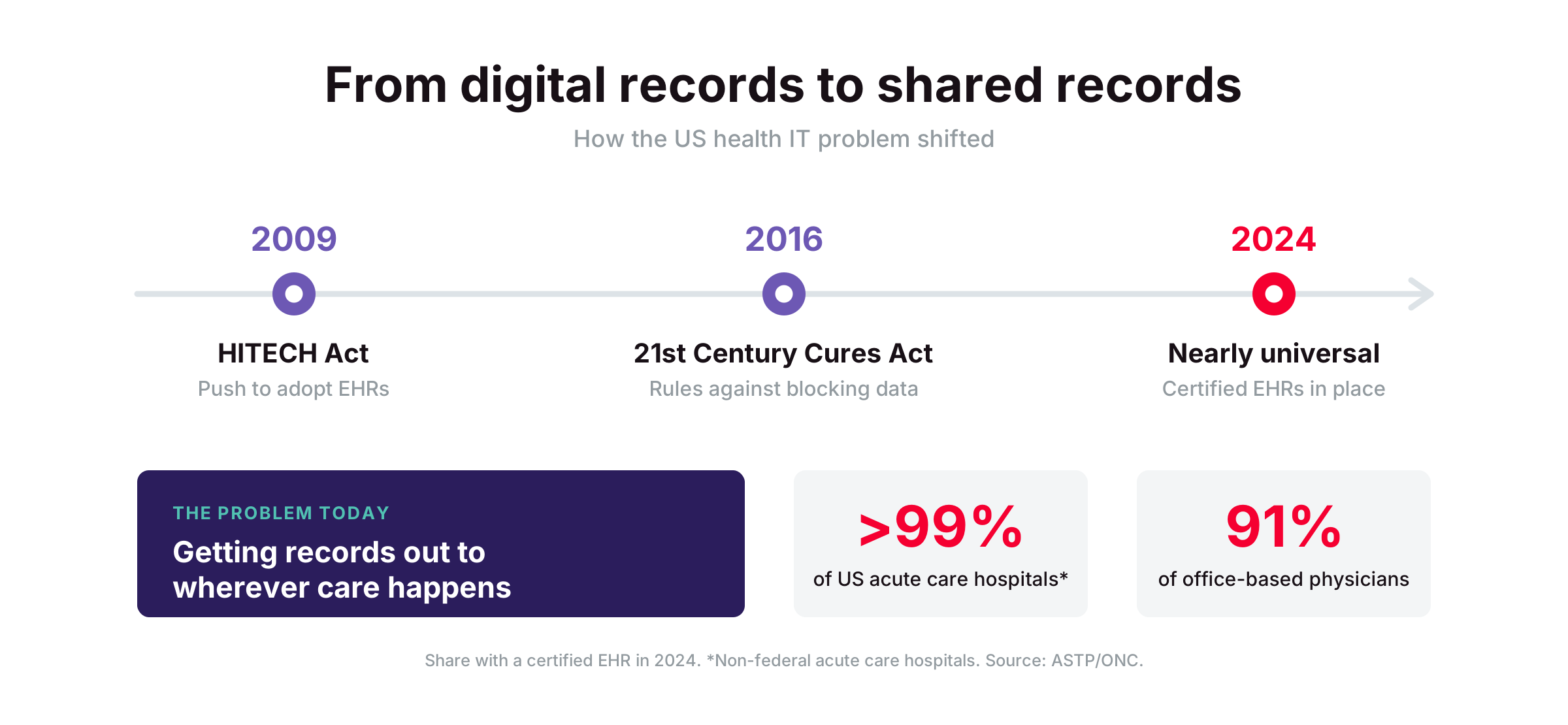
In the US, the systems are now nearly everywhere. As of 2024, nearly all non-federal acute care hospitals (over 99%) and 91% of office-based physicians had adopted a certified EHR, according to the federal health IT office, ASTP/ONC. The open problem has shifted from getting records into computers to getting them out again, to wherever they are needed.
Much of that adoption followed the HITECH Act, signed into law on February 17, 2009 to promote "the adoption and meaningful use of health information technology." The 21st Century Cures Act of 2016 then targeted the next problem: systems that hold data but do not share it.
Why Does Health Information Technology Matter?
It is the system of record for care. Clinical decisions and billing both draw on the electronic health record. Any new product that touches care eventually has to read from it or write to it.
Sharing data is now a legal expectation. Under the Cures Act's information blocking rules, healthcare providers and developers of certified health IT, among others, can be found in violation for practices likely to interfere with access to electronic health information, unless an exception applies.
How Does Health Information Technology Work?
Electronic health records (EHRs). The EHR holds a patient's clinical record, from diagnoses to lab results, and is the hub most other health IT connects to.
Health information exchange. The federal health IT office describes directed exchange, which sends information such as referrals or discharge summaries to a known recipient, and query-based exchange, which lets a provider find a patient's information held by other providers.
Shared standards. HL7 FHIR defines how systems exchange data through APIs. Terminology standards such as SNOMED CT for clinical concepts and LOINC for tests and observations give the same finding the same code in every system.
Certification. The ONC Health IT Certification Program checks EHRs against federal criteria, giving hospitals and physicians a common baseline when choosing a system.
Access controls and audit trails. The HIPAA Security Rule requires technical measures that allow only authorized people to access electronic health data, along with audit controls that record who viewed what.
What Tools Make Up Health Information Technology?
EHR platforms. Epic, Oracle Health (formerly Cerner), and MEDITECH are among the EHR systems used by hospitals and health systems.
Integration platforms. Rhapsody and Redox translate and route data between EHRs and other systems, so a new application does not need a custom connection to every hospital.
Patient-facing access. Patient portals such as Epic's MyChart let patients see their test results and medications, and third-party apps can connect through the patient-access APIs that EHRs expose using FHIR.
What Are the Key Characteristics of Health Information Technology?
Built around a long-lived core. Hospitals keep an EHR for many years, so new tools are usually designed to plug into it instead of replacing it.
Regulated mainly as data systems. The 21st Century Cures Act removed electronic patient record functions from the FDA's medical device definition, as long as the records are part of certified health IT and the software does not interpret them to diagnose or treat a condition. Software that does interpret records that way can still be a medical device.
One record, many readers. Clinicians and billing staff read the same record for different purposes, so data entered for one job has to hold up for the other.
Coded data over free text. Structured codes make data reusable across systems, while free-text notes stay easier to write but harder to share or analyze.
What Are the Benefits of Health Information Technology?
Fuller information at the point of care. A clinician can see medications and results recorded elsewhere, which reduces repeated tests and missed interactions.
Fewer transcription errors. Electronic prescribing and lab ordering remove handwriting and re-typing from the chain between decision and action.
Patients can see their own data. Portals and patient-access APIs give people their results and records without requesting paper copies.
Data for population health and research. Coded records from many patients can be analyzed to track outcomes or spot trends that no single chart would show.
What Are the Challenges of Health Information Technology?
Documentation burden. Detailed records take clinician time to create. AI-assisted documentation and medical scribes reduce typing, but add review steps and cost, and the clinician still signs off on the result.
Interoperability in practice. Standards define the format, but each vendor and each hospital configures them differently. Integration engines absorb much of that variation, but add another vendor and another contract to the data chain.
Concentrated security risk. Centralizing records makes them easier to use and a bigger target. Stronger controls such as multi-factor authentication reduce that risk, but add friction to every login during a busy shift.
Switching costs. Replacing an EHR means data migration and retraining every user. Staying put avoids that disruption, but ties the organization to its current vendor's roadmap and pricing.
What Is the Difference Between an EMR and an EHR?
Aspect | Electronic medical record (EMR) | Electronic health record (EHR) |
What it is | A digital version of the paper chart in a clinic or hospital | A record built to go beyond the clinical data collected in one provider's office |
Main users | The practice that created it | Authorized providers across different organizations |
Data sharing | Holds notes collected by and for the practice's own clinicians | Designed to share information with other health care providers |
Typical use | Diagnosis and treatment within one practice | Coordinating care across settings, such as a specialist referral or hospital discharge |
Standards needed | An internal format can be enough | Exchange standards such as HL7 FHIR |