What Is a Healthcare App?
People already manage their banking and travel from a phone, and they expect the same from their care. A healthcare app meets that expectation, but once it touches health data or medical decisions it picks up rules that a banking app never faces.
Two questions decide which rules apply: who the app works for, and what it claims to do. In the US, HIPAA applies when a developer handles patient information on behalf of a provider. In an example published by HHS, a consumer who downloads an app on her own and enters her own blood glucose readings is not using a HIPAA-covered service, while an app a provider contracts for patient management is.
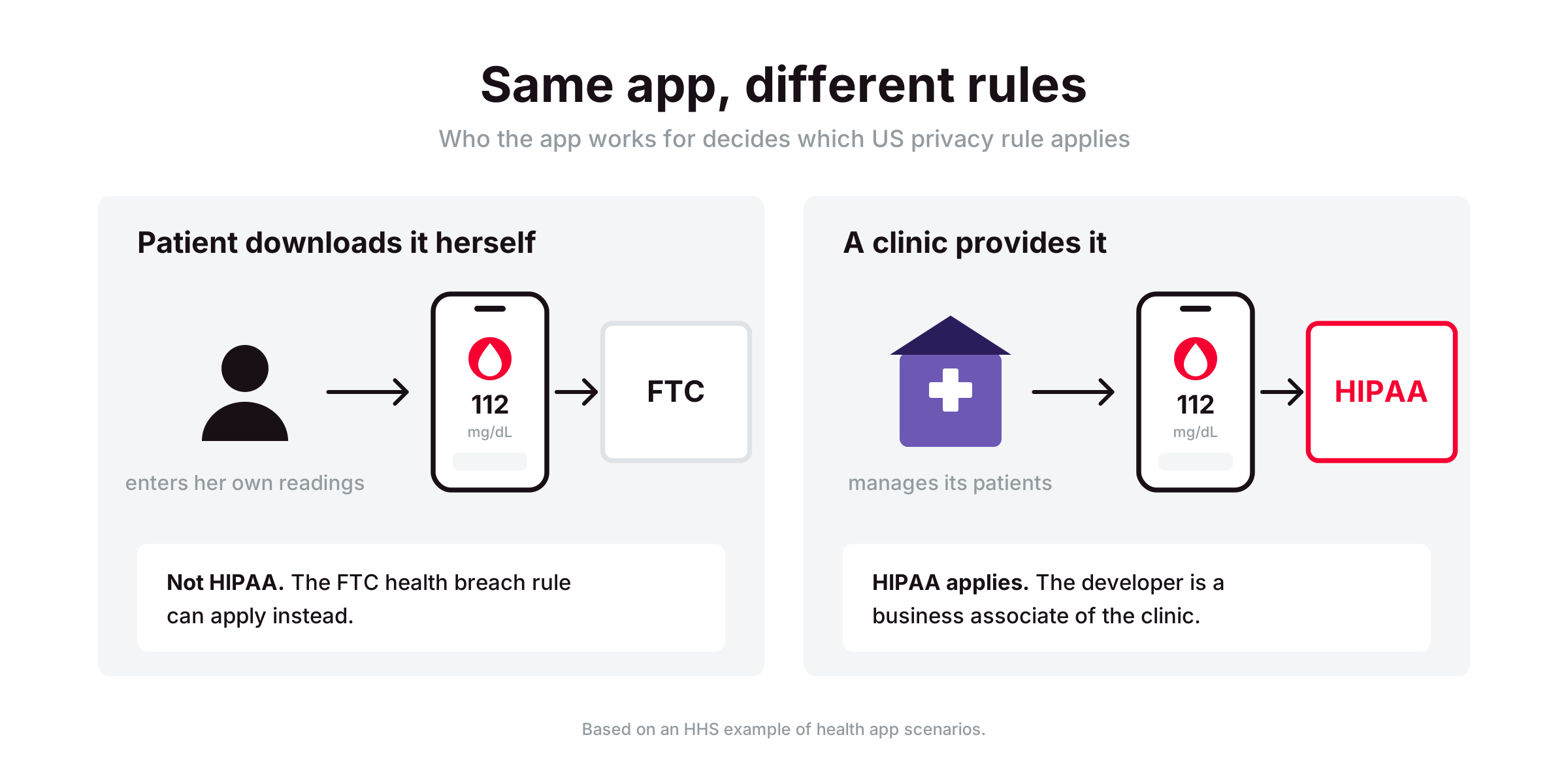
Apps outside HIPAA still face rules. The FTC's Health Breach Notification Rule, clarified in July 2024 to cover makers of health apps, treats sharing health data without the user's authorization as a breach. On the clinical side, the FDA focuses its oversight on app functions that meet the medical device definition and could put patient safety at risk if they fail.
Why Do Healthcare Apps Matter?
They are often where patients meet the health system. Booking appointments and viewing results now happen in apps for many patients, so an app's quality shapes how people experience their care.
App stores add a second gatekeeper. Apple reviews medical apps "with greater scrutiny" and requires apps to disclose the data and methodology behind health measurement claims. It also bars using HealthKit data for advertising or marketing.
How Is a Healthcare App Built?
Regulatory scoping first. Before design, the team establishes whether any feature is a medical device and whether HIPAA or the FTC rule applies. Those answers shape the architecture and the testing plan.
Privacy built into the data model. The app collects only the data it needs and asks for clear consent. Store rules add constraints too: Apple does not allow personal health information to be stored in iCloud.
Integrations. Many healthcare apps read data from wearables through Apple HealthKit or Android Health Connect, or exchange records with EHR systems through FHIR APIs.
Accessible design. Patients vary widely in age and ability, so teams design to accessibility standards such as WCAG from the first screens.
Validation and store review. Features with medical claims need evidence that they work as described, and Apple asks apps that have regulatory clearance to submit a link to that documentation.
What Tools Do Teams Use to Build Healthcare Apps?
Cross-platform frameworks. Flutter and React Native let one team build iOS and Android apps from a shared codebase.
Health data platforms. Apple HealthKit and Android Health Connect let apps read and write health and fitness data with the user's permission, including data from wearables.
EHR connectivity. Epic on FHIR gives developers free access to resources for building apps used by patients and healthcare organizations, and Redox connects an app to multiple EHR systems through a single API.
What Are the Key Characteristics of Healthcare Apps?
Sensitive data by default. Apple's own review rules call health and medical data "especially sensitive," and most healthcare apps handle some of it from the first screen.
Two very different audiences. Patient apps have to work for people with varied health literacy, while clinician apps have to fit into busy workflows where every extra tap costs time.
Access on someone else's behalf. Parents and family caregivers often manage care for someone else, so many healthcare apps need proxy access with its own permission rules.
Ongoing platform change. Mobile operating systems and store rules change regularly, so a healthcare app needs a maintenance budget long after launch.
What Are the Benefits of Healthcare Apps?
Access outside clinic hours. Patients can book appointments and check results without waiting for the phone lines to open.
Continuity between visits. Reminders and tracking features keep patients engaged with a treatment plan between appointments.
Patient-reported data for care teams. Symptoms and readings logged in an app give clinicians a fuller picture than a single visit provides.
Less routine phone traffic. Self-service booking and messaging can take simple requests off front-desk staff.
What Are the Challenges of Healthcare Apps?
Feature creep into device territory. A feature that interprets readings can turn a wellness app into a medical device. Keeping claims narrow avoids that, but limits what the app can promise and charge for.
Privacy versus product analytics. Third-party analytics and advertising tools can pass health data to other companies, and the FTC treats sharing health data without authorization as a breach. Removing those tools protects users, but leaves the product team with less insight into how the app is used.
Integration effort. Each EHR vendor and each health system configures its APIs differently. Integration platforms reduce the per-site work, but add another vendor that handles patient data.
Security without friction. Strong authentication protects health data, but every extra login step makes patients more likely to give up before reaching their results.
What Is the Difference Between Patient-Facing and Clinician-Facing Healthcare Apps?
Aspect | Patient-facing apps | Clinician-facing apps |
Main users | Patients and their caregivers | Clinicians and other care staff |
Typical features | Booking appointments and tracking symptoms | Viewing records and documenting care |
Design priority | Clarity for people with varied health literacy and abilities | Speed inside busy clinical workflows |
US privacy rules | HIPAA when offered on behalf of a provider; otherwise the FTC's rules can apply | Usually HIPAA, since they handle patient information for a provider |
Distribution | Public app stores | Often rolled out by the employer to staff devices |