The New Default. Your hub for building smart, fast, and sustainable AI software
Telemedicine App Development
Software that lets patients consult clinicians remotely, covering the full workflow around the call: scheduling, documentation, prescribing, and billing.
What Is Telemedicine App Development?
Telemedicine app development is the process of building applications that let patients consult clinicians remotely, usually via video and audio or secure messaging. Beyond the consultation itself, these applications handle scheduling, clinical documentation, prescribing, payment, and integration with the provider's existing health record system.
The video call is the most visible part and the smallest part of the engineering. A consultation that produces no record and no billing entry hasn't replaced an appointment – it has added an unrecorded conversation. The work sits in the surrounding workflow: verifying identity, checking eligibility, capturing structured notes, issuing prescriptions through the relevant national system, and writing everything back to the health record.
Regulatory constraints shape the product heavily and vary by jurisdiction. Clinician licensing usually applies where the patient is located, which limits cross-border service. Rules on remote prescribing, particularly for controlled substances, differ by country and change frequently. Reimbursement eligibility often depends on the consultation modality, with video and audio-only treated differently.
Why Are Providers Investing in Telemedicine?
Remote consultation expanded sharply during the COVID-19 pandemic and has settled at a level far above its pre-2020 baseline, now established as a standard channel.
Strategic Advantage: Remote delivery removes geography as a constraint on capacity. A provider can serve patients across a whole region without additional premises, and use clinician time more efficiently by eliminating travel and room turnover. For specialties with national shortages, remote delivery is often the only practical way to reach demand.
The Problem It Solves: It addresses access barriers that prevent people from seeking care at all: distance from a clinic, inability to take time off work, lack of transport, limited mobility, and long waits for specialist referral. It also reduces missed appointments, which are consistently lower for remote consultations than for in-person ones.
How Does Telemedicine App Development Work?
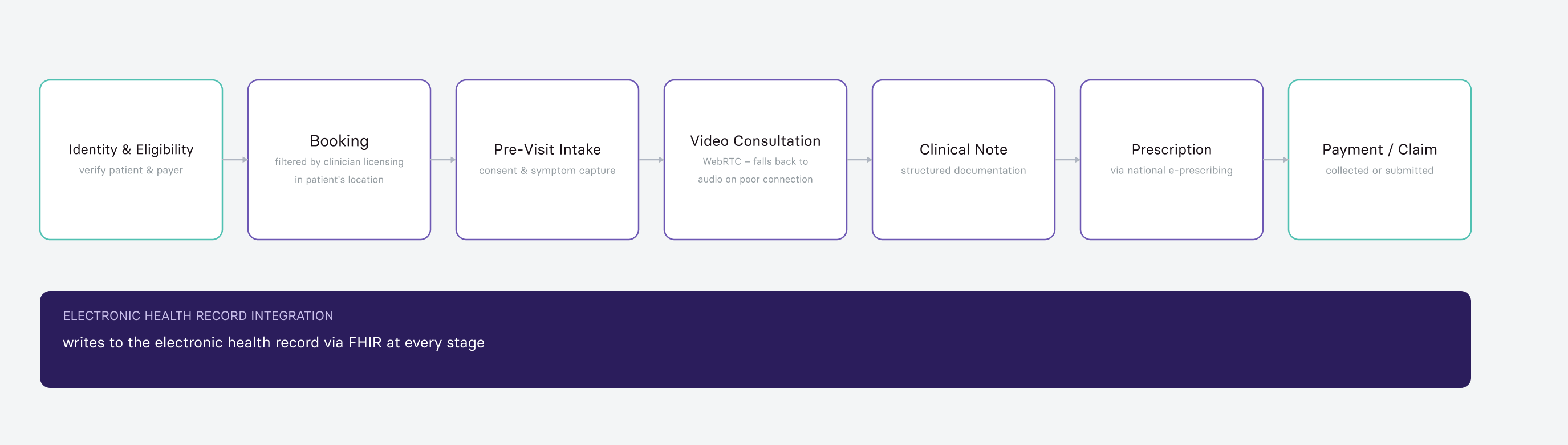
The system is built around a clinical workflow that begins before the consultation and continues after it.
Identity verification and eligibility. The patient is authenticated to the jurisdiction's required standard, and their insurance or payer eligibility is checked. For regulated prescribing, identity assurance requirements can be strict.
Scheduling and clinician matching. Availability is managed across clinicians whose licensing covers the patient's location, accounting for specialty, language, and appointment type. This is more constrained than ordinary calendar booking because licensing rules restrict which clinicians may see which patients.
Pre-consultation intake. Structured questionnaires, symptom capture, photo or document upload, and consent collection happen before the appointment, so clinical time is spent on assessment data entry.
The consultation session. Real-time video and audio run over WebRTC, usually through a managed platform providing selective forwarding and recording where consent permits. Engineering priorities are connection reliability on poor networks and a waiting-room model that gives both parties a clear session state.
Clinical documentation. The clinician records the encounter in structured form, increasingly with template or transcription support. The note must reach the electronic health record, not remain in the telemedicine platform, or the patient's record becomes fragmented.
Prescribing and referral. Prescriptions are issued through the applicable national electronic prescribing infrastructure, with rules differing by country and by drug schedule. Referrals and test orders follow the same requirement to integrate with existing systems.
Payment and claims. Payment is collected directly or a claim is submitted to the payer, using the codes and modality indicators that determine reimbursement eligibility.
Follow-up. Post-consultation instructions, results delivery, secure messaging, and repeat scheduling close the loop and are where much of the ongoing patient relationship lives.
Which Tools Build a Telemedicine App?
Real-time communication: WebRTC as the underlying standard, with managed platforms such as Twilio Video, Vonage, Daily, LiveKit, or Amazon Chime SDK handling media routing and network resilience.
Mobile and web: React Native, Flutter, or native Swift and Kotlin for apps; Vue with Nuxt or React with Next.js for web.
Backend: Node.js, Python with Django or FastAPI, Ruby on Rails, or .NET, with PostgreSQL for structured data.
Health record integration: HL7 FHIR APIs, HL7 v2 interfaces, and integration platforms such as Redox or Mirth Connect. In the US, SMART on FHIR supports launching an application inside the EHR user interface.
Infrastructure: HIPAA-eligible services on AWS, Azure, or Google Cloud under a business associate addendum; equivalent GDPR-compliant EU-region deployment in Europe.
Supporting services: identity verification providers and payment processing with healthcare-specific claim handling.
What Are the Key Characteristics of Telemedicine App Development?
Licensing rules constrain the product. Which clinician may treat which patient depends on jurisdiction, and booking logic must enforce this.
Connection reliability outweighs video quality. A consultation that drops mid-assessment is worse than one at reduced resolution. To avoid failure, systems are designed to degrade to lower bitrate and then to audio.
Documentation and prescribing integration are mandatory. A consultation must produce the same clinical and administrative artifacts as an in-person visit, which means writing to the health record and the prescribing system.
Accessibility is a functional requirement. Patients include older people and those with limited digital confidence or a sensory impairment. A joining flow requiring account creation and app installation excludes a meaningful share of the intended population.
Privacy applies to the session and the data. Consultations are protected health information in transit. Encryption and controlled recording with explicit consent are core requirements, alongside preventing unauthorized session access.
Reimbursement rules shape the feature set. Whether a consultation is funded may depend on modality, patient location, prior relationship, and documented consent, so the product must capture and report these accurately.
What Are the Benefits of Telemedicine App Development?
Wider access to care. Patients in rural areas or without reliable transport gain access to consultations that were previously impractical.
Better use of clinician time. Eliminating travel and room turnover raises the number of consultations possible in a session, and remote work lets providers draw on clinicians who cannot practise on site.
Lower missed appointment rates. Attendance is consistently higher for remote appointments than for equivalent in-person ones, which recovers capacity that would otherwise be lost.
Faster access to specialists. Remote consultation allows specialist opinion without regional referral delay, which matters most for conditions where waiting time affects outcome.
Continuity for chronic care. Routine review appointments for stable long-term conditions work well remotely, and greater convenience improves the consistency with which patients attend them.
What Are the Challenges and Trade-offs of Telemedicine App Development?
Clinical limitations. Remote consultation cannot support physical examination, and some conditions cannot be assessed safely without one. Products need clear escalation paths to in-person care, and clinicians need latitude to require it.
Licensing and prescribing rules are complex and shifting. Cross-border and interstate practice is restricted, and compliance requirements differ by jurisdiction. This is legal complexity that lands in the product logic.
Digital exclusion affects the populations with greatest need. Older patients and those in areas with poor connectivity are often the ones who'd benefit most. Telephone fallback and simple joining flows are necessary.
Health record integration is the largest engineering cost. Each provider's system differs, and integration frequently exceeds the cost of the consultation platform itself.
Care fragmentation is a risk. Standalone telemedicine services that do not write to the patient's main record create incomplete histories, which is clinically worse than the access problem they aim to solve.
Reimbursement is not guaranteed. Funding rules for remote consultation have changed repeatedly, and a business model dependent on a particular reimbursement code carries policy risk.
Telemedicine or In-Person Consultation: Which Fits?
Factor | Telemedicine | In-Person |
Physical examination | Not possible | Available |
Patient travel | None | Required |
Missed appointment rate | Lower | Higher |
Suitable for | Review, triage, mental health, follow-up | Diagnosis needing examination, procedures |
Clinician capacity per session | Higher | Lower |
Technology dependency | Connectivity and device required | None |
FAQ About Telemedicine App Development
Need expert help with Telemedicine App Development?
Monterail builds custom software solutions that leverage the latest technologies. Let's discuss how we can help with your project.
GET IN TOUCHGET IN TOUCH