The New Default. Your hub for building smart, fast, and sustainable AI software
IoMT (Internet of Medical Things)
Connected medical devices and sensors that stream patient data to clinical systems.
What Is the Internet of Medical Things (IoMT)?
The Internet of Medical Things is the network of connected medical devices and software that collect patient data and transmit it to clinical systems. It spans everything from hospital equipment like infusion pumps to wearables like continuous glucose monitors and devices implanted in the body.
IoMT is the healthcare-specific form of the Internet of Things, and the medical context substantially changes the engineering requirements. A connected thermostat that fails is an inconvenience. An infusion pump that misdelivers a dose, or a cardiac monitor that fails to raise an alert, can cause serious harm. Reliability and security sit at the center of IoMT work, under a regulatory compliance burden most connected-device categories don't have to carry.
The category divides usefully into three groups. In-hospital devices connect to clinical networks and feed data into electronic health records. Remote patient monitoring devices sit with patients at home and transmit readings between appointments. Implanted and body-worn devices operate continuously with severe constraints on power and processing.
Is IoMT Worth the Investment?
Conventional care generates data only during appointments. IoMT produces a continuous record, which changes what clinicians can detect and when they can act.
Strategic Advantage: Continuous monitoring supports care models that were previously impossible, including hospital-at-home programs and management of chronic conditions between visits. In several health systems these models are now reimbursed, giving providers a direct financial reason to adopt monitoring platforms and creating a substantial market for the software behind them.
The Problem It Solves: It closes the observation gap between appointments. A patient with heart failure seen quarterly is unmonitored for roughly ninety days at a time, and deterioration typically develops over days. Continuous data allows intervention before a condition escalates to emergency admission, which is both better clinically and considerably cheaper.
How Does IoMT Work?
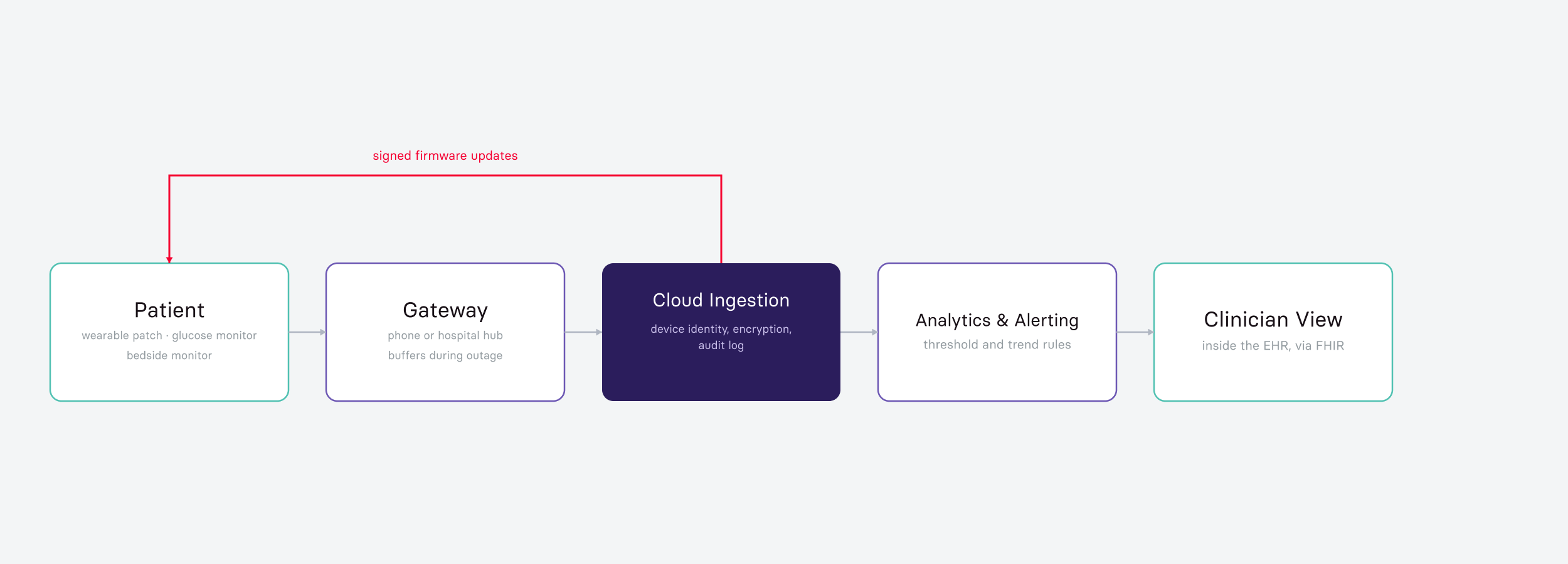
An IoMT system moves data from a sensor on or near a patient into a clinical system where it can drive a decision, with reliability and security requirements at every step.
Sensing. A device measures a physiological signal – heart rhythm, blood glucose, oxygen saturation, blood pressure, respiratory rate – usually with on-device filtering to discard noise and reduce transmission volume.
Local connectivity. Body-worn and implanted devices typically use Bluetooth Low Energy to reach a nearby phone or hub, chosen for power efficiency. Hospital equipment uses Wi-Fi or wired Ethernet on segregated clinical networks. Devices needing wide-area independence use cellular IoT protocols such as LTE-M or NB-IoT.
Gateway and buffering. A phone application or dedicated hub aggregates readings, buffers them when connectivity drops, and forwards them upstream. Buffering matters: a monitoring system that silently loses data during a network outage is clinically unsafe.
Cloud ingestion and storage. A device management platform authenticates each device, ingests time-series data at scale, and stores it with the audit trail that health data requires.
Analysis and alerting. Rules or models evaluate incoming data against thresholds and trends, generating alerts for clinical review. Alert design is a serious clinical safety problem in its own right, because excessive false positives lead staff to ignore alarms.
Clinical system integration. Relevant data and alerts flow into the electronic health record through FHIR or HL7 interfaces, so clinicians see them in their normal workflow.
Device lifecycle management. Firmware updates, certificate rotation, battery and calibration monitoring, and end-of-life handling are managed remotely across a fleet that may number in the tens of thousands.
Which Technologies Power IoMT Devices?
Connectivity: Bluetooth Low Energy, Zigbee, Wi-Fi, LTE-M, NB-IoT, and LoRaWAN for long-range low-power cases.
Embedded development: C and C++ on ARM Cortex-M microcontrollers, Zephyr and FreeRTOS as real-time operating systems, Rust where memory safety is prioritized.
Device management and ingestion: AWS IoT Core with HealthLake, Azure IoT Hub with Azure Health Data Services, Google Cloud IoT alternatives, and time-series stores such as TimescaleDB or InfluxDB.
Integration: HL7 FHIR resources for observations and devices, HL7 v2 for older hospital interfaces, IEEE 11073 for personal health device communication.
Standards and regulation: IEC 60601-1 for electrical medical equipment safety, IEC 62304 for medical device software lifecycle, ISO 14971 for risk management, IEC 81001-5-1 for health software security, and FDA premarket cybersecurity expectations including a software bill of materials.
What Are the Key Characteristics of IoMT?
Continuous data capture. Measurement happens constantly or at frequent intervals, producing trend information that a single clinic reading cannot provide.
Severe power and processing constraints. Devices expected to run for years on a small battery cannot perform heavy computation or transmit constantly, which shapes every design decision from sampling rate to encryption choice.
Safety-critical failure modes. A missed alert or a lost reading has clinical consequences, so systems are designed for fail-safe behavior and explicit handling of degraded conditions.
Long device lifespans. Medical devices remain in service for years, and implanted devices for a decade or more. Software must be maintainable and securely updatable across that period, long after the original development team has moved on.
Regulated and audited by design. Most IoMT devices are regulated medical devices requiring formal risk management and documented verification, with post-market surveillance continuing after release.
Interoperability with clinical systems is mandatory. Data that cannot reach the electronic health record has little clinical value, so standards-based integration is a core requirement.
What Are the Benefits of IoMT?
Earlier detection of deterioration. Continuous trends reveal changes days before a scheduled appointment would, allowing intervention while it is still straightforward.
Fewer avoidable admissions. Remote monitoring programs for chronic conditions such as heart failure and COPD are associated with reduced hospitalization, which is where most of the cost benefit accrues.
Objective data instead of recall. Continuous measurement replaces patient self-report, which is unreliable for symptoms that fluctuate or occur during sleep.
Better use of clinical capacity. Monitoring platforms let a small team oversee a large patient population by exception, escalating only cases whose data warrants attention.
Care outside hospital walls. Hospital-at-home and post-surgical monitoring programs depend on connected devices, freeing inpatient beds while keeping patients in a setting most prefer.
What Are the Challenges and Trade-offs of IoMT?
Security exposure is significant and well documented. Medical devices have repeatedly been found running unpatched operating systems with hardcoded credentials and unencrypted communication. A compromised device can expose patient data or, in the worst case, be manipulated. Regulators, including the FDA, now require cybersecurity documentation for premarket submissions.
Alert fatigue undermines clinical value. Systems generating frequent false alarms train staff to dismiss them, which is a patient safety hazard. Alert thresholds require clinical tuning and continual review.
Data volume outpaces clinical capacity to use it. Continuous monitoring across a large population produces far more data than clinicians can read. Without effective filtering and summarization, the information is collected and ignored.
Fragmented standards complicate integration. Despite FHIR and IEEE 11073, many manufacturers use proprietary formats, so multi-vendor deployments need per-device integration work.
Patient adherence limits effectiveness. Devices must be charged and worn correctly to work as intended. Adherence commonly declines within weeks, so program design matters as much as device engineering.
Update and support obligations run for years. Maintaining security patches for a decade-old implanted device is a genuine engineering and commercial commitment, and some manufacturers have failed to meet it.
Medical Device or Consumer Wearable: What Differs?
Factor | IoMT Medical Devices | Consumer Wearables |
Regulatory status | Regulated medical device | Usually general wellness product |
Accuracy requirement | Clinically validated | Not required to be validated |
Clinical use | Suitable for diagnosis and treatment | Informational; not for diagnosis |
Data destination | Electronic health record | Consumer app |
Support lifespan | Years to a decade or more | Typically two to four years |
Cost | Hundreds to thousands per unit | Tens to hundreds |
FAQ About IoMT
Need expert help with IoMT (Internet of Medical Things)?
Monterail builds custom software solutions that leverage the latest technologies. Let's discuss how we can help with your project.
GET IN TOUCHGET IN TOUCH