The New Default. Your hub for building smart, fast, and sustainable AI software
Knowledge Graph
A database designed so relationships are stored and searched directly, instead of being pieced together from separate records.
What Is a Knowledge Graph?
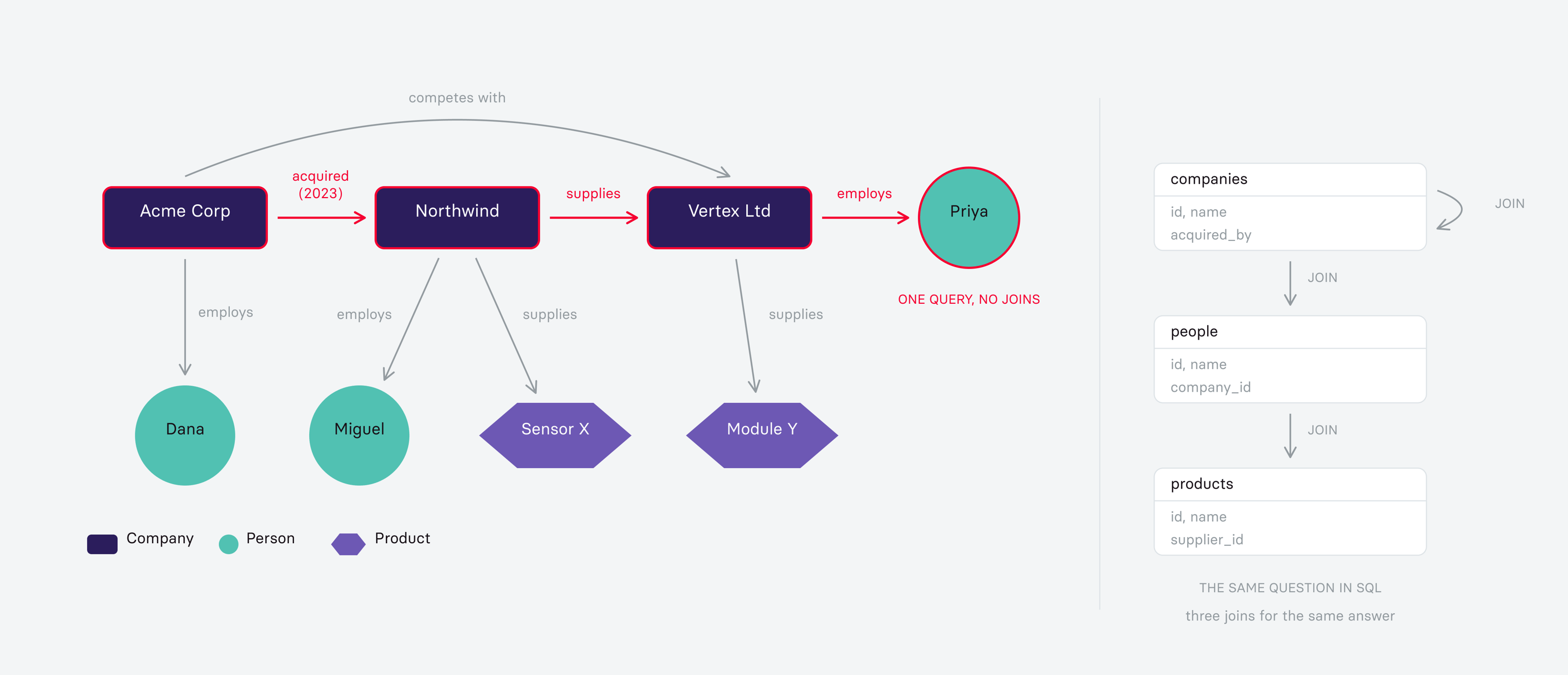
A knowledge graph stores information as a network of entities and the relationships between them. Each entity (e.g., a product or a company) is a node, and each relationship is a labeled connection, which makes the connections themselves queryable data.
The difference from a relational database is where relationships live. In a relational model, the connection between a customer and an order exists as a foreign key, discovered by joining tables. In a graph, the relationship is stored explicitly, has a type, and can carry its own properties: "acquired," with a date and a transaction value attached.
This matters for questions that traverse many connections. Finding which suppliers are indirectly affected by a factory closure four steps down a supply chain requires four joins in SQL, and the cost grows sharply with depth. A graph database follows stored connections directly, so traversal cost depends on how many relationships are actually walked, independent of total table size.
Is a Knowledge Graph Good for My Business?
Most organizations hold data whose value lies in its connections, split across systems that record only their own fragment.
Strategic Advantage: A knowledge graph provides a single connected view across previously separate sources. In practice, this supports capabilities that are hard to build otherwise: recommendations based on multi-step relationships, and fraud detection through ring structures where each record looks legitimate on its own. Supply chain risk analysis and drug discovery research depend on the same property. The competitive value lies in the curated relationships, which are expensive for a competitor to reproduce.
The Problem It Solves: It addresses questions that cross system boundaries and relationship depth. "Which of our enterprise customers share a parent company with a customer who churned last quarter, and which of our staff have worked with both?" requires connected data. Traditional warehouses answer aggregate questions well and connection questions poorly.
How Does a Knowledge Graph Work?
A knowledge graph combines a data model with a store optimized for traversal, plus a process for keeping it current.
Defining the ontology. The schema specifies which entity types exist, which relationships are permitted, and the properties each carries. This modeling work determines what the graph can answer, and it is where most of the intellectual effort sits.
Entity extraction and ingestion. Data arrives from databases, APIs, and documents. Structured sources map fairly directly. Unstructured text requires NLP to identify entities and the relationships asserted between them, increasingly with language models performing the extraction.
Entity resolution. Records referring to the same real-world thing must be merged. "IBM," "International Business Machines," and "I.B.M." are one company, and deciding this reliably across millions of records is usually the hardest part of building a knowledge graph.
Storing as nodes and edges. Data is written to a graph database where each relationship is a direct pointer between nodes, which is what makes traversal fast regardless of overall dataset size.
Querying by traversal. Queries express patterns to match: find all paths from this node to any node of that type within three hops, where relationships meet given conditions. Graph query languages such as Cypher, Gremlin, and SPARQL are built around this pattern-matching model.
Inference over stored facts. Some graph systems derive new facts from existing ones through rules (if A is a subsidiary of B and B of C, then A is indirectly owned by C), reducing what must be stated explicitly.
Maintenance and quality. Graphs degrade as sources change and extraction errors accumulate. Ongoing validation and reconciliation are part of keeping a graph running.
What Tools Are Used to Build Knowledge Graphs?
Graph databases: Neo4j, Amazon Neptune, TigerGraph, ArangoDB, Memgraph; Apache Jena and GraphDB for RDF-based approaches.
Query languages: Cypher, now standardized as GQL; Gremlin for Apache TinkerPop; SPARQL for RDF graphs.
Standards for semantic graphs: RDF, OWL, and SHACL for expressing ontologies and validating conformance.
Extraction and resolution: spaCy and Hugging Face models for entity recognition, large language models for relationship extraction, Dedupe and Zingg or commercial master data management tools for entity resolution.
Public and reference graphs: Wikidata, DBpedia, and domain resources such as UMLS and SNOMED CT in healthcare.
Analytics: graph algorithm libraries for centrality, community detection, and shortest path, available in Neo4j Graph Data Science and equivalents.
What Are the Key Characteristics of a Knowledge Graph?
Relationships are first-class data. Connections have types and properties and can be queried and filtered in the same way as entities.
Traversal cost is local. Following relationships depends on the number of connections walked, which is why multi-hop questions stay fast as data grows.
The schema can evolve incrementally. New entity and relationship types are added without restructuring existing data, which suits domains where the model is still being discovered.
Heterogeneous sources are unified. Data from separate systems is connected through shared entities, giving one view without forcing everything into a single rigid table structure.
Semantics are explicit. Relationship types state meaning directly. A foreign key records that two rows are associated; an edge labeled "prescribed_for" records what the association is.
Quality depends on entity resolution. The graph is only as useful as its resolution. Duplicate entities fragment the network and produce incomplete answers to exactly the questions the graph was built for.
What Are the Benefits of Knowledge Graphs?
Multi-hop questions become practical. Queries spanning several relationships run efficiently, whereas the equivalent SQL becomes slow and hard to maintain.
Connected view across siloed systems. Entities appearing in several systems are linked once, giving a unified picture without a full data warehouse consolidation program.
Better recommendations and search. Relationship structure supports recommendations based on connections. It improves retrieval by expanding queries through related concepts.
Detection of structural patterns. Fraud rings and circular ownership are visible as graph structures while each record looks unremarkable.
Flexible evolution of the model. Adding a new relationship type does not require migrating existing data, which suits exploratory and research-driven domains.
More reliable grounding for AI systems. Combining a knowledge graph with retrieval-augmented generation gives language models structured facts and explicit relationships, improving accuracy on questions that require connected reasoning.
What Are the Challenges and Trade-offs of Knowledge Graphs?
Entity resolution is difficult. Matching records to real-world entities across inconsistent sources is the dominant cost in most projects, and errors propagate through every query.
Ontology design requires expertise and iteration. A poorly designed schema is costly to change once populated, and getting it right needs both domain knowledge and modeling experience.
Graph databases are weaker at aggregate analytics. Columnar warehouses do counting and grouping over large volumes best. Graphs answer connection questions well and aggregate questions comparatively poorly, so most organizations run both.
The skills are less common. Cypher, SPARQL, and graph modeling are unfamiliar to teams fluent in SQL, which adds ramp-up time and limits the hiring pool.
Maintenance is continuous. Sources change, and duplicates accumulate. A graph without ongoing quality work degrades to the point where its answers cannot be trusted.
Scale requires care. Very large graphs are difficult to partition, because relationships that cross partitions undermine the traversal performance the graph was chosen for.
Should I Use a Graph or SQL Database?
Factor | Knowledge Graph | Relational Database |
How relationships are stored | Explicit typed edges | Foreign keys resolved by joins |
Multi-hop queries | Efficient; cost scales with path | Degrades sharply with join depth |
Aggregate analytics | Comparatively weak | Strong |
Schema change | Incremental, low cost | Migration required |
Query language | Cypher, Gremlin, SPARQL | SQL |
Best suited to | Connected, evolving, heterogeneous data | Structured transactions and reporting |
FAQ About Knowledge Graphs
Building AI-powered Knowledge Graph solutions?
Monterail's AI engineering team designs and delivers intelligent software that drives real business outcomes. Let's build together.
EXPLORE AI SERVICESEXPLORE AI SERVICES