The New Default. Your hub for building smart, fast, and sustainable AI software
MLOps
The practices that keep a machine learning model accurate and dependable once it's live, when the data behind it keeps changing.
What Is MLOps?
MLOps is what it takes to keep a machine learning model working after it ships. It builds on DevOps, which assumes a system's behavior lives in its code. That assumption breaks for machine learning: behavior comes from training data, so the data needs versioning too, and accuracy decays as conditions change without any test failing.
Ordinary software behaves deterministically. Given the same input, it produces the same output, and a passing test suite establishes that it works. Machine learning breaks both assumptions. A model's behavior is determined by the data it was trained on, so reproducing a result requires the exact data and code, down to the configuration. And a model that was accurate in March can be wrong in September because the world moved, with no error raised and no test failing.
MLOps exists because these differences make conventional deployment practice insufficient. The discipline versions data alongside models and automates retraining. New versions roll out gradually, under monitoring.
Is MLOps Worth the Investment?
A trained model with good test metrics has commercial value only when it serves decisions reliably. The gap between a good model and a working one is usually deployment and maintenance capability.
Strategic Advantage: MLOps turns models from research outputs into operational assets. Teams with mature practice ship model improvements in days, because retraining and deployment run without manual steps. That cycle time compounds: a team that iterates weekly improves faster than one that redeploys twice a year.
The Problem It Solves: It addresses silent failure. An unmonitored model can degrade without alerting anyone, so a fraud model missing new fraud patterns or a demand forecast drifting out of calibration can cause losses that accumulate before anyone connects them to the model. Monitoring and scheduled retraining convert that hidden risk into a managed process.
How Does MLOps Work?
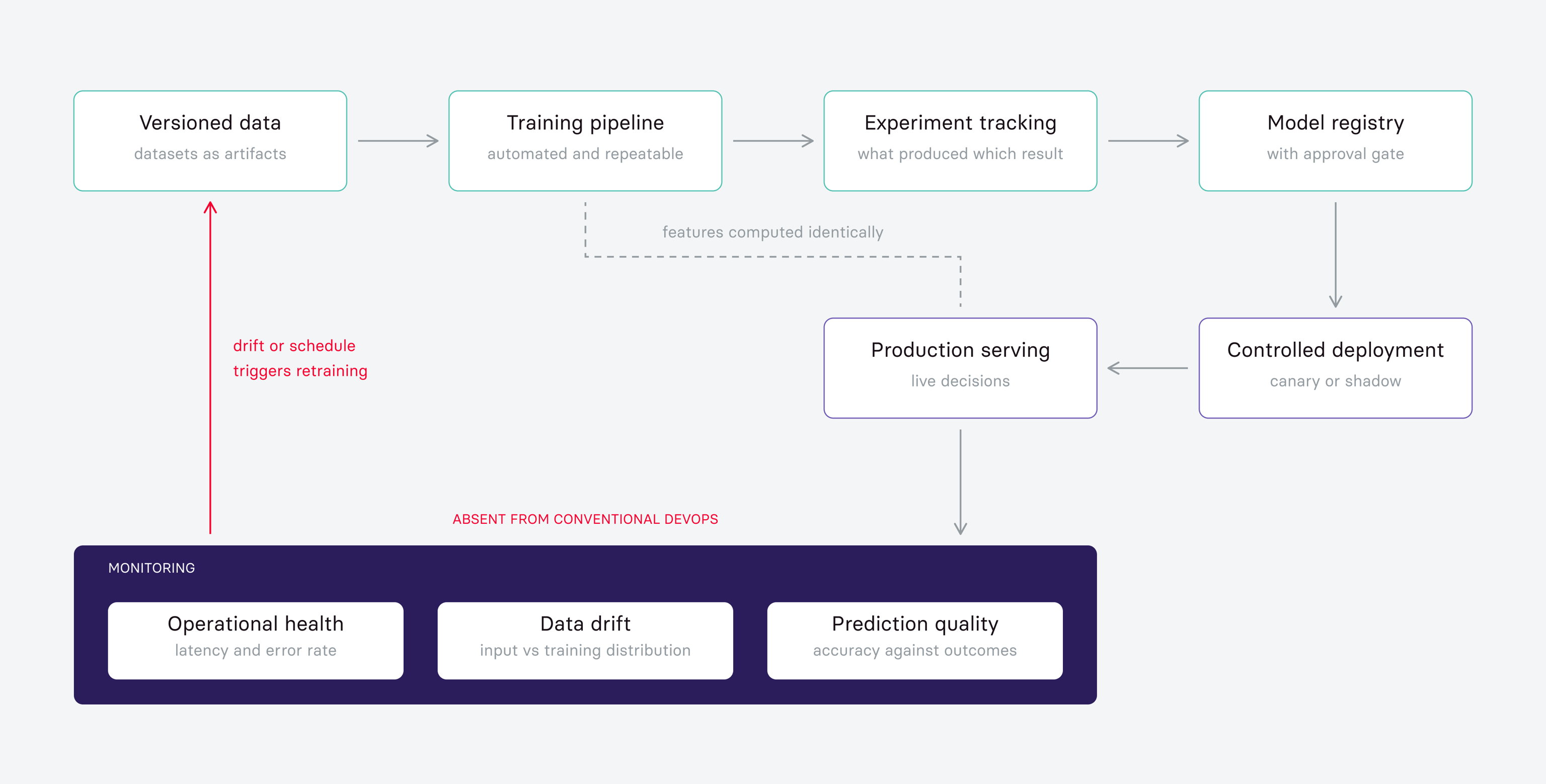
MLOps builds a pipeline covering the full path from data to a monitored production model, with automation at each stage.
Data versioning and validation. Training datasets are versioned so any model can be reproduced exactly. Incoming data is validated automatically against expected schema and value ranges, because upstream data changes are the most frequent cause of production model failure.
Experiment tracking. Every training run records the exact data and code it used, together with its hyperparameters and results. Without this, teams cannot reliably identify which configuration produced their best model or reproduce it later.
Automated training pipelines. Training is a scripted, repeatable pipeline, which is what makes retraining routine.
A model registry. Trained models are stored with full lineage and an approval status, alongside the metrics they were evaluated on, providing a controlled path from candidate to production and a record of what was deployed when.
Feature consistency between training and serving. Features must be computed identically in both contexts. Training-serving skew, where a feature is calculated one way in training and another in production, is a common and difficult-to-diagnose source of degraded accuracy, and feature stores exist to prevent it.
Controlled deployment. New model versions go out through shadow deployment or canary release, never direct replacement, so their real-world behavior is observed before they take full traffic.
Production monitoring. Three distinct things are watched: operational health (latency and error rate), data drift (whether incoming data resembles the training distribution), and prediction quality (accuracy against outcomes, once those become known).
Retraining and rollback. Retraining is triggered on a schedule or by drift detection, with automated validation gates before promotion. Rollback to the previous model version must be immediate, since a bad model deployment can be more damaging than a bad code deployment.
What Tools Are Used for MLOps?
Experiment tracking and registry: MLflow, Weights & Biases, Neptune.
Pipeline orchestration: Kubeflow Pipelines, Metaflow, Airflow, Prefect, Dagster.
Data and model versioning: DVC, LakeFS, Delta Lake.
Feature stores: Feast, Tecton, and the feature store components of Vertex AI and SageMaker.
Serving: BentoML, Seldon Core, KServe, TorchServe, NVIDIA Triton.
Monitoring: Evidently, WhyLabs, Arize, Fiddler for drift and quality; Prometheus with Grafana for operational metrics.
Managed platforms: AWS SageMaker, Google Vertex AI, Azure Machine Learning, Databricks – each bundling several of the above.
For language model applications: LangSmith, Langfuse, and Braintrust, addressing prompt versioning and output evaluation, sometimes distinguished as LLMOps.
What Are the Key Characteristics of MLOps?
Data is versioned alongside code. Reproducing a model requires the exact training data, so datasets are treated as versioned artifacts.
Retraining is automated and routine. Because models degrade, retraining is a scheduled pipeline with validation gates.
Monitoring covers quality and uptime. A model can be perfectly available and consistently wrong. Drift detection and accuracy tracking are what distinguish MLOps monitoring from conventional application monitoring.
Deployment is gradual and reversible. New models are exposed to a fraction of traffic first, with fast rollback available, because offline metrics do not fully predict production behavior.
Feature computation is shared between training and serving. The same code path produces features in both contexts, which eliminates a class of silent accuracy loss.
Lineage is traceable end to end. For any prediction, you can identify the model version and the exact data and code behind it. It's necessary for debugging and required in regulated settings.
What Are the Benefits of MLOps?
Models reach production. Automated, repeatable deployment paths remove the manual bottleneck where trained models accumulate in notebooks and never ship.
Degradation is caught before it costs money. Drift and accuracy monitoring surface problems while they are small, before a quarter of poor decisions has accumulated.
Faster iteration on model quality. When retraining and deployment are automated, improving a model takes days. Teams doing this manually iterate at a fraction of the rate.
Reproducibility and auditability. Versioning data alongside code and models means any past result can be reproduced and any past decision explained. That is a regulatory requirement in finance and healthcare, and increasingly under the EU AI Act.
Reduced dependence on individuals. Documented pipelines and registries mean model knowledge lives in the system, independent of the data scientist who built it.
Lower serving cost. Systematic monitoring of latency and resource use identifies where a smaller model or better batching would serve adequately at lower cost.
What Are the Challenges and Trade-offs of MLOps?
Tooling is fragmented and changes quickly. No single tool covers the full lifecycle well, so teams assemble several and maintain the integration. Choices made two years ago are often no longer the sensible default.
Infrastructure effort can exceed modeling effort. Building the pipelines and the monitoring around them is substantial engineering work, and for a single model with modest stakes it may not be justified.
Ground truth often arrives late or never. Measuring accuracy requires knowing the outcome. For a churn model that may take months, some decisions' counterfactuals are never observable, so proxy metrics and drift detection have to substitute.
It requires both data science and platform engineering skills. The combination is uncommon in one person, so effective MLOps usually needs collaboration between roles that often report to different parts of an organization.
Over-engineering is a risk for small teams. A full platform is disproportionate for one model serving a low-stakes decision. Version control plus a deployment script is usually the right place to start, with monitoring added next.
Retraining can degrade a model. Automated retraining on recent data will absorb whatever problems that data contains, including feedback loops created by the model's own past predictions. Validation gates and human approval are necessary safeguards for consequential models.
Should I Use MLOps or Standard DevOps?
Factor | MLOps | DevOps |
Versioned artifacts | Code, data, and model weights | Code |
Testing approach | Statistical evaluation on held-out data | Deterministic pass or fail |
Failure mode | Silent accuracy decay | Errors, crashes, outages |
Monitoring focus | Drift and prediction quality plus uptime | Uptime, latency, error rate |
Reason to redeploy | Data has changed; model has drifted | Code has changed |
Rollback trigger | Degraded prediction quality | Failed deployment or error spike |
FAQ About MLOps
Related Terms
Building AI-powered MLOps solutions?
Monterail's AI engineering team designs and delivers intelligent software that drives real business outcomes. Let's build together.
EXPLORE AI SERVICESEXPLORE AI SERVICES