The New Default. Your hub for building smart, fast, and sustainable AI software
Risk Mitigation
Set of actions a team takes to lower the likelihood of an identified risk or reduce the damage it would cause if it happened.
What Is Risk Mitigation?
A risk register tells a team what could go wrong. Mitigation is where the team decides how much effort to spend now so that a risk becomes less likely to happen, or cheaper to survive if it does.
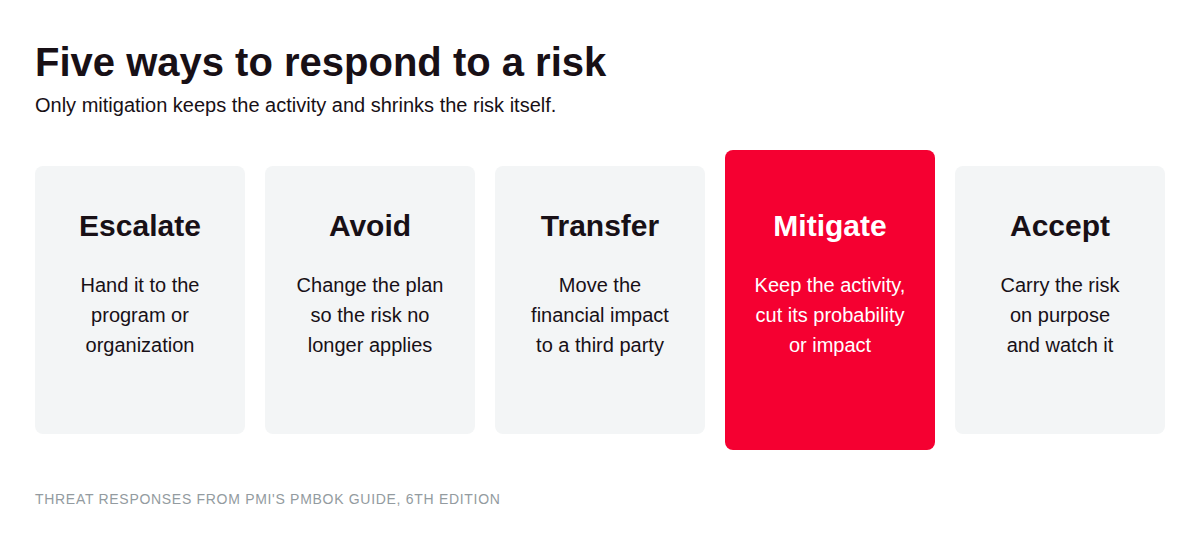
In project management standards, mitigation is one specific response, not a catch-all word for handling risk. PMI's PMBOK Guide (6th edition) lists five responses to threats: escalate, avoid, transfer, mitigate, and accept. Mitigation is the one where the team keeps the risky activity in the plan and works on its probability or its impact. ISO 31000:2018 uses broader language and lists seven risk treatment options, two of which are changing the likelihood and changing the consequences.
In software delivery, mitigation usually looks ordinary: a proof-of-concept spike before committing to an unfamiliar integration, a staged rollout behind a feature flag, a second engineer who learns the billing module, a backup that someone has tested by restoring it. None of these remove the risk. Each one shrinks it to a size the team is willing to carry.
Why Does Risk Mitigation Matter in Software Projects?
Risk mitigation matters because identifying a risk changes nothing about it. Only a planned response changes the odds or the damage.
It turns a risk register into a delivery plan. Most teams can list their risks in a kickoff workshop. Until each risk has a planned action attached, the list is a record of worries, and nobody opens it again until one of the risks has already happened.
It backs client commitments with work. Deadlines and budgets in a fixed-scope contract assume the known risks were priced in. Mitigation is how that assumption gets backed, so a slipped integration or a failed migration costs days instead of the whole release.
It moves cost to the cheapest moment. A risk handled during discovery usually costs a conversation or a short spike. The same risk found in production costs incident response and client trust.
How Does Risk Mitigation Work?
Risk mitigation works as a loop: pick the risks worth acting on, choose actions that cut probability or impact, assign them, then measure what is left.
Prioritize from the assessment. Mitigation starts from a risk assessment that scores each risk on probability and impact. Only the risks above the team's tolerance get mitigation work. The rest are accepted and watched.
Choose the lever. Preventive actions target probability, for example code review on a fragile module or load testing before launch. Contingent actions target impact, for example a rollback plan or a tested restore from backup. Many risks need one of each.
Compare the cost of the action with the exposure it removes. A simple expected-value check helps. If an integration has a 30% chance of slipping 10 working days, the expected delay is 3 days. A 2-day spike that cuts the probability to 5% brings the expected delay down to 0.5 days, so 2 days of work removes 2.5 days of expected delay. That is a modest win, and the same arithmetic shows when a mitigation is not worth doing.
Assign an owner and a trigger. Each action gets a named owner and a date. Contingent actions also get a trigger: the signal, such as an error-rate threshold or a missed milestone, that tells the team to activate the fallback.
Rescore and retire. Once an action is done, the team rescores the risk. If what remains still sits above tolerance, it gets another round of work. If the risk no longer applies at all, its mitigations are closed so the register reflects the project as it stands today.
What Tools Do Teams Use for Risk Mitigation?
Most teams pair a place to track risks and treatment plans with delivery tooling that does the mitigating itself, mainly release controls and monitoring.
Risk Registers and GRC Platforms
Vanta, LogicGate Risk Cloud, and ServiceNow Integrated Risk Management link each recorded risk to a treatment plan and track whether the planned actions are complete. They suit teams that also need the register as compliance evidence. Smaller product teams often keep the same information in a dedicated Jira project or a shared spreadsheet.
Feature Flags and Progressive Delivery
LaunchDarkly, Unleash, and Flagsmith let teams release a risky change to a small share of users first and switch it off without a redeploy. That limits the impact of a bad release to the users who saw it, for the minutes it took to flip the flag.
Monitoring and Incident Response
Sentry, Datadog, and PagerDuty support contingent mitigation, which only works if the team learns quickly that the risk has materialized. Sentry tracks application errors and Datadog covers infrastructure and performance metrics. PagerDuty routes the resulting alerts to whoever is on call and escalates if nobody responds.
What Are the Key Characteristics of Risk Mitigation?
Effective risk mitigation is tied to a named risk and sized to what that risk could cost.
Has an expiry date. A mitigation only helps if it lands before the risk can happen. A load test booked for the week after launch may still be useful, but it can no longer change anything the launch depends on.
Leaves residual risk. Mitigation reduces a risk without removing it. Removing it entirely is avoidance, a different response with a different price. Whatever remains after mitigation is residual risk, and the team has to decide whether that remainder is acceptable.
Scales with exposure. A risk that could delay launch by a quarter justifies weeks of mitigation work. A risk that could cost an afternoon justifies a note in the register.
Shifts with the project phase. Early mitigations deal with uncertainty, through spikes and prototypes. Later ones deal with operations, through rollback plans and on-call monitoring.
What Are the Benefits of Risk Mitigation?
The main benefit of risk mitigation is that problems a team saw coming arrive smaller or not at all.
Faster response when a risk hits. A fallback agreed during planning turns an incident into a checklist. The team spends the first hour carrying out a decision it already made, instead of debating options with the client on the call.
More defensible estimates. An estimate can state which risks were mitigated and which are being carried, so any buffer in the schedule has a stated reason behind it.
Smaller incidents. Contingent mitigations such as rollback plans and feature flags limit how many users a failure reaches and how long it lasts.
Ready compliance evidence. ISO/IEC 27001 requires a documented risk treatment plan, and SOC 2's Trust Services Criteria include a risk mitigation category. A maintained register with mitigation records covers much of what auditors ask for.
Deliberate acceptance. Once mitigation has a price, teams can accept some risks on purpose and record why, instead of carrying them by default.
What Are the Challenges of Risk Mitigation?
The hardest part of risk mitigation is paying for it before anyone can see what it prevented.
Successful mitigation looks like wasted money. If the risk never happens, nobody can prove the spend mattered. Recording the expected-value reasoning at decision time helps, but it adds overhead to every mitigation and still won't persuade someone who judges decisions only by outcomes.
Mitigation competes with feature work. Mitigation tasks share a backlog and engineers with visible features. Reserving a fixed share of each sprint protects them, but that capacity comes directly out of scope the client can see.
Probability estimates are guesses. The expected-value check is only as good as the 30% in it. Teams can calibrate against past project data, which takes records most teams don't keep, and on novel work there is no history to calibrate against at all.
Mitigations bring their own risks. A fallback vendor needs its own integration, and a caching layer added to cut latency risk introduces stale-data risk. Logging these secondary risks keeps the register honest, but it also makes the register longer and slower to review.
What Is the Difference Between Risk Mitigation and Other Risk Responses?
Mitigation is the threat response that keeps the risky activity in the plan and reduces the risk itself. Avoidance changes the plan so the risk no longer applies, while transfer and acceptance leave its likelihood exactly where it was.
Aspect | Mitigate | Avoid | Transfer | Accept |
Effect on probability | Reduced by preventive actions | Removed for that risk | Unchanged | Unchanged |
Effect on impact | Reduced by contingent actions | Removed for that risk | Financial share moves to a third party; operational impact often stays | Unchanged, sometimes offset by a contingency reserve |
Upfront cost | Engineering time or tooling | Lost scope or a changed plan | Contract fees or insurance premiums | None, beyond any contingency reserve |
Software example | Rolling out a payment migration behind a feature flag | Cutting an unproven integration from MVP scope | Buying cyber insurance that covers breach response costs | Tolerating a rare display bug in an internal admin tool |
Fits when | The activity is worth keeping and the action costs less than the exposure it removes | The activity is not worth its exposure | A third party can carry the financial consequences more cheaply | Every available response costs more than the expected loss |
PMBOK's fifth threat response, escalate, applies when a risk sits outside the project's authority and is handed to someone at the program or organization level.
FAQ about Risk Mitigation
Related Terms
Need expert help with Risk Mitigation?
Monterail builds custom software solutions that leverage the latest technologies. Let's discuss how we can help with your project.
GET IN TOUCHGET IN TOUCH