The New Default. Your hub for building smart, fast, and sustainable AI software
SaaS Development Services
Building subscription software that customers use in a browser or app, and keeping it improving after launch.
What Are SaaS Development Services?
SaaS development services build and run software that customers access online through a subscription. The work covers the product itself plus the parts every SaaS needs, such as tenant management, subscription billing, onboarding and usage analytics. It continues after launch, because a SaaS product ships updates to all customers at once.
Monterail has delivered 900+ projects since 2010, including Cooleaf, which grew from a 2013 MVP into an employee recognition platform with 110,000 active users and was acquired by ITA Group.
What Do SaaS Development Services Include?
SaaS development covers the product and the subscription machinery around it, from the first release to continuous updates.
What it includes
Product discovery, including input on packaging and pricing
Multi-tenant architecture that keeps each customer's data separate
Account, team and role management
Subscription billing and plan management through a billing provider
Onboarding flows that get new users to value quickly
An admin panel and a metrics dashboard for usage and revenue
Integrations with other tools, and a public API where customers need one
Continuous delivery and monitoring after launch
What it doesn't include
Cloud hosting fees, which the SaaS company pays to its provider
Billing and payment provider fees
Sales, marketing, support and customer success operations
The final pricing decision, which stays a business call
When Do SaaS Development Services Fit?
SaaS development services fit when software is the product you sell, and customers will pay for it on a subscription.
It fits when
You are launching a new subscription product and need a team to build the first version
An internal tool has proven useful enough to sell to other companies
Your SaaS has outgrown its first codebase, and growth now needs a sturdier architecture
Enterprise customers are asking for features your current team can't deliver fast enough
It doesn't fit when
The software only serves your own staff. Custom internal software skips billing and tenant management.
A no-code platform already covers the workflow for a small, early user base. It can test demand before custom work starts.
You haven't validated that customers will pay. Product validation or an MVP comes first.
The product is a one-time delivery to a single client, which is a standard custom software project.
What Are the Benefits of SaaS Development Services?
The main benefit is a product built for recurring revenue from the start, with the subscription features in place before customers arrive.
Faster path to paying customers. Billing and onboarding are planned with the first release.
One codebase for every customer. Multi-tenancy lets a single deployment serve many accounts.
Room to grow. An architecture planned for scale avoids a rewrite when usage multiplies.
Data to steer by. Usage and revenue metrics show which features keep customers.
Continuous improvement. Frequent releases reach every customer at the same time.
How Do SaaS Development Services Work?
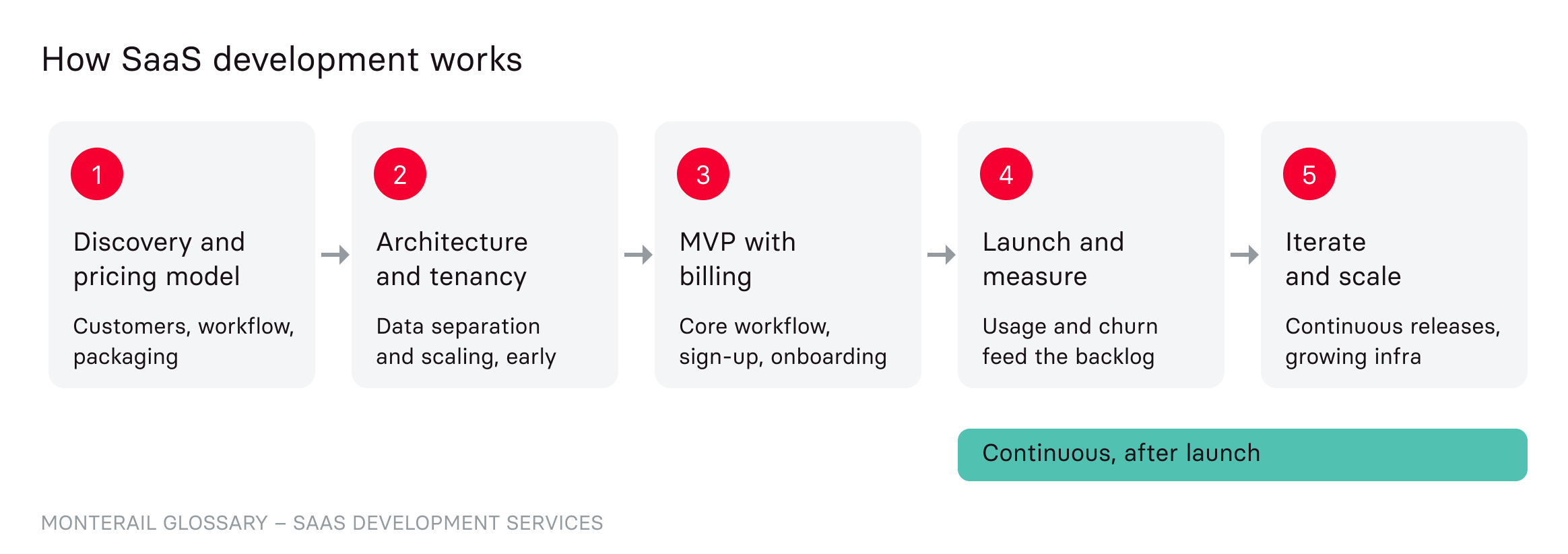
SaaS development runs in five steps, from discovery to continuous scaling.
Discovery and pricing model. The team defines target customers, the core workflow and how the product will be packaged. Assumptions about willingness to pay get tested early.
Architecture and tenancy. Engineers choose how customer data is separated and how the system will scale. These decisions are hard to change later, so they come before features.
MVP with billing and onboarding. The first release covers the core workflow plus sign-up, subscription billing, plan limits and a guided first session.
Launch and measure. The product goes live, and usage and churn metrics start feeding the backlog.
Iterate and scale. Features ship continuously. Architecture and infrastructure grow as accounts and data volume increase.
Should You Build a Custom SaaS Product or Use a No-Code Platform?
Build custom when the software is your core product and must scale and set you apart. Use a no-code or white-label platform to test demand or serve a small, early user base.
Factor | Custom SaaS development | No-code or white-label platform |
Differentiation | Features and UX designed around your market | Limited to what the platform supports |
Scalability | Architecture planned for your growth | Bound by the platform's limits and pricing tiers |
Time to launch | Longer: discovery and an MVP build first | Shorter: configuration and branding |
IP ownership | You own the code | You own your data and content, and the platform owns the software |
Integrations | Any system with an API | Only the connectors the platform offers |
Cost over time | Development and hosting, with no per-seat platform fees | Platform fees that grow with users |
Challenges to plan for: Custom SaaS puts architecture and security decisions on you from day one, and mistakes in tenancy design are costly to fix. A platform trades that for lock-in, and moving off it later means rebuilding the product.
How Does Monterail Approach SaaS Development?
Monterail treats a SaaS product as a long-term build, staying through the MVP and the growth years after it.
Cooleaf partnered with Monterail in 2013 to build an MVP. Over 12 years it grew into an enterprise-ready employee recognition platform with 110,000 active users across 103 organizations in 6 regions, and was acquired by ITA Group.
For Afriwise, Monterail built the MVP of a legal information platform with Ruby on Rails and Vue.js. It now connects over 180 law firms across 40+ African countries and serves clients including DHL, Deloitte and IBM.
Monterail rebuilt the website of Easyship, a shipping platform used by over 15,000 e-commerce sellers, in Vue.js in under three months. Conversion rates grew 36%.
When Should You Bring In a SaaS Development Partner?
A partner helps when you need a complete product team to reach a first paying customer, without hiring one first. It also helps when your SaaS needs to scale, and your team lacks experience with multi-tenant architecture.
Monterail's web application development services cover the full SaaS product lifecycle, from discovery to continuous delivery. Talk to our team about the SaaS product you want to build.
FAQ About SaaS Development Services
Need expert help with SaaS Development Services?
Monterail builds custom software solutions that leverage the latest technologies. Let's discuss how we can help with your project.
EXPLORE WEB DEVELOPMENT SERVICESEXPLORE WEB DEVELOPMENT SERVICES