The New Default. Your hub for building smart, fast, and sustainable AI software
Serverless architecture
Serverless architecture is a cloud model where application code runs as short-lived functions and managed services, with the provider owning the servers and scaling them on demand.
What Is Serverless Architecture?
The point of going serverless is to stop paying for, and stop maintaining, capacity that sits idle. A team writes the business logic, and the cloud provider decides when that code runs and how many copies of it exist at any moment.
Behind the scenes, those machines belong to AWS, Microsoft, Google, or Cloudflare, and keeping them patched and sized for the load is the provider's job. The team's unit of work shrinks from "a server that runs our app" to "a function that runs when something happens."
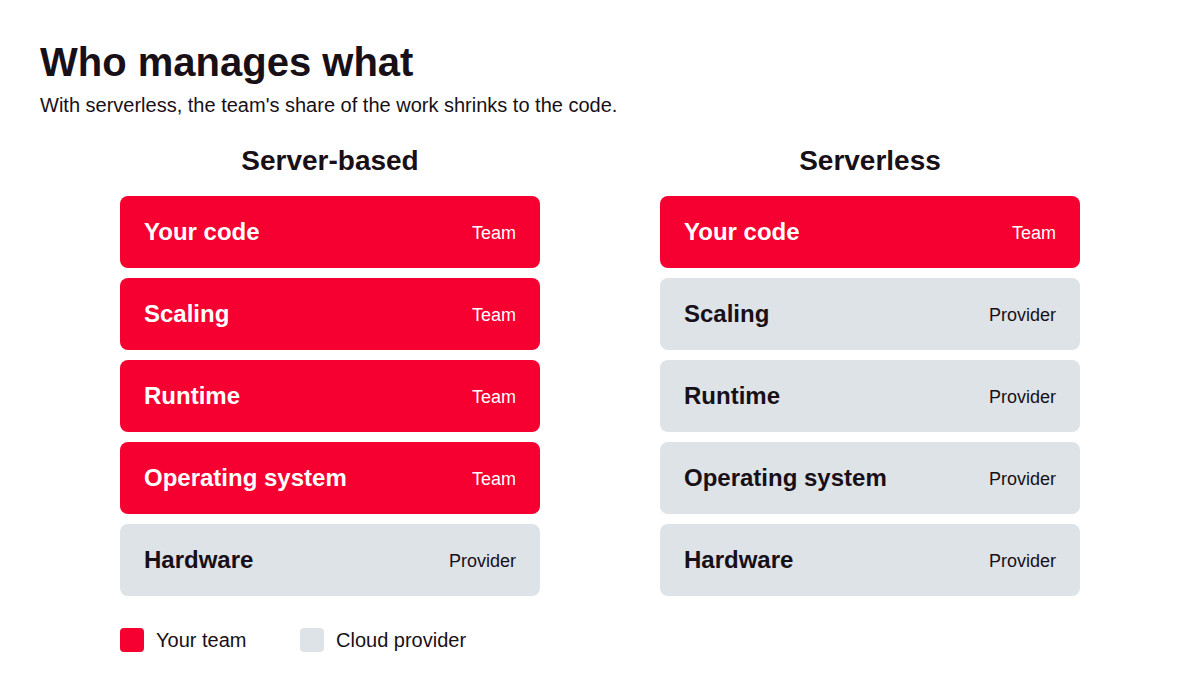
That shift covers two kinds of building blocks. Functions as a service (FaaS), such as AWS Lambda, run custom code in response to events. Managed backend services, such as hosted databases and message queues, hold the state and handle the plumbing the functions depend on. A serverless system is usually a mix of both, wired together by events.
Why Does Serverless Architecture Matter for Product Teams?
Serverless changes what a team pays for and what it has to staff for, which makes it a business decision as much as a technical one.
Infrastructure spend follows usage instead of forecasts. With always-on servers, a team pays for the peak it expects, whether or not traffic shows up. With serverless, an internal tool used twice a day costs close to nothing.
Small teams can skip a whole layer of operations work. Operating system patches and host failures become the provider's job. For a startup or a product team without dedicated DevOps engineers, that time goes back into shipping features.
How Does Serverless Architecture Work?
A serverless request follows the same lifecycle every time: an event arrives, and the platform runs the code in an environment it either reuses or creates on the spot.
An event triggers the function. Developers do not write a server that waits for traffic. The function runs in response to an HTTP call through an API gateway, a file landing in object storage, a message on a queue, or a scheduled timer.
The platform provisions an execution environment. If a warm environment from a recent request is available, the platform reuses it. If not, it starts a new one by loading the runtime and the function's code, a delay known as a cold start.
Concurrency scales with demand. On AWS Lambda, each simultaneous request gets its own environment, so a burst of 500 requests can mean 500 environments. Google Cloud Run functions can instead route several requests to one instance. AWS Lambda sets a default quota of 1,000 concurrent executions per Region, which can be raised on request.
Each function runs with its own permissions. The platform attaches an identity to every function, an IAM execution role on AWS Lambda, that controls which databases or storage buckets it can reach. Keeping those permissions narrow limits the damage if one function is compromised.
Billing counts requests and execution time. AWS Lambda charges per request plus duration, rounded up to the nearest millisecond and weighted by the memory allocated.
What Tools Do Teams Use for Serverless Architecture?
Serverless tooling splits into platforms that run functions and frameworks that define and deploy them, with edge runtimes as a specialized branch of the platforms.
Cloud function platforms: AWS Lambda, Azure Functions, and Google Cloud Run functions (formerly Cloud Functions). These run code in a provider's regional data centers and integrate with that provider's databases and identity services.
Edge function runtimes: Cloudflare Workers, Fastly Compute, and Deno Deploy. These run lightweight code in locations close to users, which cuts latency for tasks like request routing or authentication checks.
Infrastructure-as-code frameworks: AWS SAM, Serverless Framework, and SST. These describe functions and their triggers in configuration files, so a serverless system can be versioned and redeployed like any other code.
What Are the Key Characteristics of Serverless Architecture?
Applications built serverless share design traits that shape how the code is written as well as where it runs.
Event-driven design. Logic is organized around things that happen, such as an order being placed or a file being uploaded. Components communicate by emitting and reacting to events instead of calling each other directly.
Fine-grained deployment units. Each function can be deployed on its own. A bug fix to the invoice generator ships without touching the login flow.
Stateless compute. A function cannot count on memory or local disk surviving to the next invocation. Developers write each call as if it were the first, reading and writing state through external services.
Provider-defined limits. The platform caps what a single invocation can do. On standard AWS Lambda functions, an invocation runs for at most 15 minutes and can be allocated between 128 MB and 10,240 MB of memory.
Heavy reliance on managed services. A serverless backend is assembled from the provider's building blocks, such as authentication and storage. The team writes less infrastructure code and more glue code between services.
What Are the Benefits of Serverless Architecture?
The strongest benefits show up for workloads with uneven traffic and teams that want to spend their time on product code.
No cost for idle time. Workloads that run in bursts, such as nightly reports or webhook handlers, stop paying for the hours in between. AWS also includes one million requests and 400,000 GB-seconds per month in the Lambda free tier.
Scaling without capacity planning. Traffic spikes are handled by the platform adding environments, up to the account's concurrency quota. Nobody has to predict next month's peak and provision for it.
Faster path to a first release. With no servers to set up, a team can have an API endpoint running within a day. That suits MVPs and experiments where the product may change shape before the infrastructure would pay off.
Smaller blast radius per change. Because functions deploy independently, a faulty release usually breaks one feature instead of the whole application. Rolling it back is a matter of redeploying one function.
What Are the Challenges of Serverless Architecture?
Most serverless problems have known fixes, and each fix gives back part of what made serverless attractive in the first place.
Cold starts add latency. The first request to a new environment waits while the runtime loads, which users notice on interactive endpoints. Provisioned concurrency keeps environments warm, but AWS bills it for the whole period it is configured, including hours with no traffic, which reintroduces the idle cost serverless was meant to remove.
Lock-in runs deeper than the code. The function logic may be portable, but its triggers and service integrations are specific to one provider. Abstraction frameworks reduce the switching cost, at the price of an extra layer and access only to features every provider supports.
Steady, high traffic can cost more. Pay-per-use pricing carries a premium over always-on capacity once a workload runs near full utilization around the clock. Moving those hot paths to containers fixes the bill but leaves the team operating two deployment models side by side.
Debugging spans many moving parts. One user action can pass through an API gateway, several functions, a queue, and a database, and no single log shows the whole path. Distributed tracing tools such as AWS X-Ray restore that view, but every function has to be instrumented and the tracing itself is billed.
Long jobs need restructuring. Work that exceeds the platform's time limit has to be split into steps coordinated by a workflow service such as AWS Step Functions. That works, but it adds orchestration code and workflow charges that a single long-running process would not have.
What Is the Difference Between Serverless and Server-Based Architecture?
Serverless trades control over the runtime for freedom from managing it, while server-based architecture, whether on virtual machines or self-managed container clusters, keeps that control and its maintenance with the team.
Serverless functions | Self-managed servers or containers | |
|---|---|---|
Unit of deployment | Individual function | Whole application or service image |
Billing | Per request and execution time | Per provisioned capacity, used or idle |
Scaling | Platform adds environments per request, down to zero | Scaled by the team, manually or through autoscaling rules, with a minimum that stays running |
Execution time | Capped by the provider | No platform cap on process duration |
State between requests | Not guaranteed, kept in external services | Can be held in process memory |
OS and runtime patching | Handled by the provider | Handled by the team |
FAQ about Serverless Architecture
Need expert help with Serverless architecture?
Monterail builds custom software solutions that leverage the latest technologies. Let's discuss how we can help with your project.
GET IN TOUCHGET IN TOUCH