The New Default. Your hub for building smart, fast, and sustainable AI software
Software Maintenance and Support Services
The ongoing work after launch that fixes problems in live software and keeps it current.
What Are Software Maintenance and Support Services?
Software maintenance and support services keep an application secure and up to date after launch. Maintenance changes the code: fixing defects, patching security issues, updating dependencies, and adapting to new platforms. Support covers the operational side, such as monitoring and incident response. Together, they protect the value of software already in use.
Monterail has delivered 900+ projects since 2010, including 12 years as Cooleaf's technology partner, where the work moved from the first build into ongoing development and maintenance.
What Do Software Maintenance and Support Services Include?
Software maintenance and support covers everything a live application needs between major releases.
What it includes
Monitoring of uptime, errors, performance, and crash rates
Incident response and bug fixing, ordered by severity
Security patches and updates to libraries and frameworks
Updates for new operating system versions and third-party API changes
Refactoring that reduces technical debt and keeps the code easy to change
Small features and UX improvements
Release management, including app store submissions
Regular reports on incidents and system health
What it doesn't include
Hosting and infrastructure fees, which the client pays to its cloud provider
Major new products or rewrites, which run as separate projects such as legacy system modernization
First-line help desk support for the product's end users
Third-party license fees
When Do Software Maintenance and Support Services Fit?
Maintenance and support fit any software that people depend on after launch, and they matter most once the original build team has moved on.
It fits when
Your product is live, and users or revenue depend on it every day
The team that built it has moved to other work or left the company
Your stack relies on frameworks and libraries that release security updates regularly
You want small improvements to keep shipping without a full development team
It doesn't fit when
The product is being retired soon. A short stabilization plan costs less than a maintenance retainer.
The codebase is so outdated that every fix breaks something else. A modernization project comes first, and maintenance follows it.
Your in-house team has the capacity and the context to handle updates itself.
You need a large new feature set. That is a development project with its own scope and budget.
What Are the Benefits of Software Maintenance and Support Services?
The main benefit is that live software stays secure and usable while your team focuses on new work.
Fewer outages. Monitoring catches errors and slowdowns early, often before users report them.
Security gaps closed early. Dependencies get patched on a schedule, before an incident forces it.
No surprise rewrites. Steady updates keep the stack current, so it never falls years behind.
Predictable costs. A retainer or agreed hour budget replaces emergency fees.
Knowledge that stays. A maintenance team that knows the codebase fixes issues faster than a newcomer.
How Do Software Maintenance and Support Services Work?
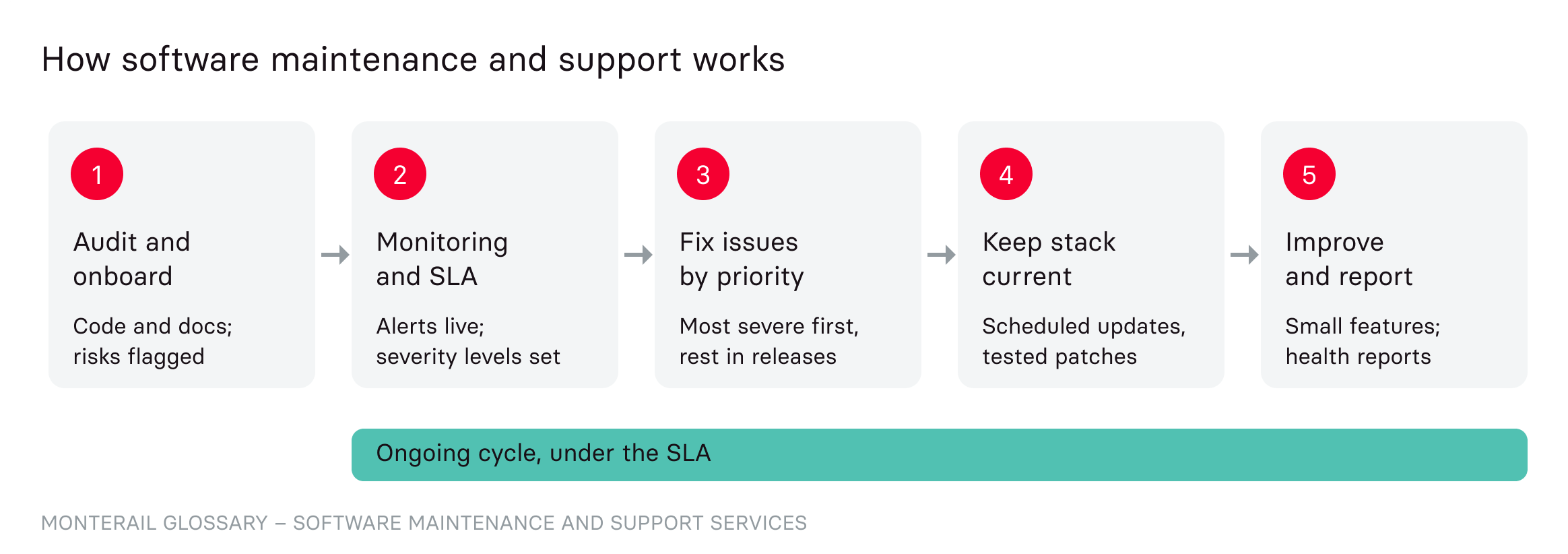
Software maintenance and support runs in five steps, from taking over the codebase to regular reporting.
Audit and onboard the codebase. The team reviews the code and its documentation. It flags security risks and outdated dependencies.
Set up monitoring and the SLA. Error tracking and uptime alerts go live. The SLA defines severity levels and the response time for each.
Fix issues by priority. Triage incidents and bugs by severity. The most severe issues get handled first, and smaller ones go into a regular release.
Keep dependencies and security current. Libraries, frameworks, and platform versions are updated on a schedule. Security patches ship as soon as they are tested.
Improve and report. Small features and refactoring fill the remaining time. Regular reports show incidents and system health.
Should You Choose a Maintenance Retainer or Ad Hoc Support for Your Software?
Choose a maintenance retainer when the business depends on the software every day, and ad hoc support when downtime has little impact and changes are rare.
Factor | Maintenance retainer | Ad hoc (break-fix) support |
Response time | Set in the SLA, by severity | Depends on the vendor's availability at the time |
Cost predictability | A fixed monthly fee or hour budget | Unpredictable: billed per incident |
Updates and patches | Done on a schedule | Usually skipped until something breaks |
Codebase knowledge | A stable team that knows the system | Often a new person each time |
Risk | Problems caught early through monitoring | Problems found by users first |
Challenges to plan for: A retainer costs money in quiet months too, and its value depends on the SLA matching how much the business relies on the system. Ad hoc support looks cheaper until the first major incident or a forced framework upgrade.
How Does Monterail Approach Software Maintenance and Support?
Monterail keeps building on the products it maintains, so maintenance and new features sit within the same team.
Over 12 years as Cooleaf's technology partner, Monterail's work moved into ongoing development and maintenance. The team maintained the legacy codebase while implementing new features, and moved the platform off an outdated AngularJS while addressing security vulnerabilities. Cooleaf grew into an enterprise platform and became part of ITA Group.
For Polaroid, Monterail held a 99.5% crash-free rate across 364 Google Play releases as the app grew to 144,000 downloads.
Monterail’s team on the Elvie apps expanded for new product integrations such as Elvie Stride and contracted during maintenance windows, scaling with the roadmap over seven years of releases.
When Should You Bring In a Software Maintenance Partner?
A partner helps when the people who built your software have moved on and nobody owns updates. It also helps when your in-house team should focus on new features while someone else keeps the live product stable. If you only need one or two engineers inside your team, staff augmentation adds them.
See Monterail's software development services, which cover both new builds and ongoing work on live products. Talk to our team about the software you need to keep running.
FAQ About Software Maintenance and Support Services
Need expert help with Software Maintenance and Support Services?
Monterail builds custom software solutions that leverage the latest technologies. Let's discuss how we can help with your project.
EXPLORE WEB DEVELOPMENT SERVICESEXPLORE WEB DEVELOPMENT SERVICES