The New Default. Your hub for building smart, fast, and sustainable AI software
Software Testing
Software testing is the practice of evaluating software, by running it or examining it, to find defects and confirm it behaves as intended.
What Is Software Testing?
Every release carries a bet that nothing important broke, and testing is how a team finds out whether that bet is safe before users do. It replaces "it worked on my machine" with evidence the whole team can check.
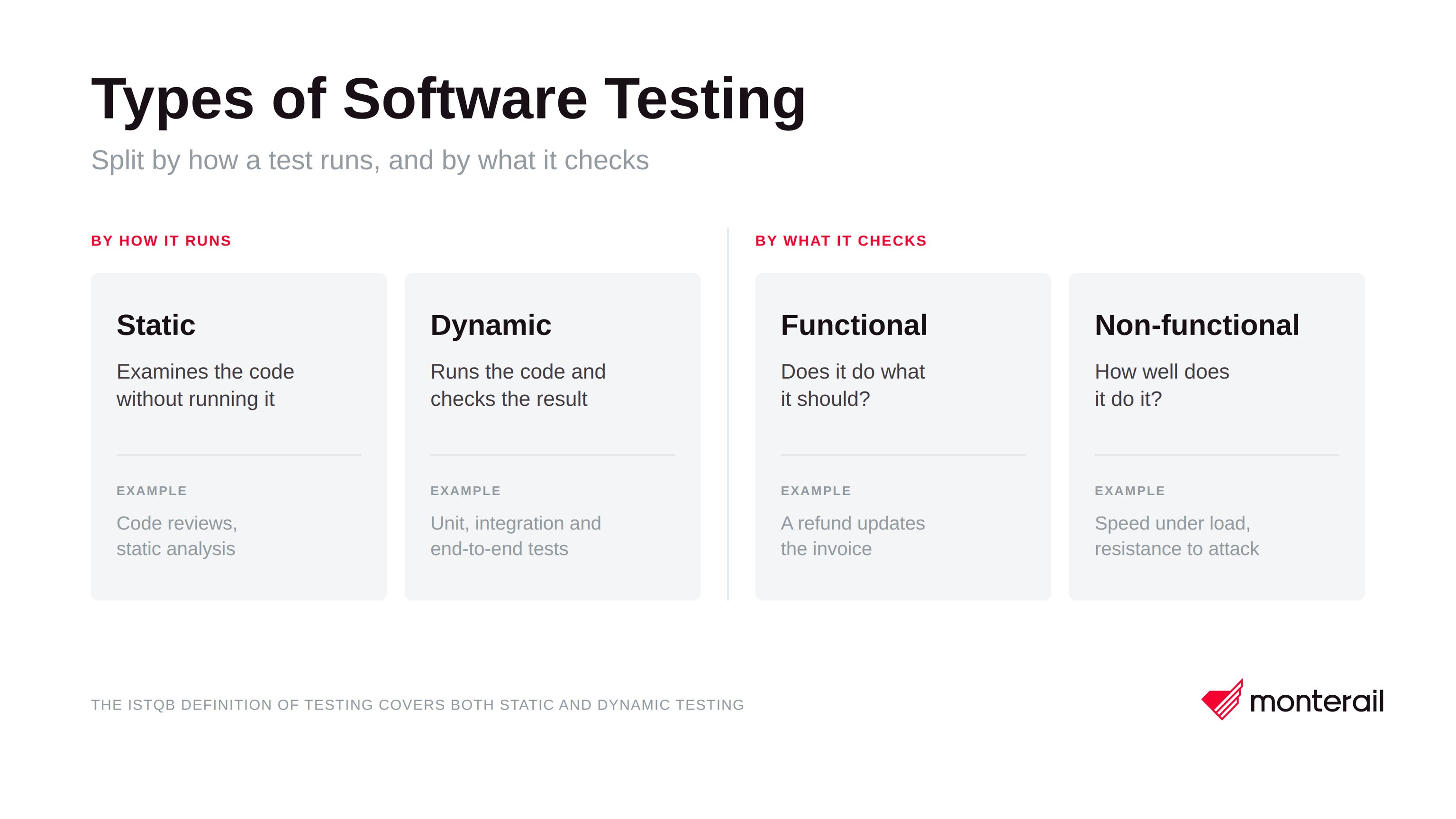
The ISTQB, the international body that certifies software testers, defines testing as the process within the development lifecycle that evaluates the quality of a component or system and its related work products. That definition deliberately includes static testing, such as code reviews and static analysis, which examine software without running it, alongside dynamic testing, which executes the code.
Testing also splits by what it checks. Functional testing asks whether the software does what it should, for example whether a refund updates the invoice. Non-functional testing asks how well it does it, covering qualities like response time under load or resistance to attack.
Why Does Software Testing Matter?
Software testing matters because every defect it misses is found later by someone else, usually a customer or an auditor.
Users find what testing misses. A defect that escapes into production shows up as a support ticket or a failed payment. The team then pays for the fix on top of the lost trust.
Requirements become checkable. Writing a test forces a vague requirement like "the report should load quickly" into a specific statement, such as "loads in under two seconds for 10,000 rows". Ambiguity surfaces while it is still cheap to resolve.
Regulated products need evidence. In domains such as medical device software, standards like IEC 62304 require documented verification activities. A test suite with traceable results is part of what makes the product certifiable.
How Does Software Testing Work?
Software testing works by checking the system at several levels of scope, with automated tests running on every change and people exploring what automation cannot anticipate.
Test levels. Testing is usually organized into four levels: unit, integration, system, and acceptance. Unit tests check one small piece of code in isolation, while acceptance tests check whether the finished product meets the business need.
The test pyramid. Popularized by Mike Cohn in Succeeding with Agile (2009), the pyramid recommends many fast unit tests, fewer service-level tests, and a small number of slow end-to-end tests through the user interface. The shape keeps the suite fast while still covering full user journeys.
Test design techniques. Techniques such as boundary value analysis pick inputs where defects tend to cluster, for example testing an age limit of 18 at 17 and 18 instead of at random values. They let a small number of tests cover a large range of behavior.
Automation in the pipeline. Automated tests run in the CI/CD pipeline on every commit or pull request. A failing test blocks the merge, so defects are caught by the person who just wrote the code.
Exploratory testing. Testers use the product without a fixed script, following hunches about where it might break. This finds the defects nobody thought to write a test for.
Non-functional testing. Load tests simulate traffic spikes, and security tests such as penetration testing probe for vulnerabilities. These usually run on a schedule or before major releases instead of on every commit.
What Tools Do Teams Use for Software Testing?
Most teams pair a framework for fast code-level tests with separate tools for browser journeys and load, since each kind of test needs a different runtime.
Which Tools Run Unit and Integration Tests?
Jest (JavaScript and TypeScript), pytest (Python), and JUnit (Java) are widely used frameworks in their languages. They run tests and report failures in a format CI pipelines can act on.
Which Tools Automate End-to-End Browser Tests?
Playwright, Cypress, and Selenium drive a browser through user journeys such as signing up or checking out. All three can run tests in more than one browser, which helps catch browser-specific defects.
Which Tools Test Performance Under Load?
k6, Apache JMeter, and Gatling simulate many concurrent users to measure response times and find breaking points. k6 and Gatling define tests as code, so they can be versioned and reviewed like the rest of the codebase.
What Are the Key Characteristics of Software Testing?
Software testing is defined by what it can and cannot prove, and by how its results should be read.
It samples behavior. Exhaustive testing is impossible for all but trivial programs, because the number of possible inputs and states is too large. As Edsger Dijkstra put it, testing can show the presence of bugs but never their absence.
A test is only as good as its expected result. Every test compares an outcome against what should have happened. If the expected result is wrong, the test passes while the software is broken.
Coverage measures execution. Code coverage reports which lines ran during tests. A line can run under a test that asserts nothing about it, so high coverage and effective tests are different things.
It spans the whole lifecycle. Testing starts with reviewing requirements, a practice often called shifting left, and continues after release through production monitoring. Treating it as a phase at the end of a project means defects surface when the least time is left to fix them.
What Are the Benefits of Software Testing?
The main benefit of software testing is that teams can change code quickly without guessing what they broke.
Safe refactoring. A good suite lets engineers restructure code and know within minutes whether behavior changed. Without one, teams avoid touching old code, and technical debt accumulates.
Shorter feedback loops. A defect caught by a failing test in a pull request is fixed by the person who wrote it, while the context is fresh. The same defect found weeks later needs someone to rediscover that context first.
Living documentation. Tests show how each part of the code is meant to be used, with concrete inputs and outputs. Unlike a wiki page, a test that goes out of date fails loudly.
Predictable releases. When the suite passes, the team has a shared signal that every known risk has been checked. Release decisions stop depending on one person's gut feeling, even though no suite can prove a release is defect-free.
Lighter on-call load. Fewer escaped defects means fewer production incidents, so engineers spend less time firefighting and more time on planned work.
What Are the Challenges of Software Testing?
The main challenge of software testing is that tests cost time to write and keep running, and that cost has to stay below the value they return.
Flaky tests. Tests that pass and fail at random erode trust in the whole suite. Quarantining them keeps the pipeline green, but every quarantined test is a gap in coverage until someone fixes it.
Brittle end-to-end tests. UI tests break when markup changes, even if nothing is wrong for the user. Replacing them with lower-level tests makes the suite more stable, at the cost of less coverage of complete user journeys.
Environments that differ from production. A test that passes in staging can still fail in production if its data or configuration differ. Production-like environments close the gap, but they add infrastructure spend.
Slow suites. As a suite grows, feedback slows down and engineers start skipping it. Running tests in parallel or only running tests affected by a change restores speed, but it raises CI compute costs or risks missing a relevant test.
What Is the Difference Between Manual and Automated Testing?
Manual testing relies on a person to run and judge each check, while automated testing uses scripts that run the same checks without human involvement.
Manual Testing | Automated Testing | |
|---|---|---|
Who runs it | A person, usually a tester | A script or CI pipeline |
Best suited to | Exploring new features and judging usability | Repeating known checks on every change |
Upfront cost | Low, no test code required | Higher, tests must be written first |
Ongoing cost | Tester time on every run | Maintenance when the code changes |
Unexpected issues | Can notice problems nobody scripted | Detects only what its assertions check |
Repeatability | Steps can vary between runs and testers | Same steps on every run |
FAQ about software testing
Related Terms
Need expert help with Software Testing?
Monterail builds custom software solutions that leverage the latest technologies. Let's discuss how we can help with your project.
GET IN TOUCHGET IN TOUCH