The New Default. Your hub for building smart, fast, and sustainable AI software
Test Automation
Test automation is the use of scripts and tools to execute software tests and check their results without a person carrying out each step by hand.
What Is Test Automation?
Every change to a codebase raises the same question: did this break something that used to work? Test automation answers it on every commit, in minutes instead of days.
A manual tester follows a script, such as logging in and confirming the dashboard loads. An automated test encodes the same steps in code, so a machine can repeat them identically thousands of times. The judgment about what to test stays with people. The repetition moves to the machine.
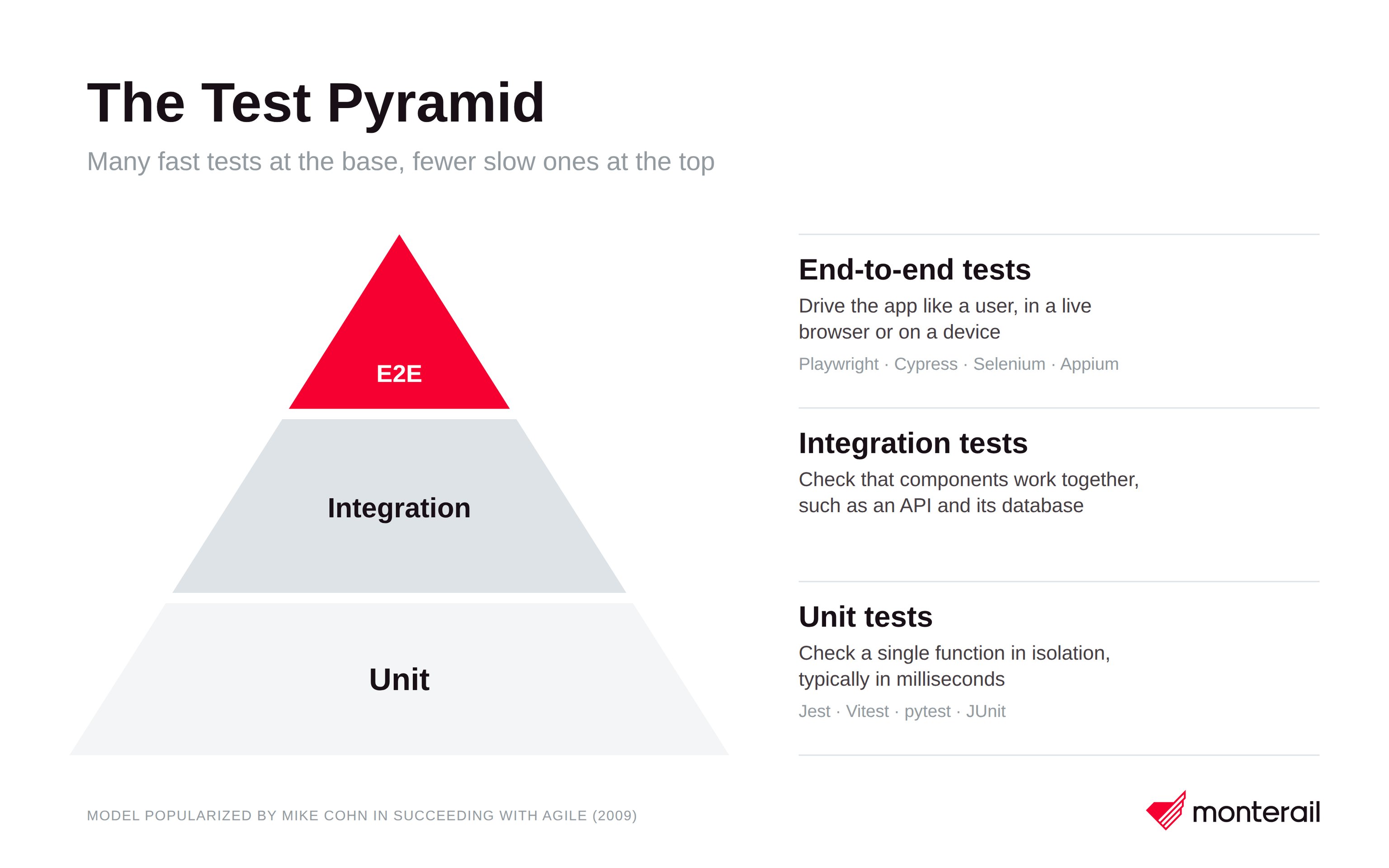
Automation covers several layers of a system. Unit tests check a single function in isolation. Integration tests check that components work together, such as an API and its database. End-to-end tests drive the application the way a user would, through a live browser or a physical device.
Most teams follow some version of the test pyramid, a model popularized by Mike Cohn in Succeeding with Agile (2009): many fast unit tests at the base, fewer slow end-to-end tests at the top. Test automation does not replace manual testing entirely. Exploratory testing and usability checks still need a person, because a script can only confirm what someone thought to write down.
Why Does Test Automation Matter?
Test automation matters because release speed and release safety stop pulling against each other once regression checks run without people.
It stops regression cost from scaling with headcount. The manual regression pass for a mature product can take a QA team days, and it has to be repeated before each release. An automated suite still grows with the product, but the extra cost is compute time and maintenance instead of tester days.
It makes frequent releases safe. Continuous delivery depends on knowing within minutes whether a build is releasable. Without an automated suite, every release waits for a manual pass, so teams release less often, which makes each release bigger and riskier.
It moves feedback closer to the change. A bug found an hour after it was written is fixed by the person who still remembers the code. The same bug found in a staging pass two weeks later needs someone to rebuild the context first.
How Does Test Automation Work?
Test automation works by turning test cases into code that a pipeline runs on every change and reports on without human input.
Test cases are written as code. An engineer writes a script for each behavior worth checking. Most follow the Arrange-Act-Assert pattern: put the system into a known state, perform one action, then check the outcome.
A test runner executes the suite. Frameworks such as Jest, pytest, and JUnit discover the tests in a codebase and report which ones passed or failed.
A CI pipeline triggers runs automatically. Every push or pull request starts the suite on a build server such as GitHub Actions, GitLab CI, or Jenkins. When the team sets the pipeline to gate merges, a failing test blocks the merge, so broken code does not reach the main branch.
Test data and environments are provisioned for each run. Tests need a predictable starting point, for example a seeded database and mocked third-party services. Containers let teams spin up a fresh environment per run and throw it away afterwards.
Results feed back to the team. Reports show each failure with logs and screenshots attached, so an engineer can see what broke without rerunning the test by hand.
What Tools Do Teams Use for Test Automation?
Teams usually pair a unit test framework with an end-to-end tool, then add a cloud grid when browser and device coverage matters.
Unit and integration test frameworks. Jest and Vitest for JavaScript, pytest for Python, JUnit for Java. These run inside the codebase and finish each test in milliseconds.
Browser and mobile end-to-end tools. Playwright, Cypress, and Selenium drive web browsers. Appium does the same for native iOS and Android apps.
Cloud device and browser grids. BrowserStack and Sauce Labs host physical devices and live browser instances, so a suite can run against dozens of browser and OS combinations without the team maintaining that hardware.
What Are the Key Characteristics of Test Automation?
Automated tests behave like any other code: predictable where their inputs are controlled, and literal about what they verify.
Repeatable steps. An automated test runs the same steps in the same order every time, which removes the drift that creeps into a manual checklist on its fortieth run. The outcome can still vary if the test depends on something outside its control, as the next points explain.
Fast feedback at the lower layers. A unit test typically runs in milliseconds, so a large unit suite reports back before an engineer has moved on to the next task. End-to-end tests are slower by orders of magnitude, which is why suites hold far fewer of them.
Only as good as its assertions. A test checks exactly what it was told to check. A suite can pass on a page with a broken layout if nobody asserted anything about the layout.
Pass or fail, nothing in between. Each test returns a binary result. That makes results easy to gate a merge on and poor at capturing "this looks slightly off" judgments.
Deterministic by design, flaky in practice. A good test gives the same result on the same code. Tests that depend on timing or shared state sometimes fail for reasons unrelated to the change being tested.
What Are the Benefits of Test Automation?
The main benefit of test automation is that confidence in a release no longer depends on how many tester hours are available that week.
Release dates stop waiting on QA. When the regression pass takes twenty minutes instead of three days, the team can ship when a feature is ready instead of when the next test window opens.
Safer refactoring. Engineers can restructure old code and know within minutes whether behavior changed. Without that net, teams avoid touching fragile modules, and technical debt collects there.
Lower cost per test run. Writing a test costs more than running it manually once. Every run after that costs compute time instead of a tester's hours, so the economics favor tests that run often.
Living documentation of behavior. A well-named test states what the system is supposed to do, and unlike a wiki page, it fails when the system stops behaving that way.
Testers freed for exploratory work. When scripts handle repetitive checks, QA specialists spend their time on edge cases and usability, the areas where human judgment finds what scripts miss.
What Are the Challenges of Test Automation?
The biggest challenge of test automation is that the suite is software too, and it costs time to keep trustworthy.
Maintenance grows with the suite. Every UI change can break end-to-end tests that were working. Stable selectors and page-object patterns reduce the breakage, but they add a layer of test infrastructure that someone has to design and keep current.
Flaky tests undermine trust. Once engineers learn that a red build is often noise, they rerun it until it passes, and failures that matter slip through with it. Quarantining flaky tests restores the signal, but every quarantined test is coverage the team has given up until someone fixes it.
Upfront cost before payback. A test pays for itself only after enough runs. For a feature that will change next sprint or a prototype that may be thrown away, automating early can cost more than checking manually.
Coverage numbers can mislead. Code coverage shows which lines ran during tests. It says nothing about whether the tests checked the right outcome, and chasing a higher percentage adds maintenance without adding confidence.
Slow end-to-end suites. Browser tests catch integration problems that unit tests miss, but a suite of several hundred can take an hour. Parallelizing across machines or a cloud grid brings the time down and raises the infrastructure bill.
What Is the Difference Between Test Automation and Manual Testing?
Test automation costs more to set up and less to repeat, while manual testing is cheap to start and catches what nobody thought to script.
Aspect | Test automation | Manual testing |
Who executes the steps | A test runner or CI pipeline | A person |
Cost of the first run | Higher: the test has to be written first | Lower: a tester can start right away |
Cost of each repeat run | Compute time | Tester hours |
Best suited to | Regression checks that repeat on every release | Exploratory and usability testing of features still in flux |
What it can detect | Only the outcomes someone wrote an assertion for | Unexpected problems a person notices while testing |
Speed of feedback | Minutes per run, and can trigger on every commit | Hours to days per regression pass |
FAQ About Test Automation
Related Terms
Need expert help with Test Automation ?
Monterail builds custom software solutions that leverage the latest technologies. Let's discuss how we can help with your project.
GET IN TOUCHGET IN TOUCH