The New Default. Your hub for building smart, fast, and sustainable AI software
Supabase
Supabase is an open-source backend platform built on PostgreSQL that bundles a database, user authentication, file storage, and server-side functions into one hosted service.
What Is Supabase?
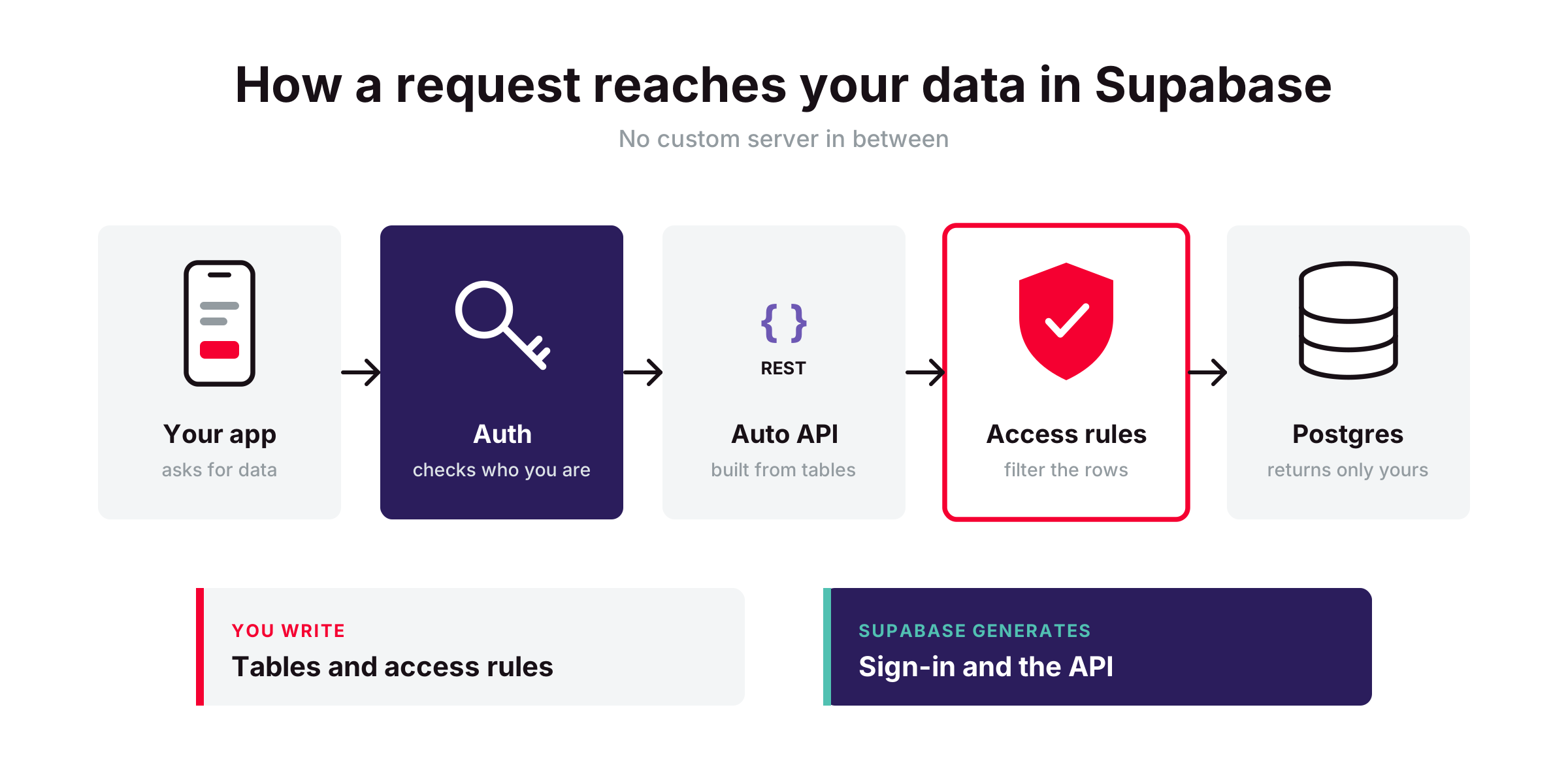
Every new product hits the same early question: how much backend has to exist before the first user can sign up and save data? Supabase's answer is very little. A team defines its tables and immediately gets sign-in and a working API, without writing server code.
Under the hood, every project is a full Postgres database. Supabase reads the table structure and generates a REST API from it, so the frontend can read and write data directly. Access is controlled by rules stored inside the database itself, not by a separate server layer.
Supabase calls itself "the Postgres development platform" and openly models its feature set on Firebase, Google's backend service. The difference is the foundation. Firebase is built mainly around its own document databases, while Supabase assembles its platform from Postgres and other open-source tools.
Why Does Supabase Matter?
It shortens the path to a first release. Sign-in and a data API are parts of a backend almost every product needs and almost no user notices. Getting them preconfigured lets a small team spend its first weeks on the features that decide whether the product works.
It moves security into the database. Access rules written as Postgres policies sit next to the data, not in application code. That changes who has to understand the security model, because frontend developers writing queries now depend on rules they may never have read.
How Does Supabase Work?
Postgres database. Every project runs its own Postgres instance with full SQL access. Extensions such as pgvector add capabilities like storing AI embeddings for semantic search.
Auto-generated APIs. PostgREST turns each table into a REST endpoint, and the pg_graphql extension exposes the same data through GraphQL. A new column appears in the API as soon as it exists in the database.
Row Level Security (RLS). Access rules are written as Postgres policies that run on every query. Once RLS is enabled on a table, the public API returns nothing from it until a policy allows access.
Auth. Supabase Auth supports email and password, passwordless, OAuth, and mobile logins. It issues JSON Web Tokens (JWTs) that RLS policies read to decide which rows each user may see.
Storage and Realtime. Storage holds large files such as images and uses RLS policies for permissions. Realtime pushes database changes to subscribed clients, which suits chat or live dashboards.
Edge Functions. Custom server-side logic, such as payment webhooks, runs as TypeScript functions on Supabase's Deno-compatible Edge Runtime, deployed close to users.
What Tools Do Teams Use Alongside Supabase?
Client libraries. Supabase's official JavaScript library works in Next.js and React Native apps, and a separate official library covers Flutter.
Database tooling. The Supabase CLI handles local development and database migrations. ORMs such as Prisma and Drizzle connect to Supabase the same way they connect to any Postgres database.
Frontend hosting. Vercel and Netlify commonly host the frontend while Supabase runs the backend.
What Are the Key Characteristics of Supabase?
Open source under Apache 2.0. The main repository is licensed under Apache 2.0, and the stack can be self-hosted with Docker instead of using Supabase's cloud.
Assembled from separate open-source services. Supabase combines Postgres with PostgREST for the API, GoTrue for authentication, and an Elixir-based Realtime server. Each piece is a known open-source project, which makes the platform easier to inspect and debug.
Tiered pricing. The Free plan includes a 500 MB database per project, 1 GB of file storage, 50,000 monthly active users, and two active projects. The Pro plan starts at $25 per month and includes $10 in monthly compute credits, enough for one Micro instance.
Database-first design. Most features, from the API to file permissions, are driven by the Postgres schema and its policies. Teams that know SQL get a lot of control, while teams that avoid SQL have to learn it.
What Are the Benefits of Using Supabase?
Portable data. Because the database is standard Postgres, a team can export it with standard Postgres tools and move it to another host. The rest of the platform is harder to replace, but the data itself is never trapped.
Full relational power. Joins and transactions work as they do in any Postgres database, which matters once a product's data stops fitting a simple document model.
AI features in the same database. The pgvector extension stores embeddings next to the application data, so semantic search does not require a separate vector database.
One permission model. RLS policies protect both the data API and file Storage, so a team writes access rules once instead of in two systems.
Low cost to try an idea. The Free plan covers a working prototype, so a team can test demand before paying for infrastructure.
What Are the Challenges of Using Supabase?
RLS mistakes are costly. A table in an exposed schema without RLS is readable and writable by any role with a grant on it. Testing every policy prevents leaks, but adds a security review step that frontend-led teams often lack the experience to run.
Logic spread across layers. Business rules can end up in SQL policies and in Edge Functions at the same time. Keeping them in one layer makes the system easier to reason about, but gives up some of the convenience that drew the team to Supabase.
Self-hosting moves the work in-house. Running the open-source stack yourself avoids platform fees and keeps data on your own servers. The team then owns upgrades and backups for several separate services instead of one.
Free projects pause. Free projects are paused after one week of inactivity. Upgrading to Pro keeps them running, but adds a monthly cost to demos and internal tools that may see little traffic.
What Is the Difference Between Supabase and Firebase?
Aspect | Supabase | Firebase |
Main database model | Relational (PostgreSQL, queried with SQL) | Document databases (Cloud Firestore and Realtime Database), with PostgreSQL available through Data Connect |
Access control | Row Level Security policies written in SQL | Firebase Security Rules, written in Firebase's own rules language |
Server-side code | Edge Functions in TypeScript on a Deno-compatible runtime | Cloud Functions for Firebase in Node.js or Python |
Open source | Yes, Apache 2.0 | Client SDKs are open source (Apache 2.0); the backend services are proprietary |
Self-hosting | Supported with Docker | Not available; the Local Emulator Suite is for local building and testing only |
FAQ about Supabase
Need expert help with Supabase?
Monterail builds custom software solutions that leverage the latest technologies. Let's discuss how we can help with your project.
GET IN TOUCHGET IN TOUCH