The New Default. Your hub for building smart, fast, and sustainable AI software
Scalable Web Application
A site built to stay fast under sudden traffic spikes, with caching and load distribution doing the work instead of a bigger server.
What Is a Scalable Web Application?
A scalable web application is a browser-based system that maintains acceptable response times as concurrent users and request volume grow, even as the underlying dataset gets larger. It achieves this through stateless servers, network-edge caching, distributed data storage, and a frontend that stays responsive no matter how large the underlying dataset becomes.
Web applications face a scaling problem with a specific shape. Traffic arrives unpredictably over the public internet, sessions are long-lived, users expect sub-second responses, and a meaningful share of load comes from repeat requests for identical content. Each of these characteristics suggests a particular technique, which is why web scalability has developed its own well-established toolkit.
Scalability here is a property of the whole delivery path. A backend capable of ten thousand requests per second sits behind an application that still feels slow if the browser must parse three megabytes of JavaScript before rendering. Frontend and backend scalability are separate problems requiring separate work.
How Does Page Speed Affect Conversion?
For any business whose product or funnel runs through a browser, page performance and availability translate directly into revenue.
Strategic Advantage: Response time affects conversion measurably. Large-scale studies from Google, Akamai, and Amazon have consistently found that added latency reduces conversion and increases abandonment, with effects visible at increments of a few hundred milliseconds. An application that holds its performance under load protects revenue during exactly the traffic peaks a business works hardest to create.
The Problem It Solves: It removes the constraint where marketing success causes technical failure. A marketing campaign or a moment of press coverage delivers a traffic spike; an application that cannot absorb it converts an opportunity into an outage at the worst possible moment.
How Does a Scalable Web Application Work?
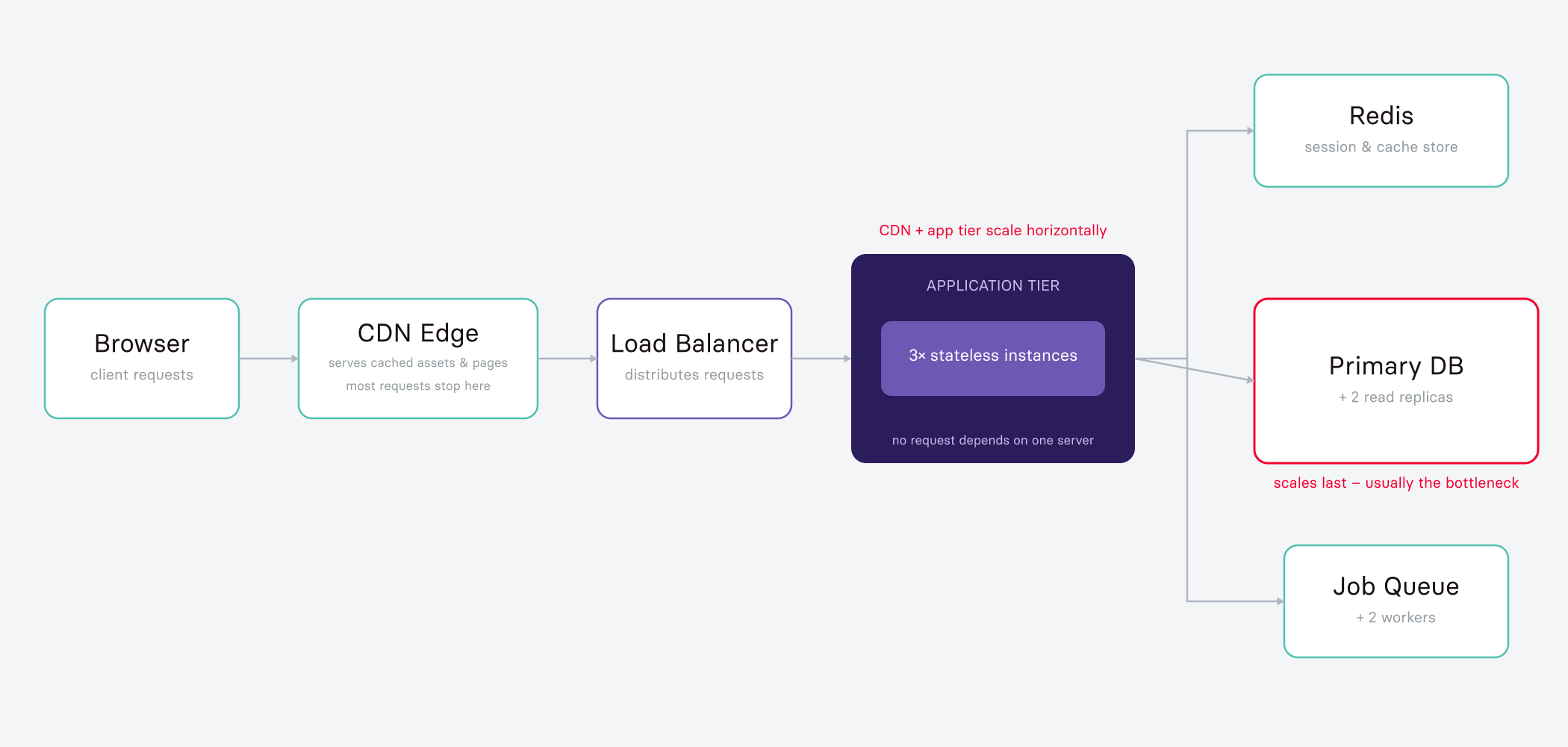
Scalability is built along the full request path, from the browser to the database.
Stateless application servers behind a load balancer. Session data lives in a shared store, such as Redis or a signed cookie, instead of in server memory. Any server can then handle any request, which is what makes adding and removing instances possible without disrupting logged-in users.
Caching at the network edge. A CDN serves static assets and cacheable pages from locations near the user. For content-heavy applications this removes the large majority of requests from the origin servers entirely, while also cutting latency.
Application and database caching. Frequently read data is held in Redis or Memcached so repeated queries do not reach the database. Cache invalidation strategy, a time-based expiry or an event-driven purge, is decided per data type, according to how tolerable staleness is.
Read replicas and connection pooling. Web workloads tend to be read-dominated, so read queries are directed to replicas while writes go to the primary. Connection pooling through PgBouncer or an equivalent prevents a large fleet of application instances from exhausting database connections.
Asynchronous background processing. Email, image processing, report generation, and third-party API calls move to a queue and worker pool, keeping request handling fast and shielding users from slow external dependencies.
Frontend performance work. Code splitting, lazy loading, image optimization, server-side rendering or static generation, virtualized lists for large datasets, and pagination or cursor-based loading instead of fetching entire collections.
Autoscaling with defined limits. Instance count adjusts to demand based on CPU load or queue depth, with a ceiling that prevents a traffic anomaly or inefficient query from producing an unbounded cloud bill.
What Stack Do Scalable Web Apps Use?
Frontend frameworks: Vue with Nuxt, React with Next.js, SvelteKit – each supporting server-side rendering and static generation for faster first paint.
Backend: Node.js with NestJS or Fastify, Python with Django or FastAPI, Ruby on Rails, Go, Elixir with Phoenix.
CDN and edge: Cloudflare, Amazon CloudFront, Fastly, Vercel Edge Network.
Caching and sessions: Redis, Memcached.
Databases: PostgreSQL with read replicas, Amazon Aurora, PlanetScale, MongoDB Atlas.
Hosting and orchestration: Kubernetes, AWS ECS, Google Cloud Run, Vercel, Fly.io.
Monitoring: Datadog, New Relic, Sentry, Google Lighthouse and Core Web Vitals field data via the Chrome UX Report.
What Are the Key Characteristics of a Scalable Web Application?
No server-side session affinity. Users are not bound to a particular instance, so scaling events and rolling deployments do not log anyone out or lose in-progress work.
A high cache hit ratio. A large share of requests is answered by the CDN or an application cache, which is the single most effective lever on web capacity.
Stable response times as concurrency rises. Latency at the 95th and 99th percentiles stays within target as load increases.
Frontend performance independent of dataset size. Pagination and virtualized rendering mean an account with a million records performs comparably to one with a hundred.
Resilience to slow dependencies. Timeouts and circuit breakers prevent a slow payment gateway or search service from consuming all available request handlers.
Load-tested capacity limits. The team knows from testing where the application breaks and which component fails first.
What Are the Benefits of a Scalable Web Application?
Traffic peaks handled without degradation. A launch or a seasonal surge is absorbed by additional capacity instead of producing slow pages and failed checkouts.
Protected conversion rates. Consistent performance under load keeps the funnel intact when volume is highest, which is when the cost of a slow page is greatest.
Lower infrastructure cost per user. Effective caching means most requests never reach a server that has to compute anything. Applications with high cache hit ratios often run on a fraction of the infrastructure their raw traffic figures would suggest.
Better search visibility. Core Web Vitals are a ranking input, and the techniques that make an application scalable, edge caching and smaller bundles among them, are largely the same ones that improve those metrics.
Deployments without downtime. Stateless instances behind a load balancer allow rolling or blue-green releases, so shipping does not require a maintenance window.
What Are the Challenges and Trade-offs of a Scalable Web Application?
Caching introduces staleness. Every cache layer creates a window in which users may see outdated data. Deciding acceptable staleness per data type, and building reliable invalidation, is ongoing design work.
Session handling becomes more involved. Moving sessions out of server memory means operating a shared store or accepting the size and revocation limits of token-based sessions.
Local development diverges from production. A developer machine running one process against one database does not reproduce cache behavior, replica lag, or load-balancer routing, so a class of bug only appears in staging or production.
Frontend and backend scaling compete for attention. Teams often optimize the server extensively while shipping a large JavaScript bundle, or the reverse. Both paths need measurement.
Autoscaling can mask inefficiency. Adding instances hides slow queries and wasteful code by paying for them. Without profiling, the cloud bill grows while the underlying problem remains.
Third-party scripts undermine performance. Analytics scripts and tag managers are added outside the engineering process and frequently become the largest contributor to slow page loads.
What are the differences between Scalable and Single-Server Web Apps?
Factor | Scalable Web Application | Single-Server Application |
Session storage | Shared store or signed token | Server memory |
Response to traffic spikes | Autoscales; edge absorbs load | Slows, then fails |
Deployment | Rolling, zero downtime | Restart with a brief outage |
Static asset delivery | CDN edge near the user | Origin server |
Failure impact | One instance lost; traffic reroutes | Complete outage |
Operational complexity | Higher; more moving parts | Low; simple to run |
FAQ About Scalable Web Applications
Need expert help with Scalable Web Application?
Monterail builds custom software solutions that leverage the latest technologies. Let's discuss how we can help with your project.
GET IN TOUCHGET IN TOUCH