The New Default. Your hub for building smart, fast, and sustainable AI software
UX Research
UX research is the systematic study of users through methods such as interviews, usability testing, surveys, and analytics, used to inform product decisions with evidence instead of assumption. It runs throughout a product's life, from early discovery to testing changes after launch.
What Is UX Research?
UX research is the practice of studying how people actually think, behave, and struggle when they use a product.Design and product decisions are based on evidence. User research spans two dimensions :
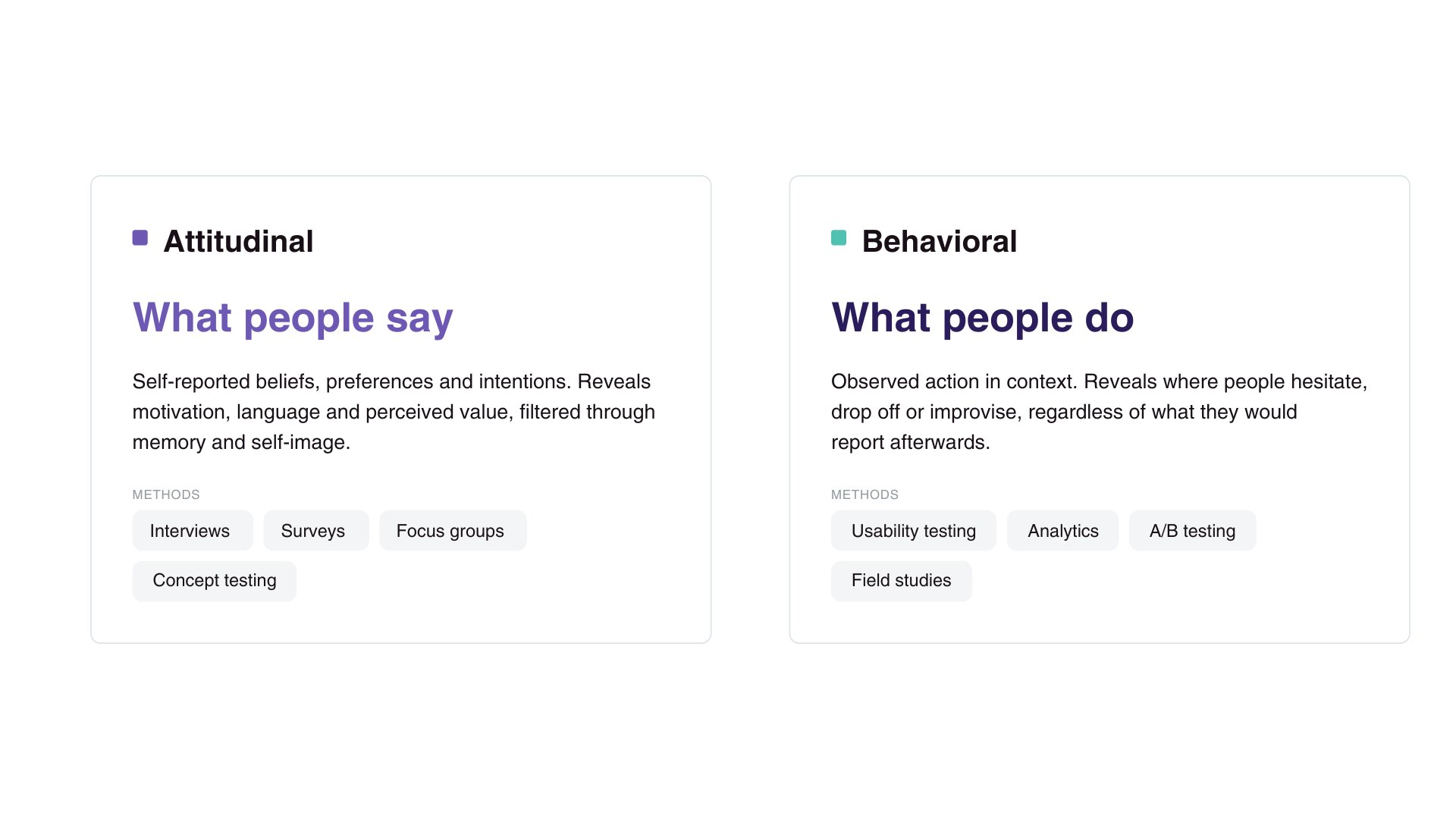
Neither dimension is more true than the other. Attitudinal research explains why, behavioral research shows what.
Research also splits by when it happens. Generative research comes early and explores open questions about user needs before anything has been designed. Evaluative research comes later and tests whether an already-built solution actually works. Both are necessary, and skipping either one tends to surface as a problem eventually, just at a different point in the process.
Why Are Product Teams Investing in UX Research?
Wrong bets get caught early. Teams that check decisions against user evidence avoid building features nobody needed, and that cost grows the later the mistake is found.
Decisions stop depending on rank. Research gives the team evidence about what users need, so the most senior voice in the room no longer settles the question by default.
How Does UX Research Work?
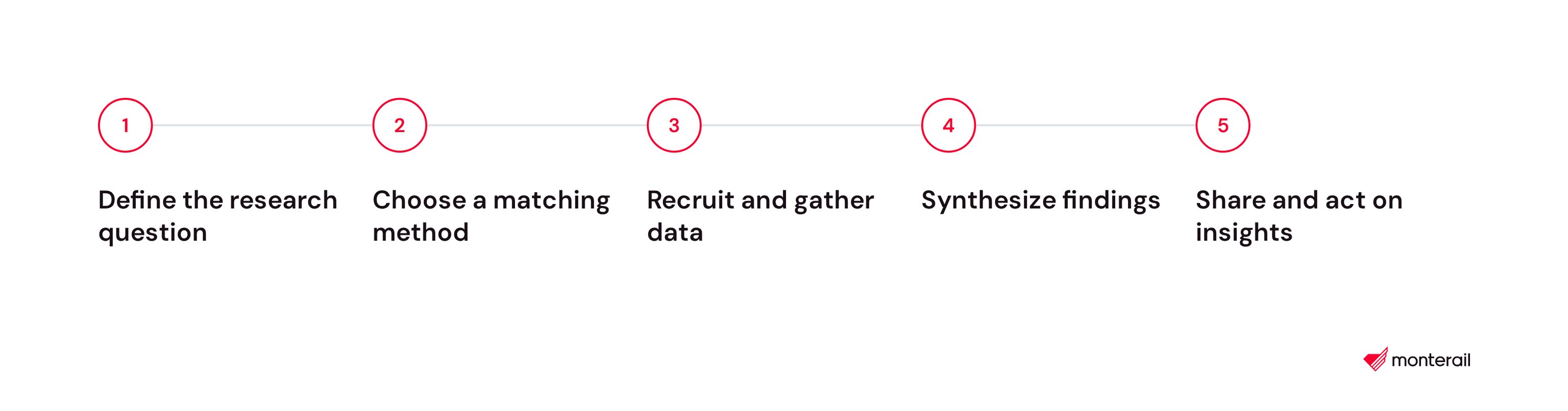
Research moves from a clear question to a synthesized, shareable answer.
Define the research question. The team identifies specifically what it needs to learn and why, since the question determines which method fits.
Choose a matching method. A mix of qualitative and quantitative, attitudinal and behavioral methods gets selected based on what the question requires, not on which method the team happens to know best.
Recruit and gather data. Participants matching the target audience are recruited, then interviewed, observed, or surveyed, depending on the method chosen.
Synthesize findings. Raw notes, recordings, and survey responses get turned into patterns, themes, and specific, actionable insights rather than staying as a pile of unstructured data.
Share and act on insights. Findings are documented and shared with the team so they feed into actual product and design decisions instead of sitting in a report nobody opens again.
Which Tools Support UX Research?
Usability testing: Tools such as Maze and UserTesting run moderated and unmoderated sessions and record how participants interact with a design.
Participant recruiting: Platforms such as User Interviews and Respondent help teams find and schedule people who match a specific target audience.
Research repositories: Tools such as Dovetail centralize interview notes, recordings, and findings so past research stays searchable instead of scattered across individual files.
Surveys and analytics: Survey tools such as Typeform capture attitudinal data at scale, while product analytics platforms such as Amplitude or Mixpanel capture behavioral data from real usage.
What Are the Key Characteristics of UX Research?
Combines qualitative and quantitative methods. Numbers reveal what is happening at scale, while qualitative methods reveal why it is happening.
Spans attitudinal and behavioral data. What people say and what people actually do frequently diverge, so research aims to capture both rather than relying on either alone.
Happens throughout the process. Generative research shapes what gets built; evaluative research tests whether what got built actually works.
Depends on representative participants. Findings drawn from the wrong audience produce confident conclusions that do not hold up once the real product ships.
Requires synthesis, not just collection. Raw interview notes and survey responses do not drive decisions on their own until someone turns them into clear patterns.
What Are the Benefits of UX Research?
Reduces the risk of building the wrong thing. Catching a flawed assumption during research costs far less than catching it after a feature has already shipped.
Grounds decisions in evidence. Choices can be defended with actual user data instead of resting on whoever has the most authority in the room.
Reveals problems the team cannot see itself. People who build a product every day are too close to it to notice what confuses someone using it for the first time.
Improves usability over time. Iterative testing catches confusing flows and unclear labels before they reach production.
Builds shared understanding. Findings that get shared broadly give designers, engineers, and stakeholders a common reference point instead of competing assumptions.
What Are the Challenges and Trade-offs of UX Research?
Time and budget pressure. Research takes real time upfront, which a deadline-driven team can be reluctant to spend even when it would save time later.
Recruiting the right participants. Reaching a niche or hard-to-access audience quickly is often the hardest logistical part of running a study.
Bias in synthesis. It is easy to notice patterns that confirm what the team already believed and miss the ones that contradict it.
Findings that get ignored. Research that is not communicated clearly, or arrives after a decision has already been made, does not actually change anything.
Small sample sizes limit certainty. Qualitative research with a handful of participants surfaces real patterns, but it cannot prove those patterns hold across an entire user base.
Qualitative vs. Quantitative UX Research: Which Fits Which Question?
Factor | Qualitative Research | Quantitative Research |
|---|---|---|
Answers | Why users behave a certain way | How many users behave a certain way |
Typical methods | Interviews, usability testing, contextual inquiry | Surveys, analytics, A/B testing |
Sample size | Small, usually five to twelve participants | Large, often hundreds or thousands |
Data type | Observations, quotes, themes | Numbers, statistics, trends |
Best for | Exploring problems, understanding motivation | Validating a hypothesis at scale, measuring impact |
FAQ About UX Research
Related Terms
Need expert help with UX Research?
Monterail builds custom software solutions that leverage the latest technologies. Let's discuss how we can help with your project.
GET IN TOUCHGET IN TOUCH