The New Default. Your hub for building smart, fast, and sustainable AI software
Usability Testing
Usability testing is the practice of watching representative users attempt realistic tasks with a product, to find where they succeed and where they struggle.
What Is Usability Testing?
A team that designs a product knows it too well to see where it confuses people, and usability testing borrows a fresh pair of eyes to find out. Representative users work through specific tasks with the product, at any stage of readiness, while the team watches.
It can be moderated, with a facilitator present who can ask follow-up questions live, or unmoderated, where a participant completes tasks alone while the session gets recorded for later review.
Most sessions use a think-aloud protocol, where participants narrate their reasoning as they work through a task. That narration shows why someone got confused, which a click recording alone cannot. Usability testing is also evaluative: it checks a design that already exists instead of exploring what to build in the first place.
Why Does Usability Testing Matter for Product Teams?
Usability testing matters because the people who build a product are the least able to see where it confuses others. A confusing flow found in a test session is fixed in a design file, while the same flow found after launch is fixed in code, with support tickets arriving in the meantime.
It replaces the team's own assumption that a design is obviously usable with direct evidence about whether people who don't share the team's context can use it.
How Does Usability Testing Work?
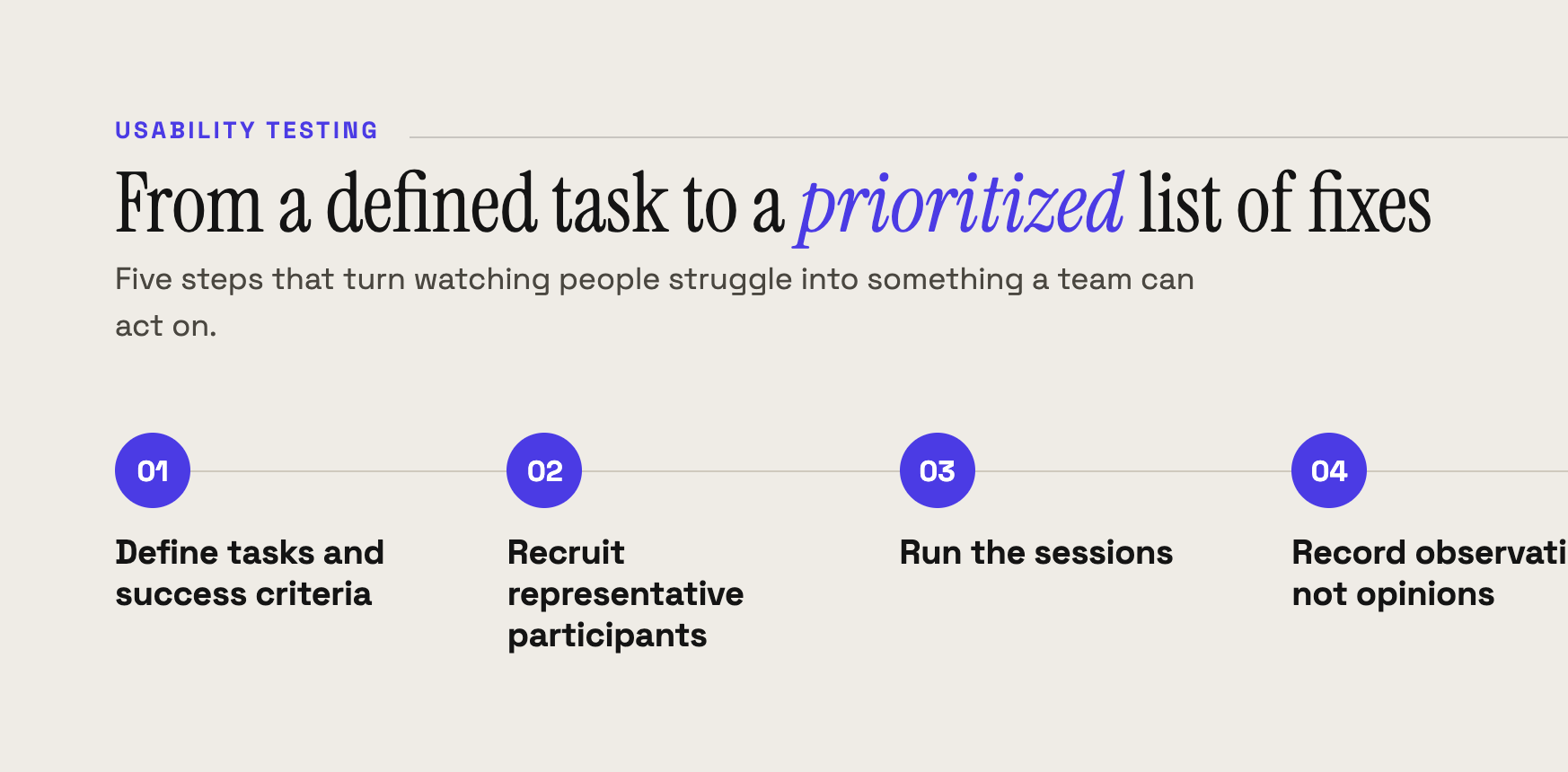
Usability testing moves from a defined task to a prioritized list of what to fix.
Define tasks and success criteria. The team writes specific, realistic tasks for participants to attempt and decides in advance what counts as success or failure for each one.
Recruit representative participants. Jakob Nielsen's widely cited research (Nielsen Norman Group, 2000) suggests around five participants surface most major usability problems in a single round, though the right number still depends on the audience and stakes of the product.
Run the sessions. Participants attempt the tasks while thinking aloud, either with a facilitator present or alone and recorded.
Record what participants do. Note where a participant hesitates or clicks the wrong thing. That record matters more than what they say they liked afterward.
Synthesize and prioritize fixes. Findings get grouped into patterns and ranked by how many participants hit the same problem and how severe each one was.
Which Tools Support Usability Testing?
Moderated and unmoderated platforms: Maze, UserTesting, and Lookback run both live moderated sessions and unmoderated recorded tests, often with a built-in participant panel.
Standardized measurement: The System Usability Scale, a 10-item questionnaire John Brooke developed in 1986, remains the most widely used way to turn a usability test into a single comparable score. Across roughly 500 studies compiled by Jeff Sauro of MeasuringU, the average score is 68 out of 100.
Participant recruitment: User Interviews and Respondent find participants who match a target profile, which helps when a platform's built-in panel does not cover a niche audience.
Open question: UserTesting now offers a Lookback integration. Confirm Lookback is still sold as a separate product before publishing.
What Are the Key Characteristics of Usability Testing?
Task-based. Participants complete specific, realistic tasks instead of offering open-ended opinions about the product.
Iterative rounds. Teams run a small round, fix what it reveals, then test the revised design with new participants. Several small rounds usually find more than one large study, because each round tests the fixes from the last.
Evaluative by design. It checks something that already has a design, instead of exploring open questions about what should be built.
Behavioral over attitudinal. What a participant does matters more than what they say they'd do afterward.
Small samples, focused questions. A handful of participants can reveal major problems reliably, as long as the tasks are specific enough to test.
What Are the Benefits of Usability Testing?
Finds problems internal reviews miss. Confusion that a team's own design review tends to overlook shows up within the first few sessions once someone outside the team attempts the task.
Shorter design debates. When a team disagrees about a flow, a round of five sessions settles the question with evidence instead of seniority.
Produces evidence stakeholders can see. A recorded session of someone struggling is far more convincing than a report describing the same problem in the abstract.
Works at any fidelity. Wireframes, prototypes, beta builds, and live products can all be usability tested, so the method applies from early design through well after launch.
Tracks usability over time. Questionnaires such as the SUS let a team compare scores release over release, so improvement can be measured instead of assumed.
What Are the Challenges and Trade-offs of Usability Testing?
Limited statistical confidence. A small qualitative round shows where people struggle, but it cannot say how many users across the whole base hit the same problem. A quantitative follow-up with a larger sample can, at the cost of more participants and more time.
Recruiting representative participants. Testing with people who don't match the target audience produces confident findings that don't hold up after launch. Specialist recruiting services find better matches, but niche profiles such as clinicians or finance managers cost more per session and take longer to book.
Facilitator influence. A moderator can unintentionally lead participants toward certain reactions. Scripted prompts and neutral follow-up questions reduce the effect, but the more tightly a session is scripted, the less room the facilitator has to probe something unexpected.
Lab conditions aren't everyday conditions. A task completed calmly in a test session can go differently when someone is rushed and on their own device. Remote testing on participants' own devices gets closer to everyday use, but the team loses some control over the setup and some sessions fail for technical reasons.
Testing too late to act on findings. Once a design is built, every finding becomes a code change instead of a design change. Testing early prototypes avoids that, but a rough prototype cannot reveal problems that only appear with live data and working interactions.
What Is the Difference Between Moderated and Unmoderated Usability Testing?
Moderated testing gives up speed and cost for depth, while unmoderated testing gives up depth for scale.
Factor | Moderated testing | Unmoderated testing |
Facilitator present | Yes, live and able to ask follow-up questions | No, participants complete tasks alone |
Cost and speed | Slower and more expensive per participant | Faster and cheaper, runs at scale |
Depth of insight | Deeper, can probe the reasoning behind a reaction | Shallower, limited to what gets recorded |
Best for | Complex flows and questions about why users struggle | Straightforward tasks that need a larger sample |
Typical setting | Scheduled video call or in-person session | Self-guided, recorded asynchronously |
FAQ About Usability Testing
Related Terms
Need expert help with Usability Testing?
Monterail builds custom software solutions that leverage the latest technologies. Let's discuss how we can help with your project.
GET IN TOUCHGET IN TOUCH