The New Default. Your hub for building smart, fast, and sustainable AI software
Wearable Health Technology
Wearable health technology is body-worn devices, such as smartwatches or adhesive glucose sensors, that measure health signals continuously and pass the data to an app or a care team.
What Is Wearable Health Technology?
A clinic visit captures a patient's health for a few minutes. A wearable keeps measuring in between, at home and overnight, where most of a person's life happens and where many changes first appear.
The category runs from consumer fitness trackers to cleared medical devices. In 2018, Apple received De Novo classification from the FDA for the Apple Watch ECG app, which records a 30-second, single-lead reading and checks it for signs of atrial fibrillation (AFib). In March 2024, the FDA cleared Dexcom's Stelo, the first over-the-counter continuous glucose monitor, for adults who do not use insulin.
What separates the two ends is the product's claim. FDA policy treats products for "maintaining or encouraging a healthy lifestyle," when unrelated to diagnosing or treating a disease, as general wellness products outside device rules. The same sensor can sit on either side of that line depending on what the product says it does.
Why Does Wearable Health Technology Matter?
It moves monitoring out of the clinic. Continuous readings show how a condition behaves day to day, which a single measurement in a doctor's office cannot.
It is often the front door to a larger product. Data from a wearable feeds apps and remote monitoring programs, so the device is frequently just the first piece of a software system built around it.
How Does Wearable Health Technology Work?
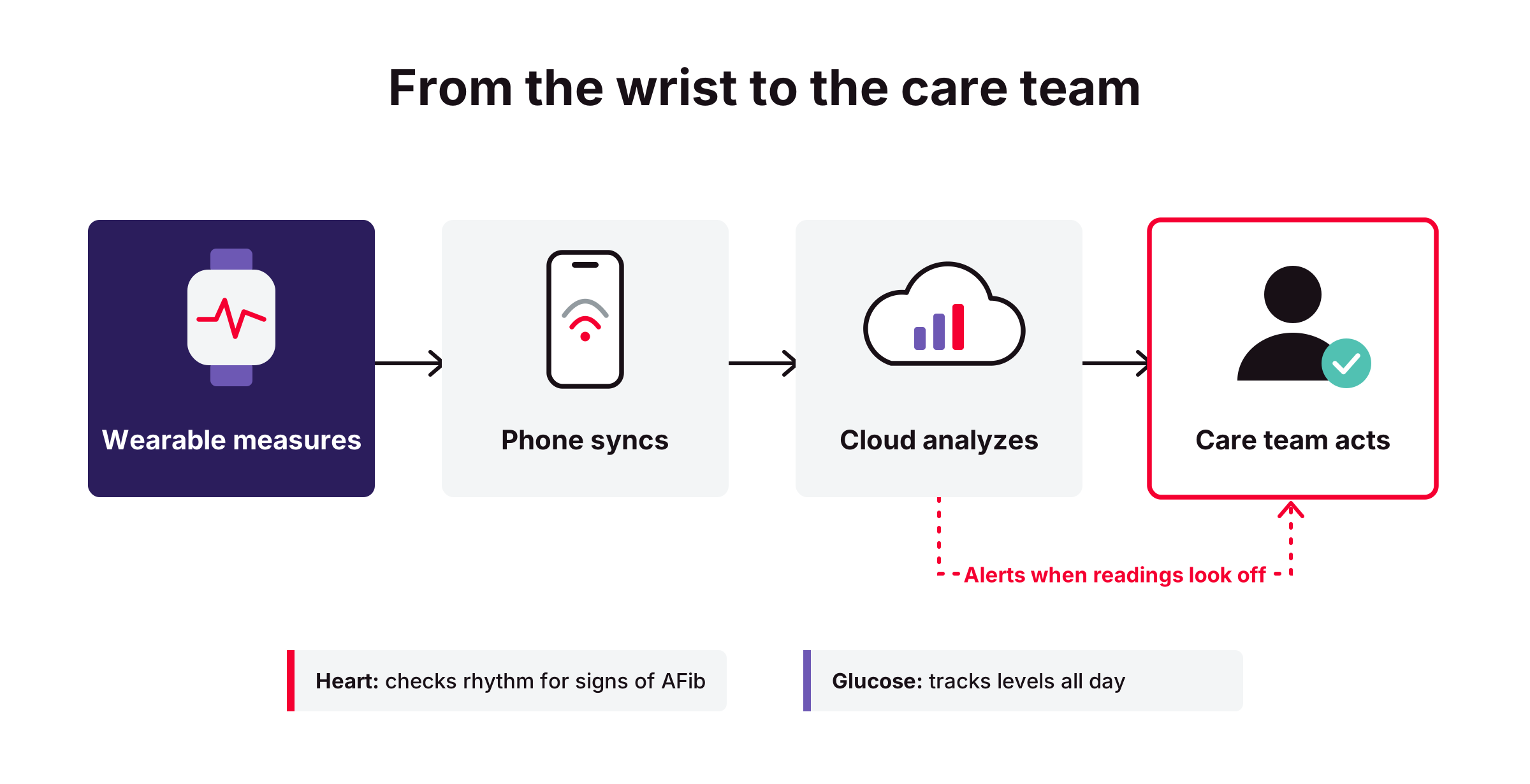
Sensors. Optical sensors estimate heart rate from changes in blood volume under the skin, accelerometers track movement and sleep, electrodes record heart rhythm, and a thin wire just under the skin measures glucose in the fluid between cells.
On-device processing. Firmware filters noise, such as motion during exercise, and turns raw signals into readings before sending them, which saves battery and bandwidth.
The phone as gateway. Many wearables send their readings wirelessly, typically over Bluetooth, to a phone app, which uploads the data to a cloud backend.
Cloud platform and integrations. The backend stores and analyzes the data, and can share it with clinicians or with health record systems when the user or care program allows it.
Alerts and feedback. Thresholds or algorithms notify the user or a care team when readings look unusual. For regulated features, that algorithm is part of the cleared device, so changing it may need regulatory review.
What Tools Do Teams Use to Build With Wearable Health Data?
Phone health platforms. Apple HealthKit and Google's Health Connect let apps read and write health data collected by phones and wearables, with the user's permission.
Wearable vendor APIs. The Fitbit Web API and Garmin's Health API give approved apps access to data that users choose to share from their devices.
Device-data aggregators. Validic and Terra connect many wearable brands through a single API, so a product does not need a separate integration for each manufacturer.
What Are the Key Characteristics of Wearable Health Technology?
Continuous but noisy data. Readings arrive every few seconds or minutes, and fit and movement affect their quality. Software has to separate signal from noise before anyone draws conclusions.
Battery life shapes every feature. Sampling more often gives richer data but drains the battery faster, and a device that needs charging every night is more likely to be left on the table.
Hardware and software release separately. The device ships once, while firmware and app updates keep arriving, so teams have to support several firmware versions in the field at the same time.
Access runs on consent. Users authorize each app's access to their data and can revoke it, so a product's data supply depends on keeping users' trust.
What Are the Benefits of Wearable Health Technology?
Earlier warning signs. Background features such as Apple's irregular rhythm notification check for signs of an irregular rhythm that appears to be AFib and alert the user if they find one.
Feedback people can act on. The FDA describes the over-the-counter Stelo monitor as useful for people who want to see how diet and exercise affect their blood sugar.
Monitoring without travel. Clinicians can follow patients after discharge or between visits, which reduces trips made only to take a measurement.
Data for research. Wearables make very large studies possible. The Apple Heart Study enrolled more than 400,000 participants entirely through an app, with no in-person visits needed to join.
What Are the Challenges of Wearable Health Technology?
Accuracy limits. Motion and poor fit degrade readings. Validation studies across the people a product is meant for build trust in the numbers, but add time and cost before launch.
Alert fatigue. Sensitive alerts catch more events but also raise more false alarms. Hospitals already know the pattern: in one ICU study cited by the US Agency for Healthcare Research and Quality, 88.8% of arrhythmia alarms were false. Raising thresholds cuts the noise, but increases the chance of missing an event that matters.
Users stop wearing them. An often-cited 2013 survey by Endeavour Partners found that a third of activity-tracker owners stopped using them within six months. Reminders keep people engaged longer, but too many notifications push users to switch them off.
Privacy outside HIPAA. Data from a wearable bought directly by a consumer often falls outside HIPAA, which only covers covered entities and their business associates. Applying healthcare-grade privacy anyway builds trust, but limits what the company can do with the data.
What Is the Difference Between Wearable Health Technology and Remote Patient Monitoring?
Aspect | Wearable health technology | Remote patient monitoring |
What it is | Body-worn devices and the software around them | A care program that tracks patients outside the clinic using connected devices |
Who usually starts it | Often the consumer, who buys the device | A clinician or care team, who enrolls the patient |
Devices involved | Devices worn on the body | Wearables, plus devices that are not worn, such as blood pressure cuffs or connected scales |
Who reviews the data | Mainly the user, unless they choose to share it | Clinical staff, as part of the care plan |
Privacy rules | HIPAA applies only when a covered entity or business associate handles the data | Usually run by covered entities, so HIPAA typically applies in the US |
FAQ about Wearable health technology
Need expert help with Wearable Health Technology?
Monterail builds custom software solutions that leverage the latest technologies. Let's discuss how we can help with your project.
GET IN TOUCHGET IN TOUCH