The New Default. Your hub for building smart, fast, and sustainable AI software
Banking Software Development
Custom software for banks and other licensed financial institutions, from customer apps to the systems behind them.
What Is Banking Software Development?
Banking software development is the design and engineering of applications that banks and bank-like providers use. Common products include mobile banking apps and online account portals. The work also covers the integrations that connect these channels to core banking and payment systems. Each release has to meet financial regulation and security requirements.
Monterail has delivered 900+ projects since 2010, including CashDeck, a wealth dashboard that became a staple tool for major Australian banks and financial institutions.
What Does Banking Software Development Include?
A banking software engagement covers the digital products a bank's customers and staff use, plus the integrations that connect them to the bank's existing systems.
What it includes
Product discovery and roadmap workshops with business and compliance stakeholders
UX/UI design for web and mobile banking channels
Web and mobile apps, including dashboards that aggregate accounts from several institutions
Backend services and APIs that connect the product to financial data providers
Rewrites of existing finance applications onto current frameworks
Security engineering such as encryption and read-only account access
Maintenance and new features after launch
What it doesn't include
Core banking platform licenses and the core vendor's own customization work
Banking licenses and regulatory filings, which stay with the institution and its legal counsel
Formal certifications such as a PCI DSS assessment, which accredited assessors carry out
Fees for third-party services such as KYC checks and payment processing
When Does Custom Banking Software Fit?
Custom banking software fits when the customer-facing product is what sets the institution apart, and the core systems behind it can stay as they are.
It fits when
You need a customer channel that sets you apart, and a white-label app would look like every competitor's
Your product combines banking data with other sources, as account-aggregation dashboards do
An existing finance app runs on an outdated framework and needs a rewrite while its users keep trading or banking
Your in-house team owns the core systems and compliance, and needs product design and engineering capacity on top
It doesn't fit when
You need a licensed core banking ledger. Established core vendors provide one with controls regulators already know.
A white-label digital banking platform already covers your product, in which case it gets you to market faster.
The goal is a compliance assessment or a legal opinion, which is work for specialist auditors and counsel.
Several regulated products need to launch at once on a short budget. Launching one product first gives each the testing it needs.
What Are the Benefits of Custom Banking Software Development?
The main benefit is control: the institution decides how its customers bank with it, and can change that as fast as the market moves.
Channels that set you apart. The app or portal is designed around your own customers and their habits.
Many sources in one view. Custom software can combine accounts and investments from several institutions in one dashboard.
Security designed in from the first sprint. Encryption and audit logging are architecture decisions, made before features are built.
Your roadmap, your timing. New features ship on your schedule, as soon as your customers need them.
Faster response to rule changes. Owned code can be updated directly when regulation changes what an app must do.
How Does a Banking Software Development Project Work?
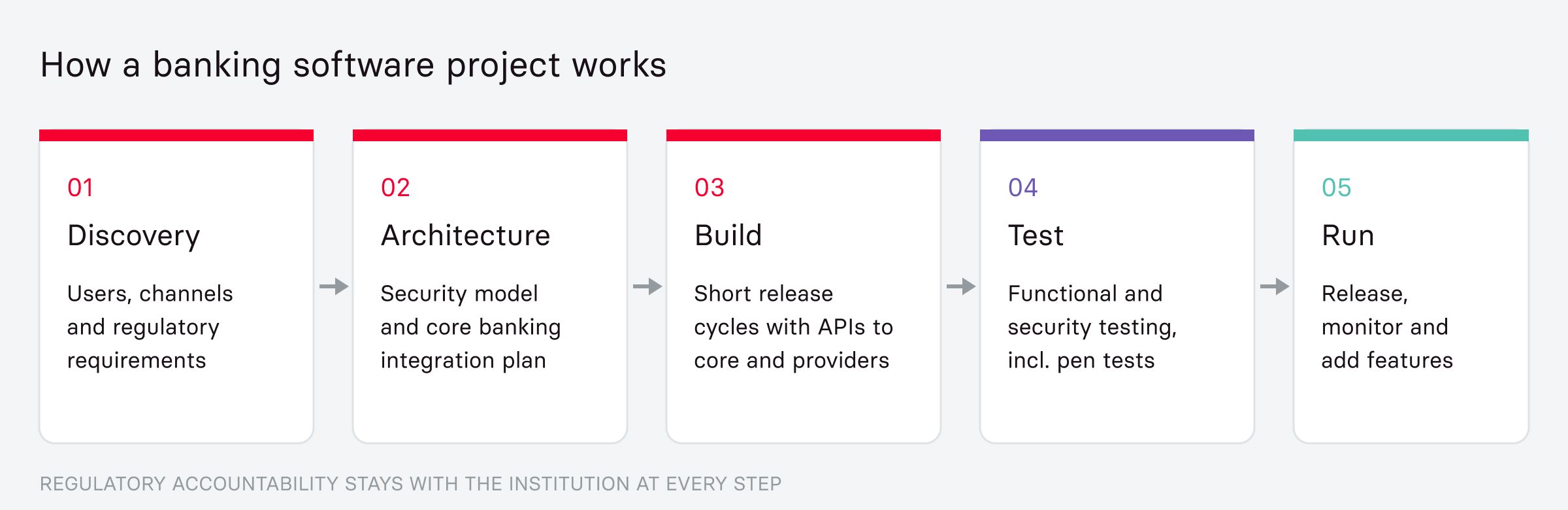
A banking software project runs in five steps, from discovery to ongoing support, with security testing before every major release.
Discovery and requirements mapping. Workshops with product and compliance stakeholders define the users and channels the product serves. The output is a backlog in which each feature carries its regulatory and integration requirements.
Architecture and security design. The team designs the APIs and integrations the product depends on. Encryption, access control, audit logging, and data residency are set here, before feature work starts.
Iterative build. Features ship in short release cycles, each one reviewed by the bank's product owner. The team builds and tests integrations with services such as KYC providers and payment rails as those features come up.
Testing and security validation. Functional testing runs on every release, and independent security testing such as penetration testing checks the product before launch.
Release and ongoing support. After launch, the team monitors the product and ships fixes and new features under an agreed support arrangement.
Should a Bank Build Custom Software or Use a White-Label Digital Banking Platform?
Build custom software when the digital experience is how you compete, and choose a white-label platform when speed to market matters more than differentiation. For the general trade-off outside banking, see custom software development.
Factor | Custom banking software | White-label digital banking platform |
Differentiation | Interface and features designed around your customers | A shared product with your branding on top |
Time to launch | Longer: discovery and design come before the build | Shorter: configuration and integration of an existing product |
Roadmap control | You decide what ships and when | The vendor's roadmap sets which features arrive |
Integration flexibility | Connects to any system with an API, including in-house tools | Limited to the integrations the vendor supports |
Ongoing cost | An engineering team plus hosting | A platform license, often priced per user or account |
Regulatory accountability | Stays with the institution | Stays with the institution, with the vendor covering controls inside its platform |
Challenges to plan for: Custom software keeps security testing and maintenance on your budget for as long as it runs. A white-label platform trades that for vendor dependency, and leaving it later means migrating every customer.
How Does Monterail Approach Banking Software Development?
Monterail builds the customer-facing layer of financial products and treats security as an architecture decision, as its work on CashDeck shows.
A seven-person Monterail team built a read-only, fully encrypted wealth dashboard on a service-oriented architecture for InvestmentLink, which supplies superannuation data to over 10,000 financial planners, covering 4.4 million members across Australia and New Zealand. CashDeck brings bank accounts, loans, mortgages, shares, superannuation and credit cards into one view for asset owners and their advisors. The brief was to provide "the same encryption and physical security as the banks." CashDeck became a staple tool for many of Australia's largest financial institutions, including major banks.
Dariusz Gertych, Senior Developer at Monterail, says:
The effect exceeded our expectations and the users’ feedback brought satisfaction to the whole team.
ZebPay, a cryptocurrency exchange with 5+ million users and $40–50 million in daily trade volume, needed its 2014 Angular web app rebuilt. A six-person Monterail team started within 15 days and rewrote it in React in six months, working alongside ZebPay's own engineers.
When Should a Bank Bring In a Software Development Partner?
A partner helps when a bank needs a new customer channel and its own team must stay on core systems and compliance. It also helps when an existing finance app needs a rewrite while customers keep using it every day. If you only need extra engineers inside your current team, staff augmentation adds them.
Monterail's fintech software development services cover lending, payments, investment and online banking products. Talk to our team about the banking product you want to build.
FAQ About Banking Software Development
Need expert help with Banking Software Development?
Monterail builds custom software solutions that leverage the latest technologies. Let's discuss how we can help with your project.
EXPLORE FINTECH SERVICESEXPLORE FINTECH SERVICES