The New Default. Your hub for building smart, fast, and sustainable AI software
IEC 62304 / MDR-Compliant Development
Building medical device software to the IEC 62304 lifecycle standard so it can pass EU MDR and FDA review.
What Is IEC 62304 / MDR-Compliant Development?
IEC 62304 / MDR-compliant development is the practice of building medical device software to the IEC 62304 lifecycle standard. The standard covers planning, requirements, testing, release and maintenance. It gives the manufacturer a traceable record that EU MDR notified bodies and the FDA can review.
Across 900+ projects since 2010, including 15+ regulated medical devices, Monterail writes regulatory documentation as development happens, so nothing needs to be reconstructed before submission.
What Does IEC 62304 / MDR-Compliant Development Include?
A compliant engagement covers the software lifecycle and its records, while the device manufacturer retains regulatory responsibility.
What it includes
A software development plan built around the safety class the manufacturer assigns to each software item
Requirements and architecture records, each traced to the risk control it implements
Verification at the test levels the item’s class calls for, with results recorded for each release
A SOUP register and a software bill of materials (SBOM) for third-party components
Inputs for ISO 14971 risk management and, where the interface can affect safety, IEC 62366-1 usability engineering
Documentation written inside the client’s quality management system, or delivered as a software-scoped package that folds into the client’s technical file
Security controls for health data, including encryption and audit trails that cannot be altered
What it doesn’t include
Acting as legal manufacturer or holding the CE mark and FDA clearance
Leading the regulatory submission: Monterail supplies the software documentation, and regulatory partners in its Monterail Universe network, such as MAE Group, lead submission strategy
The clinical evaluation report, which belongs to the manufacturer
Running the manufacturer’s vigilance and complaint-handling system
When Does IEC 62304 / MDR-Compliant Development Fit?
It fits whenever software meets the legal definition of a medical device or runs inside one.
It fits when
The software is a medical device on its own (SaMD) or part of one, a question this guide helps answer
You plan to sell in the EU, the US, or both, and need records that a notified body or FDA reviewer can follow
An existing medical device is getting a new companion app or new software features
A wellness product has a regulated version on its roadmap, and you want the codebase ready for it
It doesn't fit when
A general wellness app with no medical claims can skip the regulated lifecycle, and secure, well-tested development keeps its costs lower
Teams still working out classification or submission strategy get their answers fastest from a regulatory affairs partner, before development starts
Scheduling or billing software with no medical purpose sits outside the standard’s scope, and privacy rules such as HIPAA and GDPR govern its data instead
Teams testing product ideas every day can start with a non-regulated prototype, then move into the regulated lifecycle once the design settles
What Are the Benefits of IEC 62304 / MDR-Compliant Development?
The main benefit is a software record that regulators can review without the team rebuilding it from memory before submission.
One lifecycle record for two markets. The FDA lists IEC 62304 as a recognized consensus standard, and manufacturers use it to show their software meets the EU MDR’s state-of-the-art requirement. One record set can support both reviews, and products built to the EU MDR bar also tend to clear US review more smoothly.
Effort matched to risk. Safety classes let lower-risk items carry lighter documentation, so the team spends most of its effort where a failure could harm a patient.
Fewer audit findings. Tracing each requirement to its test and its risk control closes the gaps auditors commonly flag: orphaned requirements and untested risk controls.
Faster changes after launch. A maintained record lets the team quickly assess the impact of an update, so post-market fixes move through change control without a documentation backlog.
How Does IEC 62304 / MDR-Compliant Development Work?
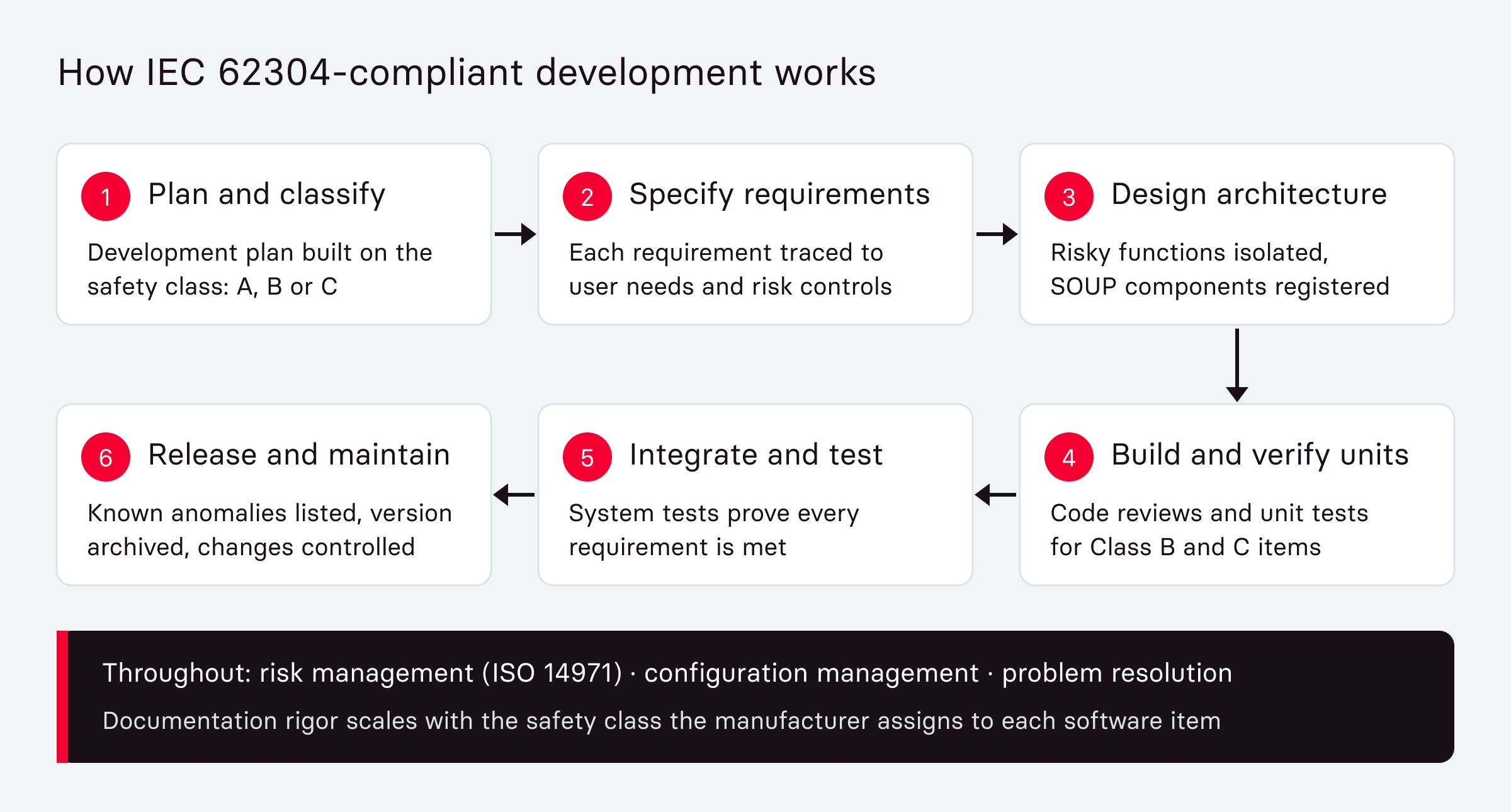
A compliant project follows six working steps, with risk management, configuration management and problem resolution running alongside them.
Plan and classify. The manufacturer assigns each software item a safety class: A when no injury is possible, B when non-serious injury is possible and C when death or serious injury is possible. The development plan then sets the activities and records each class calls for.
Specify requirements. Software requirements are written and traced back to user needs and to the risk controls in the ISO 14971 risk file. Every requirement gets a test that proves it later.
Design the architecture. Splitting the system into software items isolates higher-risk functions, so lower-risk parts can carry a lighter class. Third-party libraries enter a SOUP register with their known anomalies and risk assessment.
Build and verify units. For Class B and C items, review and unit-verify code against acceptance criteria. Automated pipelines can produce this evidence on every build.
Integrate and test the system. Integration and system tests show that the software meets each requirement. Failures enter the problem resolution process and are tracked to closure.
Release and maintain. The release record lists known residual anomalies and archives the exact version shipped. After launch, every change gets an impact analysis and regression testing before the records are updated.
The legal basis in the EU sits in Annex I, Section 17.2 of the MDR. It asks for device software built to the state of the art, taking into account the principles of the development life cycle and risk management, including information security. The same clause names verification and validation.
In the US, the FDA's premarket guidance for device software functions sets out the documentation it expects. The standard itself is IEC 62304:2006+A1:2015. For the SaMD and SiMD split and the SOUP rules, see medical device software development.
What Is the Difference Between IEC 62304, ISO 13485 and the EU MDR?
The EU MDR is the law a device must meet to reach the EU market, while IEC 62304 and ISO 13485 are standards manufacturers use to show compliance: one for the software lifecycle, the other for the quality system.
Factor | IEC 62304 | ISO 13485 | EU MDR (2017/745) |
What it is | International standard | International standard | EU regulation with the force of law |
What it governs | The development and maintenance lifecycle of device software | The manufacturer’s quality management system | Safety and performance requirements for devices sold in the EU |
Legally required? | Voluntary; the FDA lists it as a recognized consensus standard | In the US, yes in effect: the FDA’s QMSR has incorporated it by reference since February 2, 2026. In the EU, manufacturers use it to meet the MDR’s quality system requirements | Yes, for every medical device placed on the EU market |
Who applies it | Software teams, including suppliers working for the manufacturer | The manufacturer and the key suppliers it relies on | The legal manufacturer, with notified bodies assessing most device classes |
Main output | Software plans and verification records | Quality procedures and records | Technical documentation and CE marking |
Challenges to plan for: Traceability needs upkeep, because every new requirement needs a linked test and risk control; automating that evidence in the delivery pipeline keeps the extra effort small. Formal design reviews also run as separate, minuted checkpoints alongside sprint reviews, which adds scheduling effort and gives auditors a record they can accept.
How Does Monterail Approach IEC 62304 / MDR-Compliant Development?
Monterail builds medical device software to IEC 62304 as a supplier under the client’s quality system, and the client stays the legal manufacturer.
Compliance is a team practice. Every engineer and designer on a regulated project follows the applicable standards and software development best practices, working inside the client’s quality system by default.
For Elvie, Monterail built the native iOS and Android apps for the Elvie Pump, which had to meet FDA Class II and EU MDR requirements. The team automated design validation with a screenshot-generation system that produced documentation for every app module in all supported languages. That documentation stays current with each release and is used directly in FDA and MDR submission reviews. Automated regression tests run on a hardware-in-the-loop rig with every build, and one codebase supports three pump generations.
For Eargo, Monterail built iOS and Android apps for three hearing aid generations, including the 6th- and 7th-generation FDA Class II devices.
Piotr Zając, HealthTech Director at Monterail, on why early compliance work pays off:
In 15 years, I've seen more rebuilds than I'd like to count. It always costs more than the original build, both in time and money. And almost every time, it was avoidable.
When Should You Bring in an IEC 62304 Development Partner?
A partner helps when your team knows the product but has never taken software through an IEC 62304 audit. It also helps when a submission date leaves no time to build a regulated lifecycle from scratch. Device software can then keep a documented history as it evolves across hardware generations.
If your team already runs its own quality system, staff augmentation adds engineers who work inside it. Monterail’s healthcare software development covers regulated builds from discovery to long-term maintenance, with healthcare compliance and security built in from day one. Talk to our HealthTech team about your device software.
FAQ About IEC 62304 / MDR-Compliant Development
Need expert help with IEC 62304 / MDR-Compliant Development?
Monterail builds custom software solutions that leverage the latest technologies. Let's discuss how we can help with your project.
EXPLORE HEALTHTECH SERVICESEXPLORE HEALTHTECH SERVICES