The New Default. Your hub for building smart, fast, and sustainable AI software
Payment Gateway Integration
Connecting a product's checkout to a payment provider, so customers can pay and every transaction is confirmed back in your system.
What Is Payment Gateway Integration?
Payment gateway integration is the work of connecting a website or app to a payment provider so it can accept payments. It covers the checkout flow and the provider's API, including the status updates that confirm or refund each payment. Card details go straight to the provider, and the product keeps only a token in their place.
Monterail has delivered 900+ projects since 2010, including Pizza Hut Poland's rebuilt ordering app with a white-label payment integration. The new app generates 30% more conversions.
What Does Payment Gateway Integration Include?
A payment gateway integration covers everything between the customer's "Pay" button and a confirmed order in your system.
What it includes
Choosing the integration approach with you: a provider-hosted checkout, embedded payment fields or a direct API integration
Checkout and payment screens for web and mobile, designed to match the rest of the product
Server-side integration with the gateway's API, with card details replaced by provider tokens
Webhook handling, so orders update when a payment succeeds, fails, is refunded or is disputed
Additional payment methods or a second gateway, for example to serve a new market
Refunds and safe retries that never charge a customer twice
Syncing payment data with business systems such as a CRM or order management
Sandbox testing of every payment path before launch
What it doesn't include
Transaction and processing fees, which the payment provider charges
Merchant account approval, which the provider or acquiring bank decides
Building a payment gateway or processor from scratch, which is payment gateway development
The business's own PCI DSS attestation, which the merchant completes every year
When Does Payment Gateway Integration Fit?
A custom payment gateway integration fits when the checkout is part of the product, and payments have to talk to other systems.
It fits when
Checkout is part of your product experience, and a generic payment page would break the flow
You sell in several markets and need local payment methods or a second gateway
A successful payment has to update order management or a CRM without manual work
Your model needs flows a payment link can't express, such as subscriptions, donations, split payments or marketplace payouts
It doesn't fit when
A payment link or a no-code store checkout already covers a small catalog. Those launch without engineering work.
Your e-commerce platform ships a payments plugin that does what you need, so configuring it is the faster route.
You plan to process payments for other businesses. That calls for payment gateway development and a service-provider compliance program.
Nobody will own the integration after launch. Providers retire API versions, and payment code needs an owner to keep up.
What Are the Benefits of Payment Gateway Integration?
The main benefit is a checkout you control, connected to the rest of your business.
Checkout inside the product. Customers pay on screens that match the rest of the product, without a redirect to another site.
Smaller security burden. Tokenized card data stays with the provider, which reduces your PCI DSS obligations.
More ways to pay. New payment methods and gateways can be added as you enter new markets.
Orders that update themselves. Webhooks confirm payments in your system, so staff don't reconcile them by hand.
Room to switch providers. A clean integration layer makes adding or replacing a gateway a contained change.
How Does Payment Gateway Integration Work?
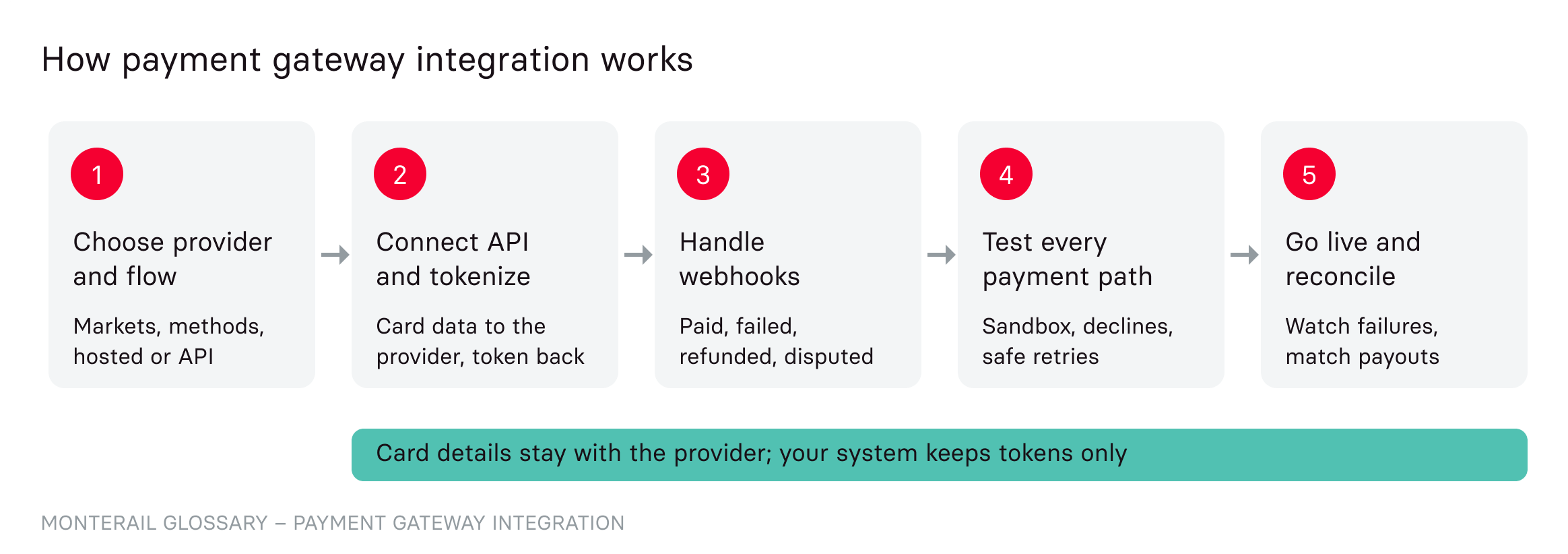
A payment gateway integration runs in five steps, from choosing the checkout flow to monitoring live transactions.
Choose the provider and checkout flow. The team maps your markets and payment methods to the providers that support them. Then it picks a hosted checkout, embedded fields or a full API integration.
Connect the gateway API and tokenize card data. Card details go from the customer's device straight to the provider. Your servers receive a token and use it for charges and refunds.
Handle webhooks and payment states. The provider reports results asynchronously, for example when a bank confirms a payment or a customer disputes a charge. Your system listens for these events and updates each order.
Test every payment path in the sandbox. The team tests successful and declined payments, abandoned checkouts, refunds and authentication challenges. Retries use idempotency keys, so a repeated request never charges twice.
Go live, monitor and reconcile. After launch, the team watches failure rates and checks that provider payouts match the orders in your system.
Should You Use a Hosted Checkout or a Direct API for Payment Gateway Integration?
Use a hosted checkout when speed to launch matters most, and a direct API integration when checkout is part of your product experience. For general API design and versioning, see API development services.
Factor | Hosted checkout | Direct API integration |
Checkout design | The provider's page, styled within its options | Your own screens, designed like the rest of the product |
Customer journey | Customers leave your site or app to pay | Customers pay without leaving your product |
PCI DSS scope | Card data never reaches your servers, so your obligations stay small | Depends on card collection. Provider-hosted fields keep scope small. Handling raw card numbers can mean more than 300 security controls |
Time to launch | Shorter: configuration and a redirect | Longer: checkout design, backend work and testing |
Flexibility | Limited to the flows the provider supports | Subscriptions, split payments and custom flows are possible |
Maintenance | Mostly handled by the provider | Your team keeps up with API version changes |
Challenges to plan for: A direct integration puts checkout quality in your hands, so it also puts testing and API upgrades on your roadmap for as long as it runs.
How Does Monterail Approach Payment Gateway Integration?
Monterail builds payments as one part of the product, so checkout screens and order systems are designed together.
For Pizza Hut Poland, Monterail built a new React.js frontend on the existing backend in five months. The work included a white-label payment integration, and the rebuilt app generates 30% more conversions.
GiveDirectly, a nonprofit that has delivered $800M+ to people in extreme poverty, needed a simpler way to donate. Monterail rebuilt its donation flow in four months with Vue.js and Nuxt. The new Donate module made additional payment methods, including checks and stocks, easier to find and connects to Salesforce.
For Admyt, a ticketless parking app used in South African shopping malls, Monterail built a React Native mobile app and connected additional payment gateways, including PayU.
When Should You Bring In a Payment Integration Partner?
A partner helps when your launch depends on checkout, and your team hasn't built payments before. It also helps when you are adding markets and need new gateways while the current ones keep running. If you only need extra engineers inside your own team, staff augmentation adds them.
Monterail's fintech software development services cover payments and transfers, along with lending, investment, insurance, and online banking products. Talk to our team about the checkout you want to build.
FAQ About Payment Gateway Integration
Need expert help with Payment Gateway Integration?
Monterail builds custom software solutions that leverage the latest technologies. Let's discuss how we can help with your project.
EXPLORE FINTECH SERVICESEXPLORE FINTECH SERVICES