The New Default. Your hub for building smart, fast, and sustainable AI software
Product Discovery
Product discovery is the research and testing a team does to decide what to build, and in what form, before committing engineering time to it.
What Is Product Discovery?
Discovery exists so a team finds out an idea is wrong while being wrong is still cheap. Every feature on a roadmap is a bet, and discovery is where the team checks the odds before placing it.
Teams run discovery in two forms. Continuous discovery, the model Teresa Torres describes in Continuous Discovery Habits, means "weekly touch points with customers by the team building the product." Project-based discovery is a bounded phase at the start of a new product or engagement, common when an outside development partner joins and needs to understand the problem before estimating the build.
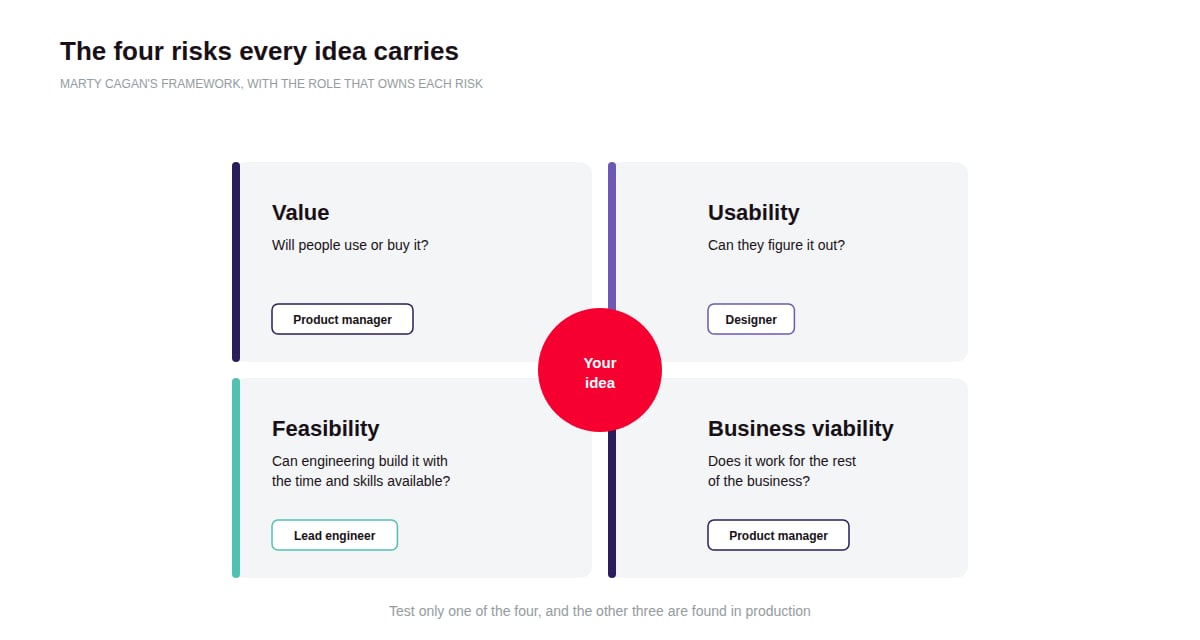
Marty Cagan of Silicon Valley Product Group frames the work around four risks: value (will people use or buy it), usability (can they figure it out), feasibility (can engineering build it with the time and skills available) and business viability (does it work for the rest of the business). A discovery effort that tests only one of the four leaves the others to be found in production.
 Why Does Product Discovery Matter?
Delivery capacity is the tightest constraint on most teams. Every sprint spent on a feature nobody uses is a sprint not spent on one they would. Discovery is how a team decides where that capacity goes.
Fast execution cannot fix a wrong direction. A capable engineering team can ship a weak idea quickly and cleanly. Discovery checks the direction before speed starts to matter.
How Does Product Discovery Work?
Product discovery works as a loop: pick an outcome, find the needs behind it, test the riskiest assumptions, then pass what survives to delivery.
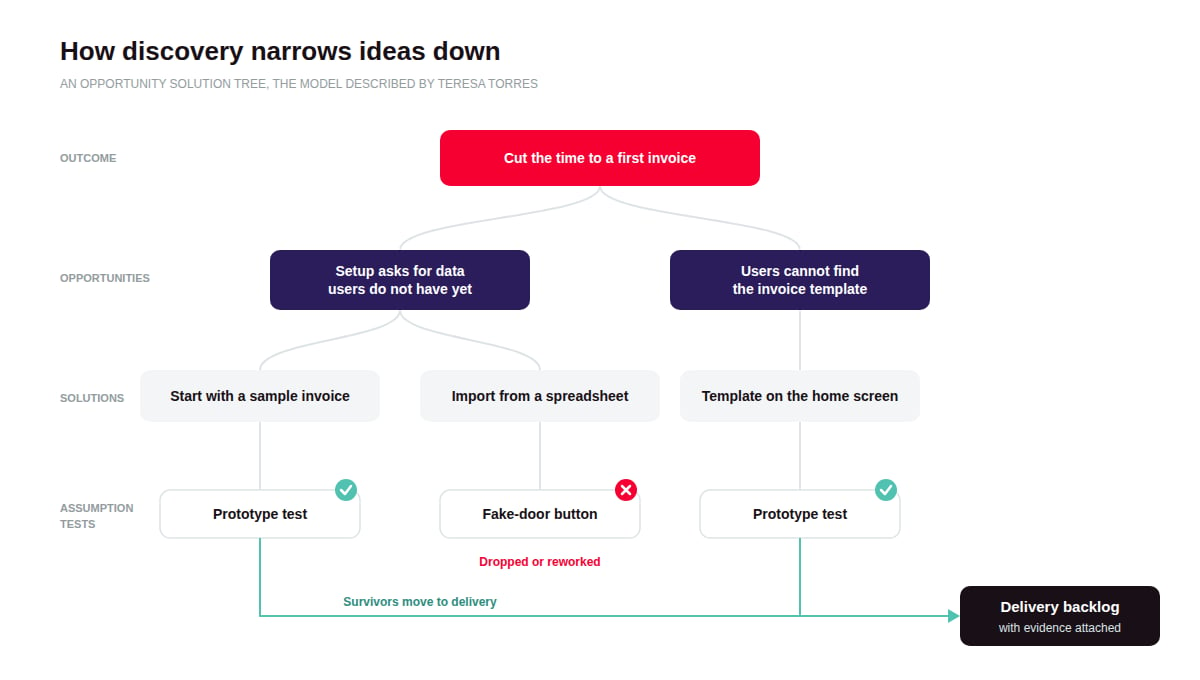
Start from an outcome. A discovery effort begins with a measurable goal, such as raising activation or cutting the time to a first invoice. A feature request is a possible answer, so it enters later.
Map the opportunity space. Interviews and product data surface unmet needs and pain points. Torres's opportunity solution tree arranges them under the outcome, with candidate solutions and assumption tests branching beneath.
Name the riskiest assumptions. Each candidate solution rests on assumptions about the four risks. The team ranks them by how much damage a wrong guess would cause against how little evidence exists.
Test cheaply. Clickable prototypes check usability in days. Fake-door tests, a button for a feature that does not exist yet, measure demand before anyone builds it.
Decide and hand off. Each test ends with a decision to proceed with the idea or change it. Ideas that survive move into the delivery backlog with their evidence attached.
What Tools Do Teams Use for Product Discovery?
Discovery tooling splits by stage, from capturing what users say in interviews to collecting their feedback once the product is live.
Which Tools Store Interview Findings?
Dovetail and Great Question are research platforms. Dovetail centers on tagging and analyzing interview transcripts, while Great Question adds participant recruitment and scheduling.
How Do Teams Test Prototypes With Users?
Maze and Lyssna run unmoderated tests on prototypes, including Figma files. Participants complete tasks on their own time, and the tools report where they succeeded or got stuck.
What Do Teams Use to Collect Ongoing Product Feedback?
Productboard and Canny gather feature requests and feedback from existing users and link them to roadmap items, which keeps discovery connected to what customers ask for after launch.
What Are the Key Characteristics of Product Discovery?
Cross-functional ownership. Cagan assigns value and viability risk to the product manager, usability to the designer and feasibility to the lead engineer. Discovery run by one role alone misses the risks the others own.
Evidence over certainty. Discovery reduces risk without removing it. A passed test means the idea has earned the next, more expensive test.
A fixed end or a fixed rhythm. Project discovery has an end date; continuous discovery has a weekly cadence. Discovery with neither tends to drift into research for its own sake.
Discarded ideas by design. A process that approves every idea is not testing anything. Prototypes that get thrown away are part of the expected output.
What Are the Benefits of Product Discovery?
Less rework. Usability problems found in a prototype never reach the backlog as bug fixes, and value problems never reach it as features to remove.
Estimates with fewer unknowns. Feasibility questions answered during discovery leave less to find mid-sprint, so delivery estimates hold up better.
Shorter roadmap debates. Test results give stakeholders the same facts to argue over, which moves prioritization away from whoever argues loudest.
Sharper MVP scope. Discovery shows which parts of an idea carry the value, so the first release can ship those and defer the rest.
What Are the Challenges of Product Discovery?
It delays the first line of code. Stakeholders who measure progress by shipped features see weeks with nothing to demo. Short, visible test cycles help, but they need a product lead willing to defend time spent producing evidence instead of features.
Users are hard to reach. Weekly interviews need a steady recruitment pipeline. In B2B and healthtech, where users are busy specialists, building that pipeline can take as much effort as the research, and paid panels add cost.
Small samples mislead. Five interviews can expose a usability problem but cannot size a market. Adding quantitative validation closes that gap, at the price of more time before a decision.
Evidence can be overruled. When the decision is already made, discovery turns into a ritual that confirms it. Preventing that means someone with authority agrees in advance that a failed test can stop an idea, which costs them some control over the roadmap.
What Is the Difference Between Product Discovery and Product Delivery?
Product discovery decides what is worth building, while product delivery builds it and ships it. Most teams run both at once, with discovery working one or more steps ahead.
Aspect | Product Discovery | Product Delivery |
Central question | Is this worth building at all? | How do we build and ship it well? |
Main output | Ideas validated or rejected, with evidence | Working software in production |
Typical artifacts | Interview notes and prototype test results | Production code and release notes |
Measure of progress | Assumptions tested and risk reduced | Features shipped at the agreed quality |
Cost of changing course | Low, because only sketches and prototypes change | Higher, because code and users already depend on the work |
Who takes part | A small cross-functional group | The full delivery team |
FAQ about Product discovery
Need expert help with Product Discovery?
Monterail builds custom software solutions that leverage the latest technologies. Let's discuss how we can help with your project.
GET IN TOUCHGET IN TOUCH