The New Default. Your hub for building smart, fast, and sustainable AI software
User Research
User research is the practice of studying the people who use, or might use, a product, to understand what they are trying to get done and how they behave while doing it.
What Is User Research?
User research exists to replace a team's assumptions about its customers with evidence, before those assumptions get built into the product. Every product decision rests on a belief about users. Research is how a team finds out which of those beliefs are wrong while changing course is still cheap.
It covers any systematic way of learning from users directly: interviews, usability tests, field observation, surveys, diary studies, and analysis of product usage data.
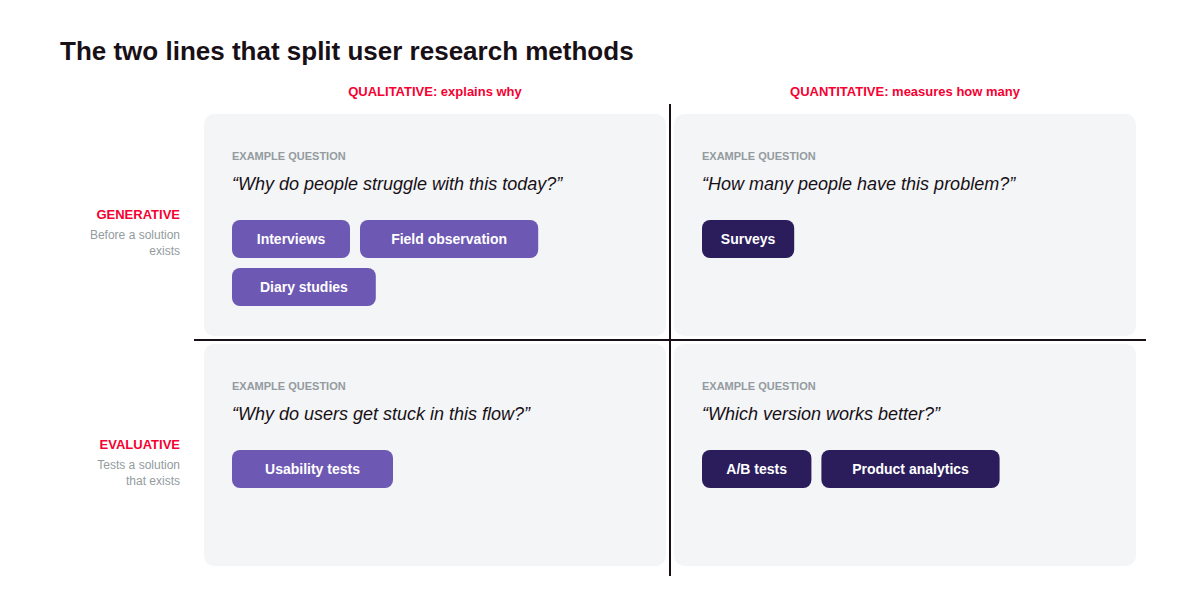
Methods split along two lines. Qualitative research explains why people behave as they do, while quantitative research measures how many of them do it. Generative research explores problems before a solution exists, while evaluative research tests a solution that does.
Many teams use "user research" and "UX research" interchangeably. Where a distinction is drawn, user research is the broader term, because its findings also feed product strategy and positioning, not only interface design.
Why Does User Research Matter?
User research matters because the people building a product are the people least able to see it the way a new user does.
Teams are not their users. Builders know the product too well to see it fresh. The steps they find obvious are often the ones new users miss, and internal review rarely surfaces that gap.
It reaches users the team never hears from. Support tickets and sales calls over-represent the most vocal customers. Research can deliberately recruit the quiet majority, including users who churned without ever complaining.
It gives the team a shared picture of the user. Personas and journey maps built from research replace a dozen private mental models with one the whole team can check decisions against.
How Does User Research Work?
User research works as a loop: define what the team needs to learn, pick a method that can answer it, gather evidence from the right participants, then turn findings into decisions.
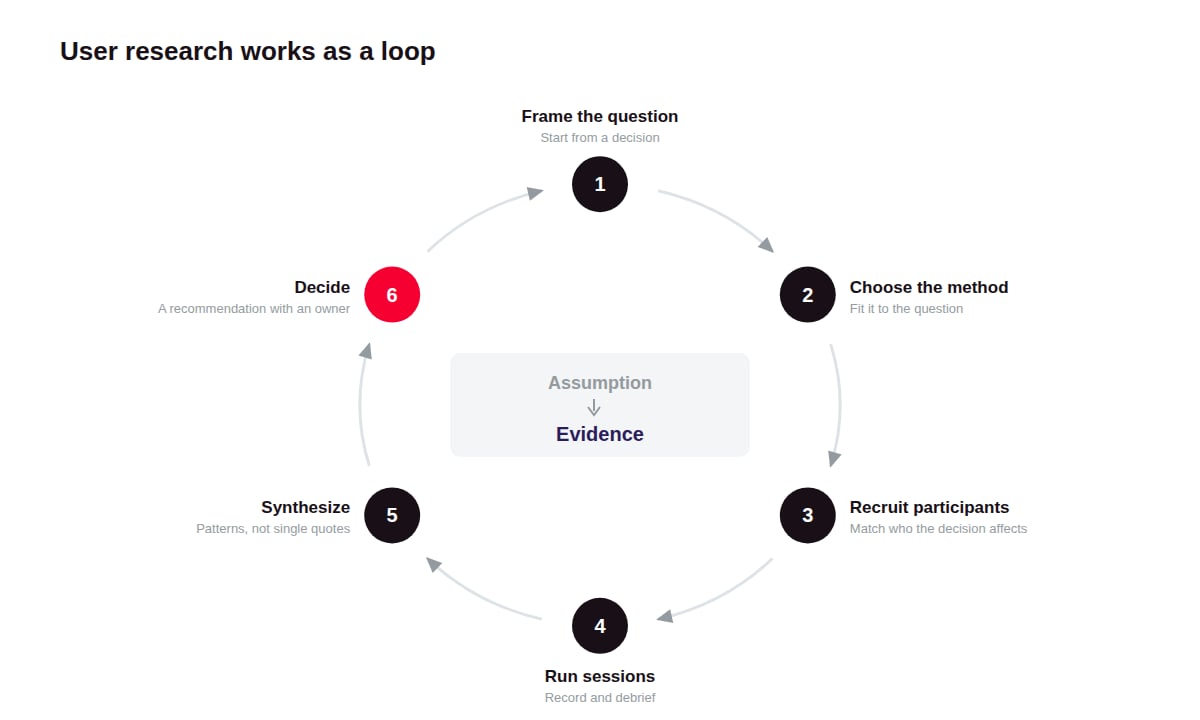
Frame the research question. Start from a decision the team has to make, such as whether to build a feature or how to package a pricing tier. "What do users think?" is too vague to study. "Why do trial users stop before connecting their first data source?" is a research question.
Choose the method. Open "why" questions call for interviews or field studies. Questions about whether people can complete a task call for usability testing. Questions about how many users do something call for surveys or product analytics, and questions about which of two versions performs better call for A/B tests.
Recruit the right participants. Participants must match the people the decision affects. Five enthusiastic power users will not explain why new users churn.
Run sessions and capture evidence. Record sessions with consent, with notes taken against the research question. A short debrief after each session catches observations before they blur together.
Synthesize into findings. Cluster observations into patterns, usually with affinity mapping, and separate what several participants did from what one participant said. A finding is a pattern backed by evidence, not a single memorable quote.
Turn findings into decisions. Each finding should end in a recommendation with an owner. Research that ends as a slide deck nobody acts on has cost the full price and delivered none of the value.
What Tools Do Teams Use for User Research?
Most teams separate the tools that bring participants in from the tools that capture and store what they learn.
Where Do Teams Find Research Participants?
User Interviews and Respondent recruit participants from large panels, including hard-to-find B2B professionals, and handle scheduling and incentive payments. For existing customers, many teams recruit directly through their own product with in-app prompts.
Which Tools Run Research Sessions and Tests?
Maze, Lyssna, and UserTesting support unmoderated tests, such as prototype tests, where participants complete tasks on their own and the tool records what they do. Moderated interviews usually run on video tools such as Zoom or Google Meet.
Where Do Teams Store and Analyze Findings?
Dovetail and Condens are research repositories that transcribe and tag session recordings, so anyone on the team can search past findings before commissioning new research.
What Are the Key Characteristics of User Research?
User research is defined by direct contact with the people a product serves, and by methods chosen to fit the question instead of habit.
Evidence from the source. Opinions from sales or support teams are useful inputs, but they are secondhand. User research goes to the people who use, or might use, the product.
Behavior over stated preference. Researchers weigh what people do more heavily than what they say they would do, because predictions about future behavior are unreliable. "Would you pay for this?" is a weak question; watching whether people try to pay is a strong one.
Neutral facilitation. Researchers ask open, non-leading questions ("walk me through the last time you did this") instead of "would you use a feature that…?", because leading questions produce agreement, not information.
Traceable findings. Every finding links back to the recordings or data behind it, so anyone who doubts a conclusion can check the evidence.
Continuous, not one-off. Mature teams run small studies every sprint or two instead of one large study per year, so research keeps pace with product decisions.
Ethical by design. Participants give informed consent, and recordings are handled as personal data under rules such as GDPR.
What Are the Benefits of User Research?
The main benefit of user research is that product decisions rest on observed behavior instead of internal opinion, which changes both what gets built and in what order.
Cheaper course corrections. A concept test with a handful of target users costs days. Finding the same problem after launch costs a release cycle and the users who left in the meantime.
Roadmaps built on evidence. Features get ranked by observed user need instead of by the loudest request, which makes feature prioritization easier to defend.
Products people can use without help. Usability testing before release finds the steps where users get stuck, which lowers support load and onboarding friction.
Faster answers over time. A searchable repository of past findings answers many new questions without a new study.
Sharper positioning. Research into how customers describe their problem gives marketing and sales the words customers use themselves.
What Are the Challenges of User Research?
The hardest part of user research is keeping it close enough to delivery that findings change decisions, without slowing the team down.
Recruiting is slow and expensive. Niche B2B roles, such as hospital IT managers, can take weeks to find and expect high incentives. Panels speed this up, but panel participants skew toward people who join studies often, which can bias results.
Research competes with delivery for time. Skipping a study saves a week now. Lightweight methods, such as five-user tests and short unmoderated studies, cut the cost, but they answer narrower questions than a full study.
Findings get ignored. Research that contradicts a roadmap already promised to leadership is easy to dismiss. Inviting stakeholders to observe sessions makes findings harder to ignore, but it costs their time and needs a facilitator who can keep observers from steering participants.
Small samples invite skepticism. Qualitative studies with a handful of participants are valid for finding problems, not for measuring how common they are. Pairing them with quantitative data answers the skeptics, at the cost of a second study.
Synthetic users are a tempting shortcut. Language models can simulate interview answers quickly, but they reproduce plausible averages instead of the surprises that live participants bring. Using them to draft early hypotheses is reasonable; using them in place of participants removes the point of the exercise.
What Is the Difference Between User Research and Market Research?
User research studies how people use and experience a product, while market research studies the size and buying behavior of a market.
User research | Market research | |
Main question | What do users need, and how do they use the product? | Who will buy, and at what price? |
Unit of study | People who use, or might use, the product | Market segments and buyers |
Typical methods | Interviews, usability tests, field studies, surveys, product analytics | Surveys, focus groups, competitor analysis, market sizing |
Main consumers of findings | Product and design teams, plus marketing for positioning | Marketing and leadership teams |
When it happens | Throughout development, including after launch | Mostly before entering a market or launching a product |
FAQ about User Research
Need expert help with User Research?
Monterail builds custom software solutions that leverage the latest technologies. Let's discuss how we can help with your project.
GET IN TOUCHGET IN TOUCH