The New Default. Your hub for building smart, fast, and sustainable AI software
Product Strategy Consulting
Hiring experienced product people to set a product's direction before the team commits budget to building it.
What Is Product Strategy Consulting?
Product strategy consulting is outside expert help in deciding where a digital product should go and why. It settles which users the product serves and which problem it solves for them. It also sets how the product makes money and which bets come first. The result is one evidence-backed direction for roadmap and design decisions.
Monterail has delivered 900+ projects since 2010 and runs product strategy work through product discovery engagements of 2–6 weeks that end in a prioritized roadmap.
What Does Product Strategy Consulting Include?
A product strategy engagement covers the decisions about direction and the evidence behind them, and hands execution over to design and development.
What it includes
Stakeholder workshops that align leadership on goals and success metrics
Hypothesis mapping that turns business and operational knowledge into testable product assumptions
User research through interviews and behavioral data analysis
Competitive benchmarking
A technical feasibility assessment of the options on the table
Prototypes that test the riskiest assumptions before budget goes into the build
A prioritized product roadmap with recommended next steps
What it doesn't include
Brand identity work, which runs as a separate branding engagement
Go-to-market execution, such as campaigns and sales enablement
Design and development of the product itself, which follow as their own phases
Ongoing product management after handover
When Does Product Strategy Consulting Fit?
Product strategy consulting fits at a decision point, when the direction is still open and getting it wrong would be expensive.
It fits when
A new product idea is waiting for budget approval, and the business case rests on assumptions nobody has tested
An existing product has stalled, and the leadership team disagrees about what comes next
A founder from outside software needs years of operational knowledge turned into a product specification
A major rebuild or pivot is planned, and the next version needs a clear purpose before scoping starts
It doesn't fit when
The direction is set and validated, and the open question is one feature. Usability testing or a focused discovery sprint answers that faster.
The product needs strategy owned week to week for years, which is the job of a full-time head of product.
The need is market sizing across a whole industry, so a market research firm with panel access is the better choice.
Scope is fixed and the goal is a working product in weeks. MVP development gets there directly.
What Are the Benefits of Product Strategy Consulting?
The main benefit is that budget goes to the product bets with evidence behind them, before the expensive part of the work begins.
One agreed direction. Workshops bring competing views into one room and end with a decision, so design and development stop absorbing unresolved disagreements.
Assumptions get tested while they are cheap. A hypothesis disproved in a prototype costs days. The same hypothesis disproved after launch costs a release cycle.
An outside view of the business model. Consultants who have shaped other products ask the questions an internal team has stopped asking.
More accurate estimates. A scoped, prioritized roadmap gives the build team something concrete to estimate, instead of a list of wishes.
Less rework in delivery. When the specification comes from tested hypotheses, fewer features get built twice.
How Does a Product Strategy Consulting Engagement Work?
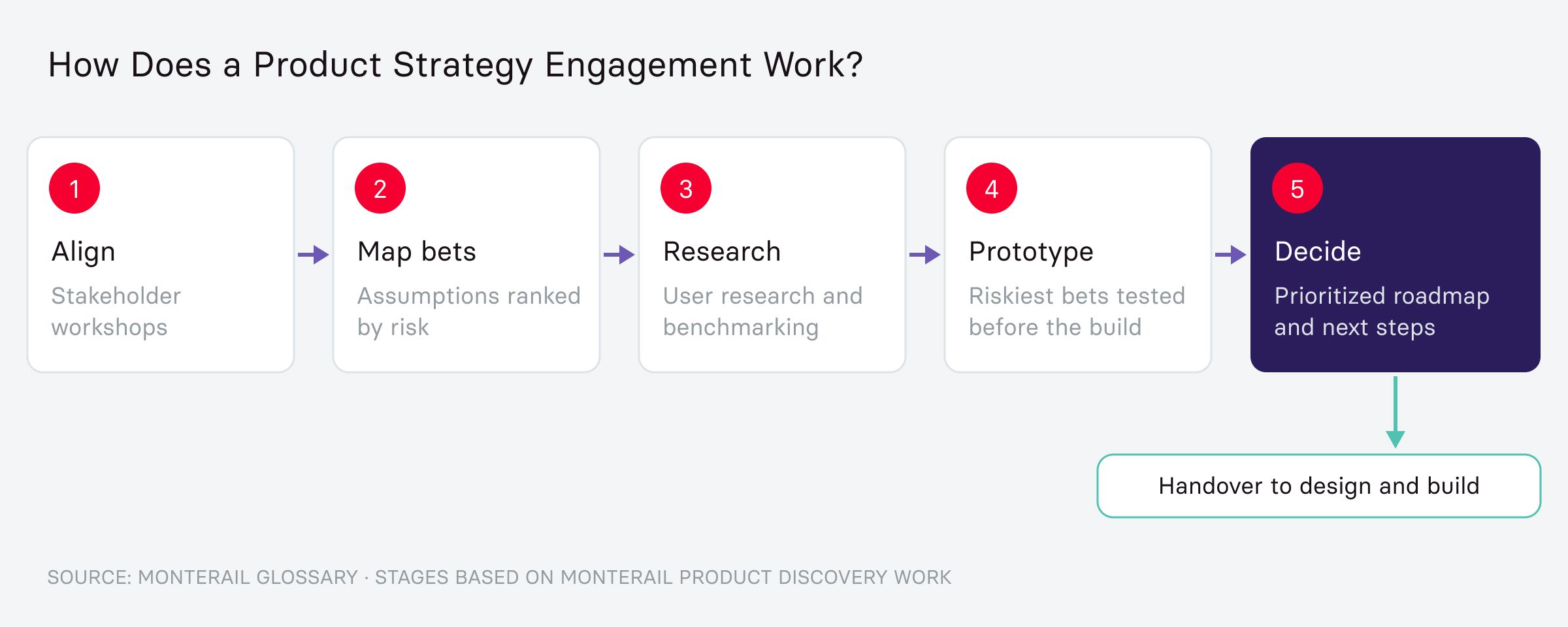
A product strategy engagement moves from alignment to a prioritized roadmap in five stages.
Align stakeholders. A workshop, usually one to three days, brings decision-makers and domain experts together to agree on goals and the metrics that will define success.
Map the bets. The team turns business knowledge into explicit hypotheses about users and revenue, then ranks them by risk. The riskiest hypotheses get tested first.
Research and benchmark. User interviews and competitive benchmarking check the hypotheses against evidence. A technical feasibility assessment confirms which options can be built within the budget.
Prototype the riskiest bets. Hypotheses that research alone can't settle become prototype features that users or stakeholders can react to. Prototypes also validate the commercial logic before any production code exists.
Decide and sequence. The engagement ends with a product roadmap ordered by value and risk, plus a short strategy summary that design and development can start from.
Should You Hire a Product Strategy Consultant or an In-House Head of Product?
Hire a consultant for a defined decision point, and hire an in-house head of product when the strategy needs an owner every week.
Factor | Product strategy consultant | In-house head of product |
Time to start | Weeks, once the engagement is scoped | As long as the hiring process takes |
Cost structure | Paid per engagement, for a defined scope | Ongoing salary and benefits |
Perspective | Brings patterns from other products and industries | Builds deep knowledge of one product over time |
Continuity | Ends with a roadmap handover | Owns the strategy and adapts it continuously |
Link to delivery | Hands over to whoever builds, in-house or external | Directs the team that builds |
Best fit | A new product or a pivot | A product whose strategy changes week to week |
Challenges to plan for: A strategy set with outside help only holds if someone inside owns it after handover, so budget time for a product owner to carry the roadmap or it goes stale within a few release cycles. Workshops also need senior stakeholders in the room, and their calendars are often the slowest part of the schedule.
How Does Monterail Approach Product Strategy Consulting?
Monterail starts strategy work with hypotheses and tests them early in prototypes, and its work for a UK construction-finance founder shows how fast that can move.
The founder, launching a first custom software product, wanted an AI cost-intelligence platform for large construction enterprises. Monterail ran hypothesis-first workshops that turned decades of operational knowledge into a product specification, with each hypothesis becoming a prototype feature. They had an interactive prototype ready two weeks after kick-off. The MVP followed in three months within a 500-hour budget, needed no rework, and passed its first pilot review at CFO and board level. When a prospective client’s financial data proved incomplete, the team paused the AI rollout rather than risk misleading outputs.
Amelia Christie, Director of Christie Constructive Limited, says:
I was impressed with the speed at which Monterail was able to grasp a complex and niche industry and translate that into a clear and practical system structure.
When Should You Bring In a Product Strategy Partner?
A partner helps when the people closest to the product are too invested in one answer to test it neutrally. It also helps when nobody in-house has run discovery and strategy work before. If you need designers inside your team once the direction is set, staff augmentation adds them.
Monterail runs product strategy consulting through its product discovery engagements, from the first workshop to a roadmap the build team can use. Talk to our team about the product decision in front of you.
FAQ About Product Strategy Consulting
Need expert help with Product Strategy Consulting?
Monterail builds custom software solutions that leverage the latest technologies. Let's discuss how we can help with your project.
EXPLORE PRODUCT DESIGN SERVICESEXPLORE PRODUCT DESIGN SERVICES