The New Default. Your hub for building smart, fast, and sustainable AI software
Product Validation Services
Evidence-gathering work that shows whether users want a product before a team spends its budget building it.
What Are Product Validation Services?
Product validation services test whether a product idea solves a real problem and whether people will use it or pay for it. The testing happens before full development or before a major new feature. It combines user interviews and prototype tests with demand and feasibility checks. The result is an evidence-based decision on whether to build.
Monterail has delivered 900+ projects since 2010, including Joii's period-tracking scanner, a prototype that reached 99% accuracy and became the basis of an app with UK Class I Medical Device certification.
What Do Product Validation Services Include?
Product validation covers the research and tests that turn assumptions about a product into evidence, up to a recommendation on what to build.
What it includes
Assumption mapping: listing what must hold for the product to succeed and ranking the riskiest assumptions
Interviews with target users about the problem and how they handle it today
Competitive analysis of the alternatives users already have
Clickable or functional prototypes, tested with target users
Demand tests, such as a landing page with a sign-up form
A technical feasibility assessment of integrations and constraints
AI-assisted analysis of research findings and user sessions
A findings report with a recommendation and a prioritized roadmap
What it doesn't include
Building the production version or the MVP, which is a separate engagement
Paid advertising budgets for demand tests
Product analytics after launch, which measure product-market fit
Regulatory classification or certification for health and other regulated products, which the product owner pursues with the relevant authorities
When Do Product Validation Services Fit?
Product validation fits when building the wrong thing would cost more than a few weeks of research and testing.
It fits when
You have a new product idea and need evidence before committing a development budget
Leadership needs a roadmap it can commit to, backed by user research
The core technology is unproven, and a prototype has to show it can work
An existing product has data and feedback, and you need to decide which opportunity to pursue next
It doesn't fit when
The product is live with clear usage data. Iterating on analytics gives faster answers there.
Regulation or a client contract already fixes the requirements, so the question is how to build, which is a design and engineering task.
The smallest working product costs about as much as a test. In that case, an MVP answers the question directly.
You can't reach your target users yet. Recruiting a research panel comes first.
What Are the Benefits of Product Validation Services?
The main benefit is that the riskiest assumptions get tested while changing course is still cheap.
Budget goes to proven ideas. Development starts on features that users have already responded to.
Risks surface early. Interviews and feasibility checks expose blind spots before any production code exists.
Stakeholders align on evidence. A research-backed roadmap is easier for decision-makers to commit to.
Investors see proof. A tested prototype shows more than a pitch deck about whether users want the product.
Faster learning cycles. AI-assisted research tools can cut synthesis from weeks to days.
How Do Product Validation Services Work?
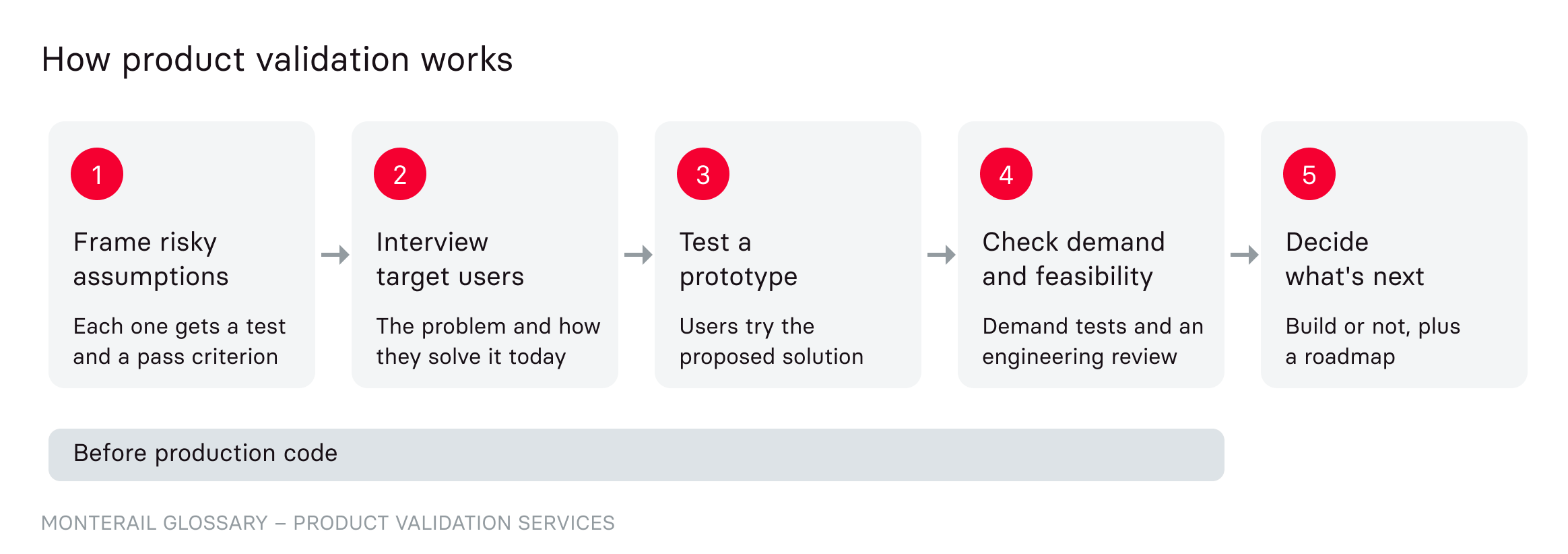
Product validation runs in five steps, from naming the riskiest assumptions to deciding what happens next.
Frame the riskiest assumptions. The team lists what must hold for the product to work, covering both user demand and the technology. Each assumption gets a test and a success criterion before research starts.
Interview target users. Researchers talk to people who have the problem to learn how they handle it today and what they would change. The interviews also refine who the product is for.
Test a prototype with users. A clickable or functional prototype puts the proposed solution in users' hands. Their behavior shows whether the concept is usable and wanted.
Run demand and feasibility checks. Demand tests measure interest outside the interview room. In parallel, engineers assess the integrations and technical constraints the product depends on.
Decide what to do next. Compare findings with the success criteria. The outcome is a recommendation on whether to build, plus a prioritized roadmap if the idea holds.
Should You Validate a Product Idea or Build an MVP First?
Validate first when the main risk is whether users want the product. Build an MVP first when only people using working software can answer the question. The prototyping entry covers how a prototype differs from an MVP.
Factor | Product validation | Building an MVP first |
What you test | Demand and concept, through research and prototypes | Everyday use of a working product |
Time to first evidence | Shorter: interviews and prototype tests come before code | Longer: the product has to be built and launched first |
Cost of a wrong idea | Research and prototyping time | The full MVP build |
What you have at the end | A recommendation backed by evidence, and a roadmap | A working product and live usage data |
Best for | New ideas and unproven technology | Ideas where only everyday use gives a reliable answer |
Challenges to plan for: Validation measures what users say and do in tests, which can differ from what they do once a product is live. Validated ideas still need an MVP, and its usage data can overturn a finding from the research.
How Does Monterail Approach Product Validation?
Monterail tests the riskiest assumption first, whether that is user demand or the technology itself.
Lyv wanted an app for women with endometriosis, a group with little research behind their needs. Monterail ran user research for this previously unanalyzed group and validated the core concept through a working prototype. Lyv received a defined app scope and a ready-to-use development roadmap.
Joii came to Monterail at the "no one has done it before" stage, with the idea of measuring menstrual flow from photos. Monterail built a functional prototype with an integrated scanner that reached 99% accuracy in image processing. The app launched in 2025 and holds Class I Medical Device certification in the UK.
When Should You Bring In a Product Validation Partner?
A partner helps when your team is too close to the idea to test it neutrally. It also helps when the idea depends on technology that has to be proven before anyone commits a budget. After validation, MVP development turns the validated concept into a working product.
Monterail's product discovery services turn an unvalidated idea into a buildable plan, and rapid prototyping puts the concept in front of target users. Talk to our team about the idea you want to test.
FAQ About Product Validation Services
Need expert help with Product Validation Services?
Monterail builds custom software solutions that leverage the latest technologies. Let's discuss how we can help with your project.
EXPLORE PRODUCT DESIGN SERVICESEXPLORE PRODUCT DESIGN SERVICES