The New Default. Your hub for building smart, fast, and sustainable AI software
QA and Software Testing Services
Specialists who plan, run and automate the checks that keep defects out of each software release.
What Are QA and Software Testing Services?
QA and software testing services check that software works as intended before each release. Testing finds defects in the product itself. Quality assurance (QA) improves the process, so defects get caught earlier through test strategy and automation built into delivery. A provider supplies QA engineers who plan and run the tests, then automate the repeatable ones.
Monterail has delivered 900+ projects since 2010, including Elvie's breast pump apps, where an automated hardware-in-the-loop test rig runs full end-to-end tests on every build.
What Do QA and Software Testing Services Include?
A QA engagement covers how quality is planned and checked, from the first acceptance criteria to release-day smoke tests.
What it includes
A QA audit of current test coverage and tools
A test strategy covering unit, integration, end-to-end and performance testing
Test plans and acceptance criteria for each feature
Manual and exploratory testing on devices and browsers
Automated regression suites that run in the CI pipeline, as described in test automation
Performance and load testing
Smoke tests before and after each deployment
Bug reports and regular quality reports
What it doesn't include
Security assessments, which specialist penetration testing covers
Regulatory sign-off or product certification, which the product owner pursues with the relevant authorities
Fixing the defects QA finds, which is development work
Test device hardware and third-party testing tool licenses
When Do QA and Software Testing Services Fit?
QA and testing services fit when a defect reaching users costs more than the testing that would have caught it.
It fits when
Your product has paying users, and a broken release costs revenue or trust
The software controls hardware or handles health or financial data
You release often and need regression coverage that keeps up
A legacy app is being refactored or migrated while users keep using it
It doesn't fit when
The code is a throwaway proof of concept. A short manual check covers it.
A small internal tool has a handful of users, and the developers' own tests are enough.
What you need is a security assessment. Penetration testers handle that.
The goal is regulatory approval. Testing produces evidence for it, but sign-off involves regulatory specialists.
What Are the Benefits of QA and Software Testing Services?
The main benefit is fewer defects reaching users, with the cost of finding them moved earlier in development.
Safer releases. Regression and smoke tests catch breakages before customers do.
Faster delivery over time. Automated suites let developers change code with less fear of side effects.
Earlier defect detection. QA reviews acceptance criteria before code exists, when a fix costs least.
Coverage that scales. Automation runs the same checks on every build, across devices and browsers.
Evidence for audits. Test plans and reports document what was checked, which regulated products need.
How Do QA and Software Testing Services Work?
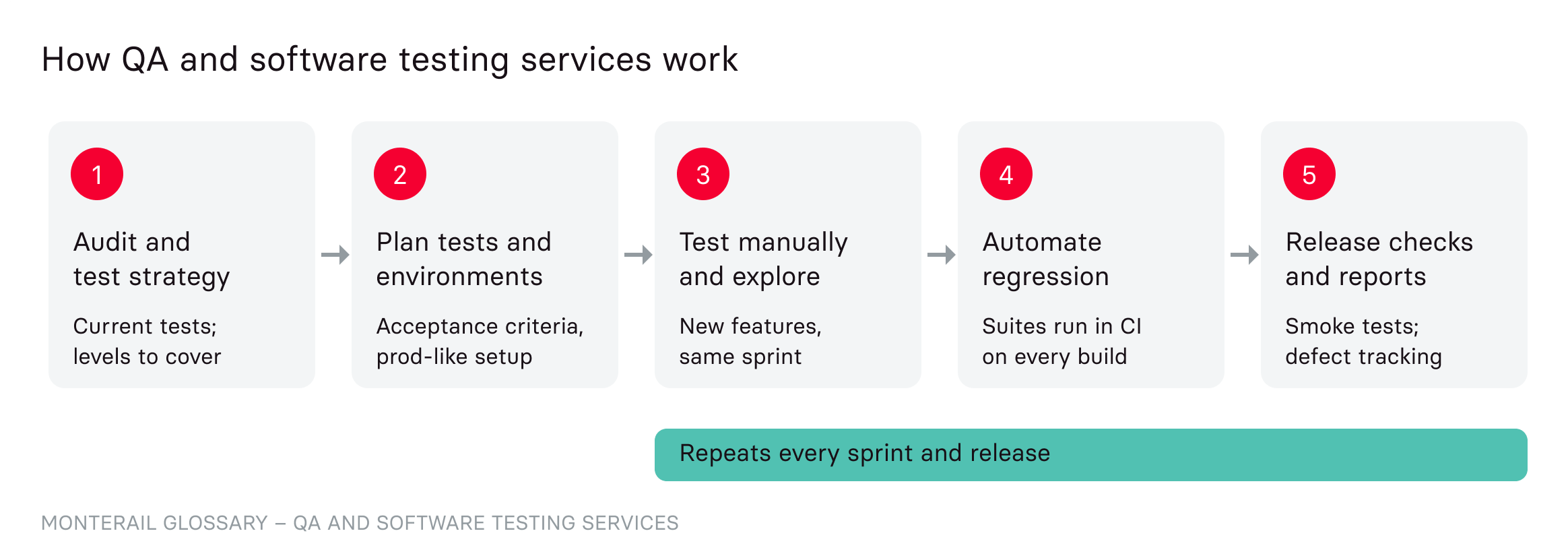
A QA engagement runs in five steps, from auditing the current state to reporting on every release.
Audit and set the test strategy. QA engineers review existing tests and the release process. They decide which levels of testing the product needs and where automation pays off.
Plan tests and environments. Each feature gets acceptance criteria and test cases. Test environments and devices are set up to mirror production.
Test manually and explore. New features get manual and exploratory testing as they are built, so defects reach developers within the same sprint.
Automate regression in CI. Repeatable checks become automated suites that run on every build. Manual effort shifts to new features and edge cases.
Run release checks and report. Smoke tests run before and after each deployment. Regular reports track defects found and those that escaped to users.
Should QA Be Part of the Development Team or an Independent Vendor?
Embed QA in the delivery team when you need fast feedback on every feature, and use an independent QA vendor when you need an outside check on software another team built. For the difference between QA and testing as concepts, see software testing.
Factor | QA embedded in the delivery team | Independent QA vendor |
Feedback speed | Within the sprint, as features are built | After handover of a build or release |
Product knowledge | Deep: QA joins planning and reviews | Built up per engagement |
Objectivity | Shares the team's assumptions | An outside view of the product |
Automation | Grows with the codebase in the same pipeline | Often a separate suite to maintain |
Best for | Ongoing product development | Audits and acceptance testing |
Challenges to plan for: Embedded QA can drift toward the team's blind spots, so periodic outside audits still help. An independent vendor sees problems later, when fixing them costs more.
How Does Monterail Approach QA and Software Testing?
Monterail builds QA into its delivery teams and automates the checks that would otherwise slow every release.
Elvie's apps control physical breast pumps over Bluetooth, and manual testing across iOS and Android for each new pump generation wasn't sustainable. Monterail built an automated test rig with physical devices controlled by an Arduino. On every build, the QA team runs full end-to-end tests covering BLE connectivity, session recording, data sync and UI flows.
When Monterail took over Admyt's parking app, 30,000 users were relying on it almost every day. The team wrote 2,000 unit tests and automated testing with Cypress, so it could refactor legacy code while the app stayed live.
For Flink, Monterail's QA engineers worked on both backend and frontend, from ad hoc regression to smoke testing, through a data migration between commerce platforms.
When Should You Bring In a QA Partner?
A partner helps when releases keep breaking things users notice and your team has no dedicated QA. It also helps when a product needs specialized testing, such as hardware-in-the-loop rigs or regulated documentation.
Monterail places QA engineers inside client teams through IT staff augmentation services, and its software development services include QA in every delivery team.
For a step-by-step view of the process, see the quality assurance process for digital products. For regulated products, see why testing health apps matters.
Talk to our team about your release quality.
FAQ About QA and Software Testing Services
Need expert help with QA and Software Testing Services?
Monterail builds custom software solutions that leverage the latest technologies. Let's discuss how we can help with your project.
EXPLORE WEB DEVELOPMENT SERVICESEXPLORE WEB DEVELOPMENT SERVICES