The New Default. Your hub for building smart, fast, and sustainable AI software
Software Architecture
Software architecture is the high-level structure of a software system: the major components it is divided into and the rules for how those components interact and change over time.
What Is Software Architecture?
Every system has a shape whether anyone chose it or not, and architecture is the work of choosing that shape on purpose. It decides, before the first feature ships, which parts of a product will be cheap to change later and which will cost a migration.
The international standard for architecture description, ISO/IEC/IEEE 42010, describes architecture, in paraphrase, as the fundamental concepts or properties of a system in its environment and the principles that govern how it is built and how it evolves. In practice, that means the decisions a team would struggle to undo, such as how the system is split into parts and which of those parts are allowed to share data.
Architecture is also where business constraints turn into technical ones. A requirement like "the platform must stay available during a regional cloud outage" or "patient data must never leave the EU" cannot be met by clever code in one module. It has to be designed into the structure of the whole system.
Why Does Software Architecture Matter?
Software architecture matters because its decisions reach well past the code, shaping how teams coordinate and what the product can promise its users.
It is where vendor dependence gets decided. Building core workflows on one cloud provider's proprietary queue or database ties the system to that provider's pricing and roadmap. The decision often looks like a small convenience when it is made, and the cost only shows up when the team wants to move.
Structure shapes how teams can work. Conway's Law, stated by Melvin Conway in 1968, observes that systems tend to mirror the communication structure of the organizations that build them. A system with tangled dependencies forces teams into constant coordination, however the org chart is drawn.
Quality attributes cannot be bolted on. Availability and response time under load depend on how components are arranged and connected. Retrofitting them into a system not built for them usually means restructuring it.
How Is Software Architecture Built?
Software architecture is built by translating business and quality requirements into a small set of structural decisions, then recording and enforcing those decisions as the system grows.
Start from quality attributes. Before picking technologies, the team agrees which qualities matter most for this product, such as scalability or regulatory compliance. These priorities decide every trade-off that follows.
Choose an architectural style. Common styles include the layered monolith, the modular monolith, microservices, serverless, and event-driven architecture. Each style makes some changes cheap and others expensive, so the choice follows from the quality attributes, not from what is fashionable.
Define boundaries and interfaces. The team decides how the system is divided, often along business domains such as billing or scheduling, and how those parts communicate. Clear interfaces let one part change without breaking the others.
Record decisions. Architecture Decision Records (ADRs), a format popularized by Michael Nygard in 2011, capture each structural decision with its context and consequences. They explain to future engineers why the system looks the way it does.
Describe the system in views. The C4 model, created by Simon Brown, describes a system at four zoom levels: context, containers, components, and code. Different audiences read different levels, so a product manager and a backend engineer can both use the same model.
Enforce and evolve. Automated checks, sometimes called architectural fitness functions, verify that the code still follows the agreed structure, for example that the UI layer never calls the database directly. When requirements change, the team updates the decisions deliberately and records why.
What Tools Do Teams Use for Software Architecture?
Teams split architecture tooling by job: some tools describe the structure and record the reasoning behind it, while others check that the code still matches it.
Which Tools Diagram and Model Software Architecture?
Structurizr, IcePanel, and draw.io (diagrams.net) are widely used for architecture diagrams. Structurizr and IcePanel are built around the C4 model, and Structurizr lets teams define diagrams as code so they can be versioned alongside the system.
Which Tools Record Architecture Decisions?
adr-tools and Log4brains help teams create and manage ADRs as Markdown files in the code repository. Keeping decisions next to the code makes them easier to find and harder to lose.
Which Tools Check Code Against the Architecture?
ArchUnit (Java), dependency-cruiser (JavaScript and TypeScript), and NetArchTest (.NET) let teams write rules about allowed dependencies and run them as tests. A pull request that breaks a boundary fails the build instead of eroding the structure unnoticed.
What Are the Key Characteristics of Software Architecture?
Software architecture is defined less by any single technology than by a handful of recurring properties.
Decisions are expensive to reverse. A useful working test for whether a decision is architectural is how much it would cost to change. Choosing a logging library usually is not architectural; choosing between one shared database and a database per service usually is.
Every decision is a trade-off. An event-driven design decouples services at the price of harder debugging, since no single request path shows what happened. A shared database keeps queries simple at the price of tying every team to one schema. Whether a style is right depends on which of those prices the product can afford.
The code is the authoritative version. Documents and diagrams describe the intended structure. The dependencies in the running code describe the structure the team maintains, and the gap between the two is where architectural drift starts.
It evolves with the product. An architecture that fits a ten-person startup rarely fits the same product at a hundred engineers. Good architecture makes its own next change possible without a rewrite.
What Are the Benefits of Deliberate Software Architecture?
Designing architecture deliberately turns structural decisions from accidents into choices the team can explain and change on purpose.
Faster onboarding. New engineers learn the system from a small set of boundaries and recorded decisions, not from reading the whole codebase. That shortens the time before they can safely ship changes.
Contained failures. Clear boundaries limit how far a fault spreads. A slow reporting module can degrade on its own instead of taking checkout down with it.
Selective scaling. When components are separated by load profile, the team can scale the busy parts without paying to scale everything.
Auditable decisions. Recorded decisions, backed by conformance checks that prove the code still follows them, give compliance reviews under frameworks such as HIPAA or GDPR a clear trail of where sensitive data flows and why.
Honest roadmap estimates. When the structure is known, product and engineering can see which roadmap items fit the current architecture and which require structural change first.
What Are the Challenges of Deliberate Software Architecture?
The main challenge of deliberate architecture is spending the right amount of design effort at the right time, since both too much and too little are expensive.
Designing too much, too early. Building for scale a product may never reach slows an MVP down. Deferring those decisions keeps early delivery fast, but it means planning for rework once the product proves which parts need to scale.
Documentation drift. Diagrams and decision records go stale as the code moves on. Keeping them as code in the repository reduces the drift, but it only works if updating them is part of the definition of done, which takes engineering time every sprint.
Distributed complexity. Splitting a system into services allows independent deployment, but it adds network failures and data consistency problems that a single process never has. Teams that split early often pay that cost before they need the benefit.
The architect as a bottleneck. Routing every structural decision through one person keeps the system consistent but slows every team down. Delegating decisions to teams with shared guardrails speeds delivery, at the cost of some inconsistency between parts of the system.
What Is the Difference Between Software Architecture and Software Design?
Software architecture covers the structure of the whole system, while software design covers how each part inside that structure does its job.
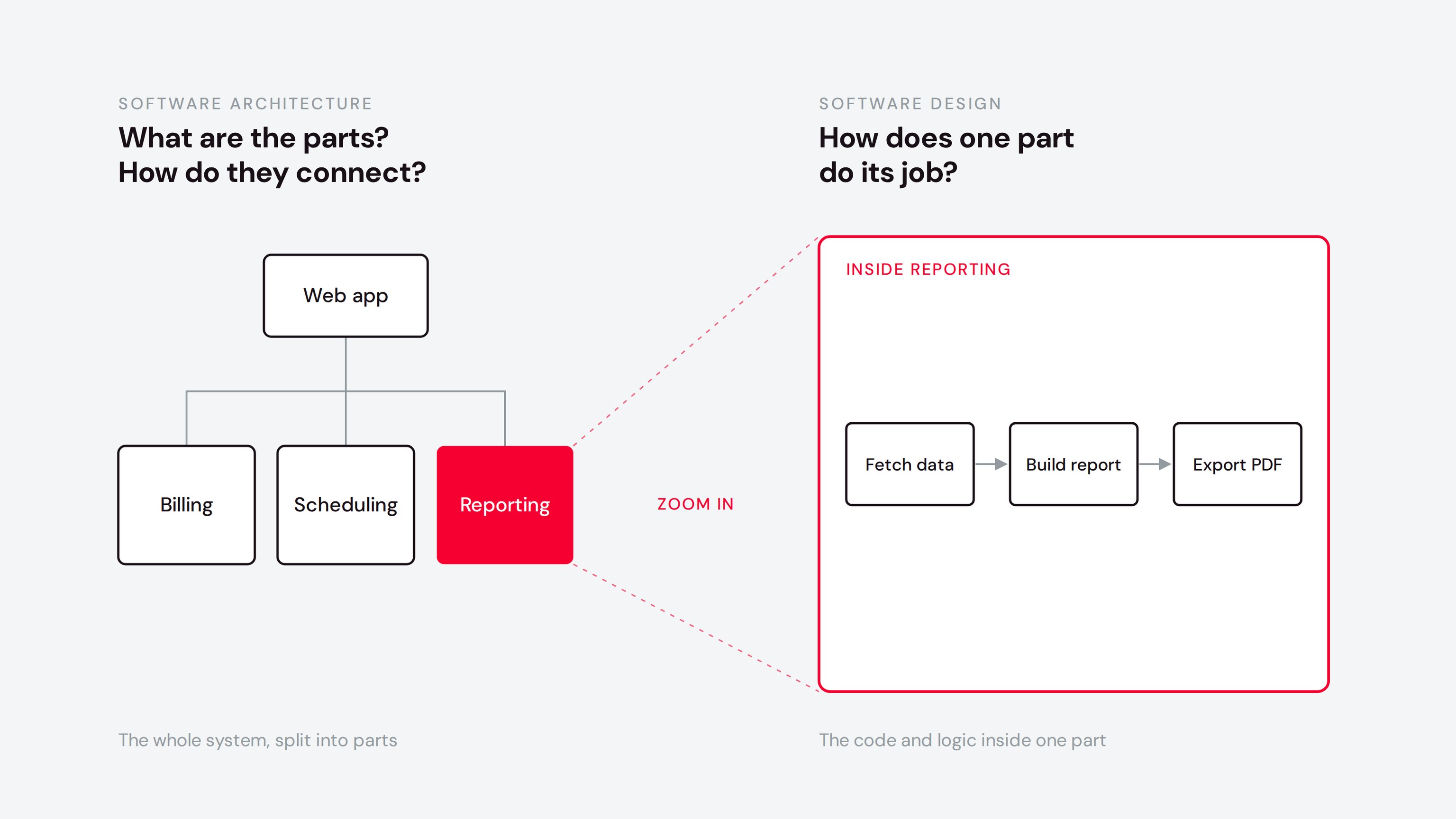
Software Architecture | Software Design | |
|---|---|---|
Scope | The whole system and its major parts | Individual modules and the code inside them |
Core question | What are the parts, and how do they connect? | How does this part do its job? |
Cost of reversing | High, often requiring a migration | Lower, usually a refactor within one codebase |
Driven by | Quality attributes and business constraints | Functional requirements of a specific component |
Typical artifacts | ADRs, context and container diagrams | Class and sequence diagrams |
Time horizon | The life of the system | The life of a feature or component |
Need expert help with Software Architecture?
Monterail builds custom software solutions that leverage the latest technologies. Let's discuss how we can help with your project.
GET IN TOUCHGET IN TOUCH